


GWM's Li Ruifeng: Only Automakers Surviving Healthily to 2025 Can Plan for 2030
GWM is facing a severe crisis in sales growth.
In 2021, GWM’s total sales reached 1.28 million units, with total revenue of RMB 136.4 billion and net profit of RMB 6.73 billion, representing a year-on-year sales increase of 15.24%. This marked the sixth consecutive year that its annual sales exceeded 1 million units.
However, the situation took a sharp turn for the worse in 2022, as GWM’s total sales dropped to 1.067 million units, a year-on-year decline of 16.64%.
This downward trend continued into 2023 and intensified.
From January to March this year, GWM’s total sales fell by 22.41% year on year. Sales across its brands, including HAVAL, WEY, and Oula, all experienced varying degrees of declines. WEY was particularly hard hit, with a year-on-year drop of 73.19%.
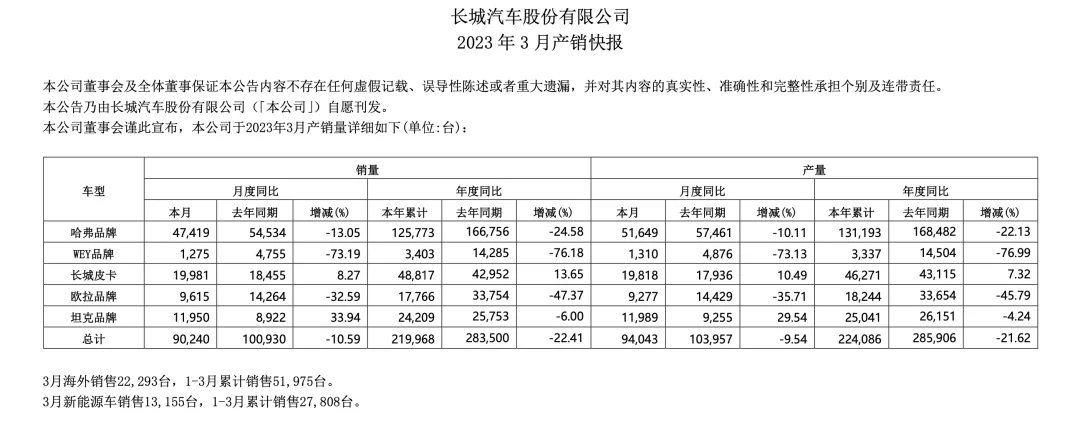
Furthermore, GWM’s performance in the new energy vehicle (NEV) sector has also been lackluster. From January to March this year, cumulative NEV sales totaled 27,808 units, down 21.5% from 35,403 units during the same period last year. Against the industry-wide backdrop of growing NEV sales, this result appears to be falling behind.
So, facing the dual challenges of declining sales and the transition to new energy vehicles, how can GWM restore growth amid fierce industry competition?
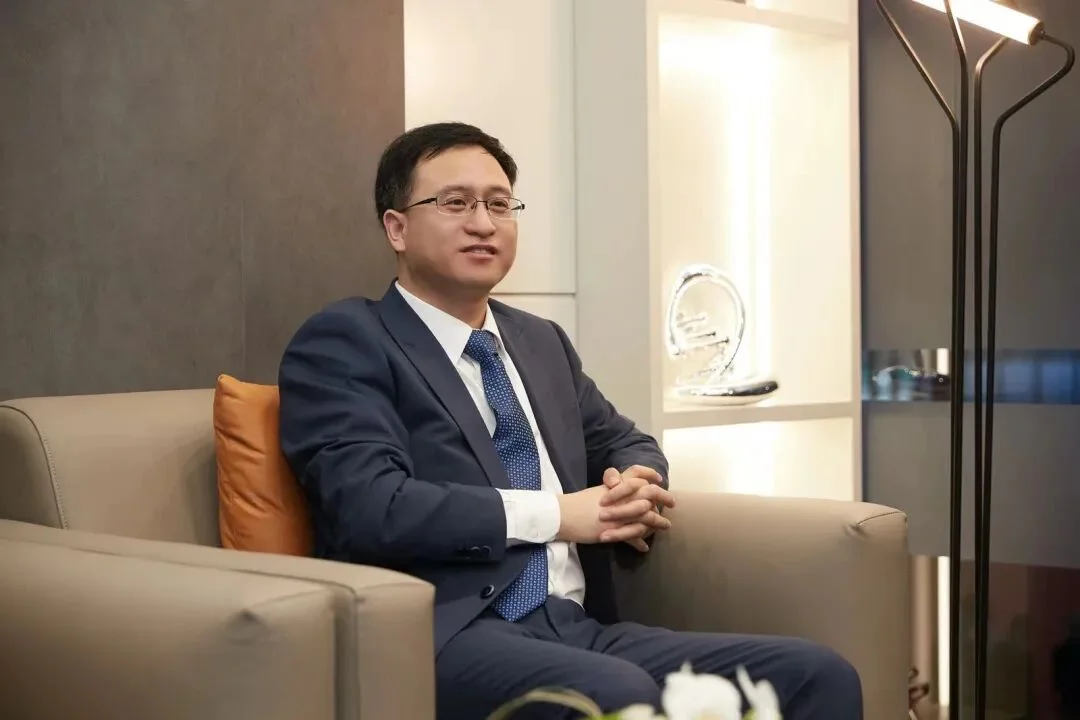
On April 18 at the Shanghai Auto Show, Li Ruifeng, Chief Growth Officer of GWM, gave an interview to the media. Here are the key points from that conversation.
Q: What experiences or valuable insights has Lanshan gained from its breakthrough? In the face of price wars, how does Great Wall plan to defend itself or strike back?
A: The popularity of Lanshan is just a good beginning; it still needs to pass long-term tests by customers. Starting in 2022, WEY went all-in on new energy, fully transitioning to a positioning of 'zero-anxiety smart electric mobility.' However, because our understanding of the new energy market was not deep enough at the time, we encountered many problems during this strategic transformation. Nevertheless, these lessons have empowered every brand within Great Wall, helping us improve our cognition of new energy, including the new energy transitions for HAVAL and TANK. This clarity in brand strategy deployment and product planning led to the creation of excellent products like the Lanshan large six-seater.
In January this year, Tesla led a wave of price cuts across the entire Chinese market. By March, some joint-venture brands, possibly due to inventory pressures, began steep discount promotions with prices halved. For Chinese independent brands that have painstakingly built brand awareness and trust, this is not a positive sign.
Although the pricing trends in April did not pursue further price cuts, if companies do not operate rationally, lack sound business thinking, fail to balance short-term and mid-to-long-term strategies, and cannot see a clear path for corporate survival and profitability models, it remains unknown how long any enterprise can endure.
For us, the focus should be on the concept of 'One Great Wall.' Among so many category brands, including profitable models and strategic new energy transition vehicles, we should not view our profitability through the lens of a single product. Instead, each brand should have its own mission, forming a pincer movement to ensure GWM's overall sales volume. Profit and market share exist in a balancing relationship; Great Wall must achieve balanced, high-quality market share while ensuring sustainable development.
After 32 years of automotive manufacturing experience, our core technology reserves, forest ecosystem, vertical integration, cost amortization from million-unit sales volumes, and global market layout create a profound sense of systemic strength. This is fundamentally different from the scale of a single entity. It is the risk-resistance capability brought about by systematic operational capacity.
Q: You mentioned that GWM is now "all set, only waiting for the right opportunity." What do you understand by this "right opportunity"?
A: Lanshan is that opportunity. It represents a momentum shift. Subsequent models like Xiaolong, as well as the TANK 400 and Gaoshan MPV, will serve as additional driving forces.
First and foremost is sales volume; only by scaling up can we consider it a success. Secondly, there must be steady profits to ensure that our service commitments to customers remain consistently reliable over the long term, guaranteeing the quality of conscientious vehicle manufacturing and effectively safeguarding consumer rights. With the implementation of China 6B emission standards and increasingly stringent emission regulations, as well as the transition toward intelligent technologies, significant R&D costs are incurred. In these areas, price reductions without profitability would undermine our ability to maintain high manufacturing quality and sustain the after-sales service chain.
Of course, it is not advisable to sit on the sidelines during the price war, waiting until the market polarization becomes clear before entering the fray. We need to sense market changes and release products in an orderly manner. For instance, large-volume models like HAVAL Xiaolong and H6 require sufficient time to penetrate the market and achieve significant sales scale. Therefore, having too many products is not necessarily a good thing.
Q: At the auto show, everyone is competing on price and technology. Where does GWM see its future space?
A: Some media outlets claim that GWM’s development in new energy vehicles has been somewhat slow. In reality, GWM does not lack speed; rhythm is more important than speed. GWM’s strategic direction is very clear. Its extensive reserves in new energy, combined with the technical advantages derived from the vertical integration of its forest ecosystem, will be popularized across various products in the future. Many products are already ready for SOP (Start of Production).
Q: Facing strategic transformation, what is the core focus or concentrated business objective for GWM’s next campaign?
A: First, stability. The strategic 'deep squat' last year lasted a considerable time, so we intend to play our cards densely at the Shanghai Auto Show. However, it is imperative to remain steady; only by proceeding steadily can we go far.
Second, balance. GWM must strike a balance between sales volume and profitability across its various brands and products. This is not a binary choice but a matter of proportional allocation. During the price cuts in March, GWM implemented corresponding strategies. However, for certain models, it is essential to maintain brand elevation by securing quality market share while simultaneously safeguarding profit margins.
Third, profitability. Healthy earnings serve as a long-term driver for corporate development.
Fourth, efficiency. We must consider not only the performance of individual vehicles, dealerships, and star single-product lines from the manufacturer's perspective but also the operational quality of our channels to ensure their sustainable growth. Such strategic and tactical considerations are necessary, which is why transformation cannot be rushed.
Q: During the auto show, manufacturers seemed focused on boosting sales at the expense of profits. Is there a consensus or awareness among GWM's senior management regarding this approach?
A: Products occupy different positions within the brand pyramid, defined by their primary category, segment, price point, and design language. HAVAL represents a core category with a price range of RMB 90,000 to RMB 150,000. Within this primary category and price bracket, it is tasked with contributing to sales volume and scale.
Therefore, significant resources will be heavily invested in the brand level to ensure the success of HAVAL's transformation and the development of the Xiaolong star product. Each product has a specific mission within its respective price segment, supported by corresponding sales volumes. With multiple brands, categories, and products, we employ distinct strategies to guarantee long-term, healthy scale and profitability.
Q: What has been the impact of the '541' strategy so far? What is the current progress of HAVAL New Energy? From a sales perspective, why hasn't GWM adjusted to external environmental changes?
A: The '541' framework consists of five middle platforms, four product categories, and 'one Great Wall.' The five middle platforms include communication, channel, user operations, sales services, and digitalization. These platforms integrate into four combat organizations. Effectively implementing the management models, talent pipelines, and incentive mechanisms within this structure presents significant challenges.
High-level synergy and mechanism integration are not simple tasks to complete; they require continuous advancement, expanding the 'Five Major Middle Platforms,' and fully empowering these brands. Therefore, the '541' strategy is only the beginning. We must avoid blind confidence, as many difficulties will arise during the process.
Regarding HAVAL's progress, the manufacturer and dealerships now share highly aligned goals and strategic directions. Everyone is working around the clock to build the entire system, including channel acquisition, store construction and renovation, recruitment and training of dedicated personnel, and the operation of new stores.
Before the first half of the year, we projected coverage of 400 to 500 locations, including 4S stores and shopping mall networks. As new energy products continue to enrich, we expect to have approximately 900 to 1,000 comprehensive network locations established before the Chinese New Year. This is the current progress.
When assessing new energy construction, don't just look at simple progress; look at the overall substance. You need to see whether dealers trust you, and how much time it takes for terminal dealers to have a clear understanding of and high identification with your strategic transformation, while also following you without reservation. This is a very long process.
On sales figures: First, as a listed company, we focus on long-term operations. We are responsible for our upstream and downstream partners, dealers, employees, and shareholders over the long term. Therefore, we must prioritize the health of long-term operations and absolutely cannot compromise for a simple short-term data point.
Second, why do we dare to go against the grain? Because with a long-term operational mindset, we have the confidence to hold our ground during the process. We will no longer allow our strategy to be distorted by short-term external pressures.
Third, we possess a strong capacity for self-reflection. If others do not offer us suggestions and we make no mistakes, that may be our greatest error. When our sales figures face significant controversy, every team member at GWM calms down to reflect on our strategy.
Q: In previous years, Mr. Wei proposed consolidating resources to create a unified Great Wall. Specifically, how was this implemented?
A: Previously, we implemented a strategy of one brand per vehicle, requiring each brand to operate independently with separate resources and target its own customer base. During this process, we found that there was no coordination between brands, resource utilization was low, and experience was not shared. Sometimes the differentiation happened too quickly, leading to significant waste of company resources; for instance, external work such as media and platforms should have been coordinated centrally. This is why we adopted matrix management.
The five major middle offices coordinate shared resources and platforms across brands, achieving unified external management, consistent messaging, resource sharing, and experience sharing. This represents a change in management model. However, what has not changed is that each brand's combat group remains highly empowered and authorized, given autonomy and flexibility, with subsidiary brands holding substantial power.
Q: Is Oula’s insistence on a female-oriented positioning too narrow? What are the reasons and underlying thoughts behind sticking to this female positioning?
A: Categorization is a core essence of GWM’s focus. While others divide new energy vehicles by domain, we boldly entered the female track because women’s dominant role in families is growing stronger, with greater decision-making power. In this fiercely competitive era, GWM defines Oula with a female-centric approach—'carrying love to the end' or 'loving women'—to firmly empower women in product definition and R&D.
This direction is unwavering and correct, and may bring significant dividends in the future.
Q: Recently, a leader from another automaker made a prediction: by 2030, only about eight automakers will remain. What is your view on this?
A: I believe this viewpoint is correct. As competition in the automotive market intensifies, survival of the fittest will accelerate. Companies with sales scale and comprehensive strength will survive, leading to a K-shaped divergence in the future.
In this scenario, similar to the century-old automotive industries in Germany or the United States, only a few major players will remain. China may follow a similar trend, meaning that only those who can operate healthily until 2025 will be in a position to discuss strategies for 2030. If actions become distorted during this process and business performance is poor, reaching that scale will be impossible.
This is what I just mentioned: you must have long-term operational thinking.
Written by: Willa Edited by: 308