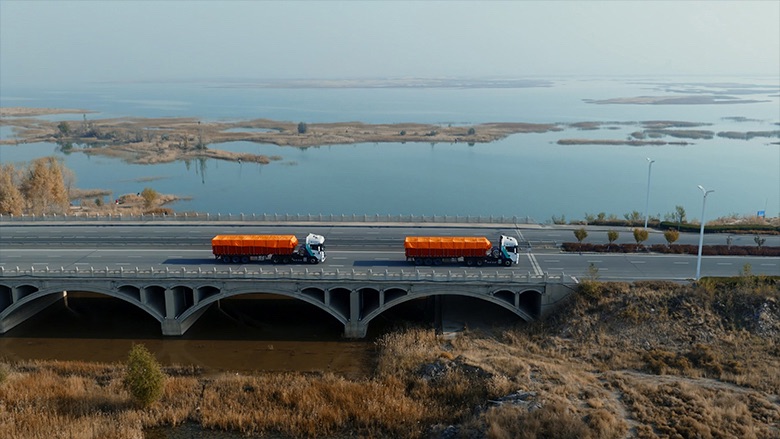
In 2026, the autonomous long-haul freight sector reached a highly delicate juncture. The capital market, having navigated through phases of frenzy and caution, has become increasingly pragmatic, with several companies racing to secure IPO positions. However, amid this bustling capital landscape, the industry’s core question remains unchanged: Can Level 4 autonomous freight transport break free from the reliance on “burning money” and achieve sustainable economics in genuine commercial operations?
In response, Kar Power maintains a clear and sober approach. In a recent in-depth exchange with Garage 42, Kar Power emphasized that the company’s tactical focus remains on technological implementation and closing the commercial loop. At present, Kar Power has assembled a fleet of over 400 vehicles, achieving a routine operational mileage of 45 million kilometers in door-to-door service, becoming the first in the industry to attain profitable single-vehicle operations.
In the wave of IPOs, Kar Power not only secured the first deployment credential of physical AI in long-haul freight but is also reshaping the foundational ecosystem of Chinese road freight with an in-depth economic calculation logic.
The First Ticket to Physical AI
At the recently concluded 2026 World Artificial Intelligence Conference, embodied intelligent robots were a focal point, yet few successfully transitioned into real-world applications. Long-haul freight is a critical segment where AI is applied in day-to-day real commercial operations. Kar Power believes that the essence of physical AI is enabling AI to autonomously decide, interact in real-time, and bear consequences in the real physical world. Long-haul freight conveniently meets three stringent conditions: clear commercial goals, stringent safety constraints, and vast real-world interactions.
The clarity of commercial goals necessitates precise cost calculations, the stringent safety constraints of high-speed heavy trucks require systems to respond within milliseconds, and the vast real-world interactions of long-haul routes provide algorithms with an endless supply of long-tail scenarios. This combination of conditions makes long-haul freight a hardcore sector for the quickest realization of physical AI’s commercial value loop.
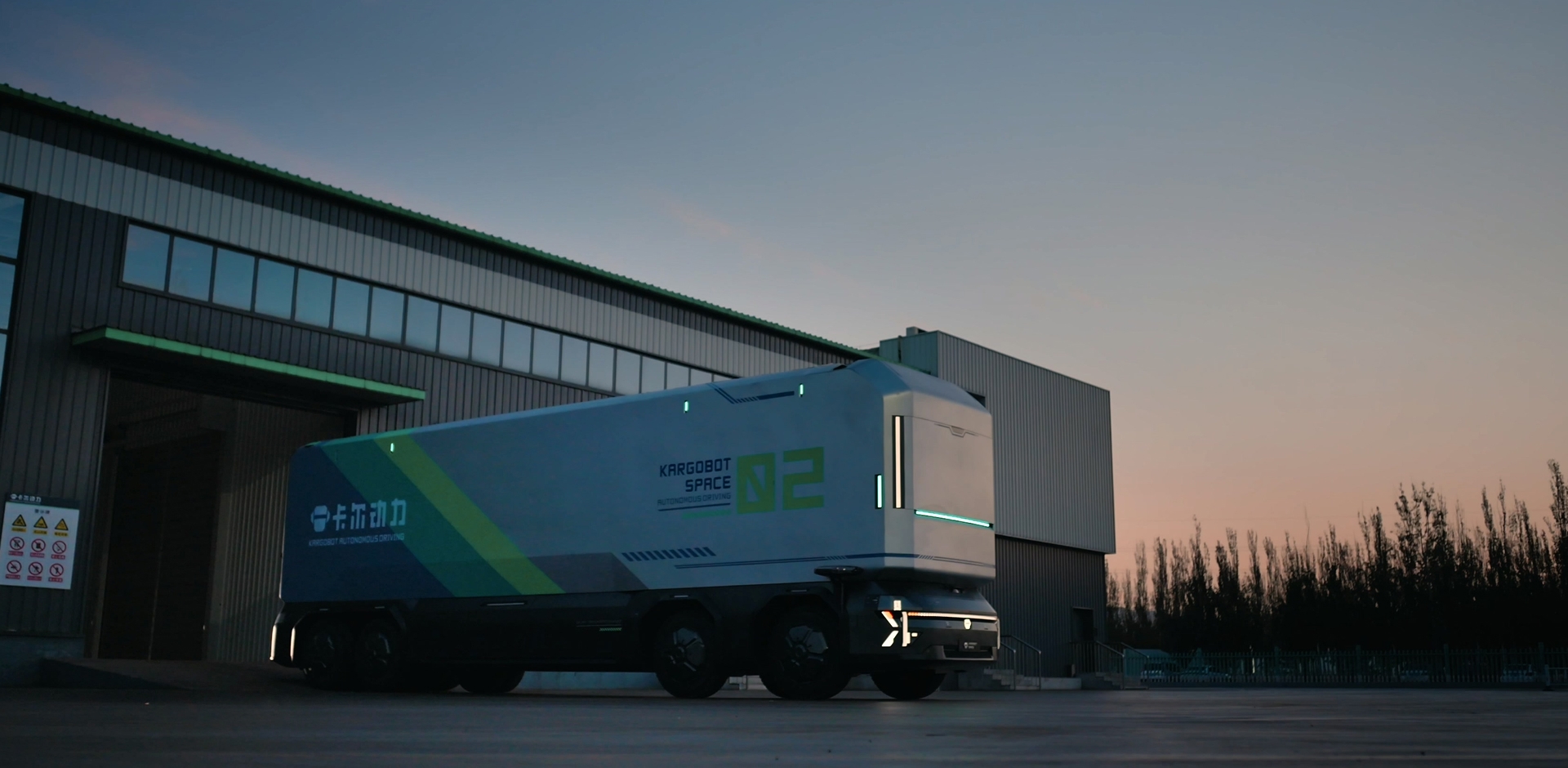
Most importantly, L4 freight itself is a typical “empirical industry,” where the intelligence cap and problem-solving capacity of AI models fully depend on the complexity of real-world scenarios it has encountered. Extreme weather and unexpected road conditions, which cannot be tested in laboratories, can only be encountered on the highway. Kar Power’s accumulated experience from over 400 vehicles and 45 million kilometers of real operations essentially constructs an enormous “freight AI training ground.”
Within this training ground, Kar Power exhibits a systematic capability to tackle complex scenarios. From the early “mixed convoy with manned lead and driverless following vehicles,” to the “parent-child convoy” addressing single-trip empty loads, and further to jointly developing with Shaanqi the mass-production transport robot without a driver’s cabin, Kar Power continuously addresses real-world challenges through product and technological innovation. With every increase in operational mileage by an order of magnitude, both the system’s safety and efficiency ascend simultaneously.## Unpacking Single Vehicle Profitability
In the minds of many, L4 autonomous driving is often linked to high hardware costs and losses, but Karl Power’s successful “single vehicle profitability operation” has thoroughly shattered this stereotype.
The so-called single vehicle profitability suggests that the savings in labor costs, energy consumption optimization, and scheduling efficiency improvements in the actual operation of autonomous driving convoys can completely cover the investment cost of autonomous driving suites. The traditional cost structure of trunk freight mainly consists of four components: labor, energy consumption, tolls, and vehicle depreciation and maintenance. Except for tolls, which are rigid expenses, Karl Power’s solution has effectively targeted almost every cost through specific measures.
On the labor front, Karl Power employs a hybrid convoy model of “1 lead vehicle + multiple L4 follower vehicles,” wherein the follower vehicles operate without drivers, directly reducing labor costs by 83%. On the energy front, thanks to an extreme 10-meter gap between vehicles and millisecond response delay, the follower vehicles can fully enjoy the drafting effect, reducing the overall convoy energy consumption by about 10%.
In terms of hardware and scheduling, the intelligent scheduling platform KargoCloud can improve operational efficiency by 20%, while the latest Gen5 hardware platform’s BOM cost has decreased by 50%, reducing hardware suite costs to 90,000 yuan. Altogether, these measures result in a comprehensive profit margin per vehicle reaching 3 to 6 times that of traditional freight, moving beyond the trap of burning money on subsidies.

Upon resolving the accounting logic, the standardized delivery of business models follows naturally. Karl Power positions itself as a “full-stack intelligent transportation service provider,” offering TaaS (Transportation as a Service, where customers pay per transport volume without needing to own vehicles) and SaaS (virtual driver software subscription service) capabilities. This ability to package AI algorithms, vehicle carriers, and scheduling as standardized services has also attracted deep cooperation from the six major domestic leading commercial vehicle manufacturers. Through joint development with OEMs for native adaptation of line-controlled chassis Robotrucks and transport robots, hardware costs continue to decrease.
From Fatigued Drivers to “Transportation CEOs”
China has long faced a shortage of road freight drivers, with their average age exceeding 46. From Karl Power’s perspective, the introduction of AI is never about simply replacing drivers but rather freeing them from hazardous, high-pressure manual labor to become service managers overseeing intelligent equipment.
According to a report by “China Economic Weekly,” Yang Kai, who has worked at Karl Power for 5 years, exemplifies this transformational shift. Once a seasoned long-haul truck driver with over 20 years of experience, Yang Kai joined Karl Power’s team of pilots by chance. After over a month of theoretical training, practical onboard operations, and rigorous assessments, he officially took charge of managing the pilot vehicle and the L4 heavy truck convoy.After this, Master Yang’s working approach underwent a fundamental change. Now he sits behind the wheel, acting as the “captain” and decision-maker for the entire fleet. In KargoPower’s fleet, more and more traditional drivers like Master Yang are transforming from fatigued laborers into “Transport CEOs” managing intelligent equipment.
Looking to the future, KargoPower has set a goal to scale from hundreds to tens of thousands of vehicles. KargoPower understands that achieving a scale of tens of thousands is not simply about stacking vehicles; it requires the deep integration of AI models suited for large-scale operations, a native L4 architecture, and a global transportation scheduling system. Through the “KargoBot Inside” strategy released this year, KargoPower is building an infinitely replicable and readily deployable smart transportation network with a three-tiered architecture of AI (freight base model), Robot (native intelligent carrier), and Service (intelligent dispatch services).
As the noise of the capital markets fades, the competition in autonomous long-haul freight will ultimately return to real performance on the highways. KargoPower, through an economic model validated over 4.5 million kilometers, not only demonstrates the enormous feasibility of physical AI driving cost reduction and efficiency in the real economy but also outlines a clear future for the intelligent transformation of China’s long-haul logistics within the vast highway network.
This article is a translation by AI of a Chinese report from 42HOW. If you have any questions about it, please email bd@42how.com.