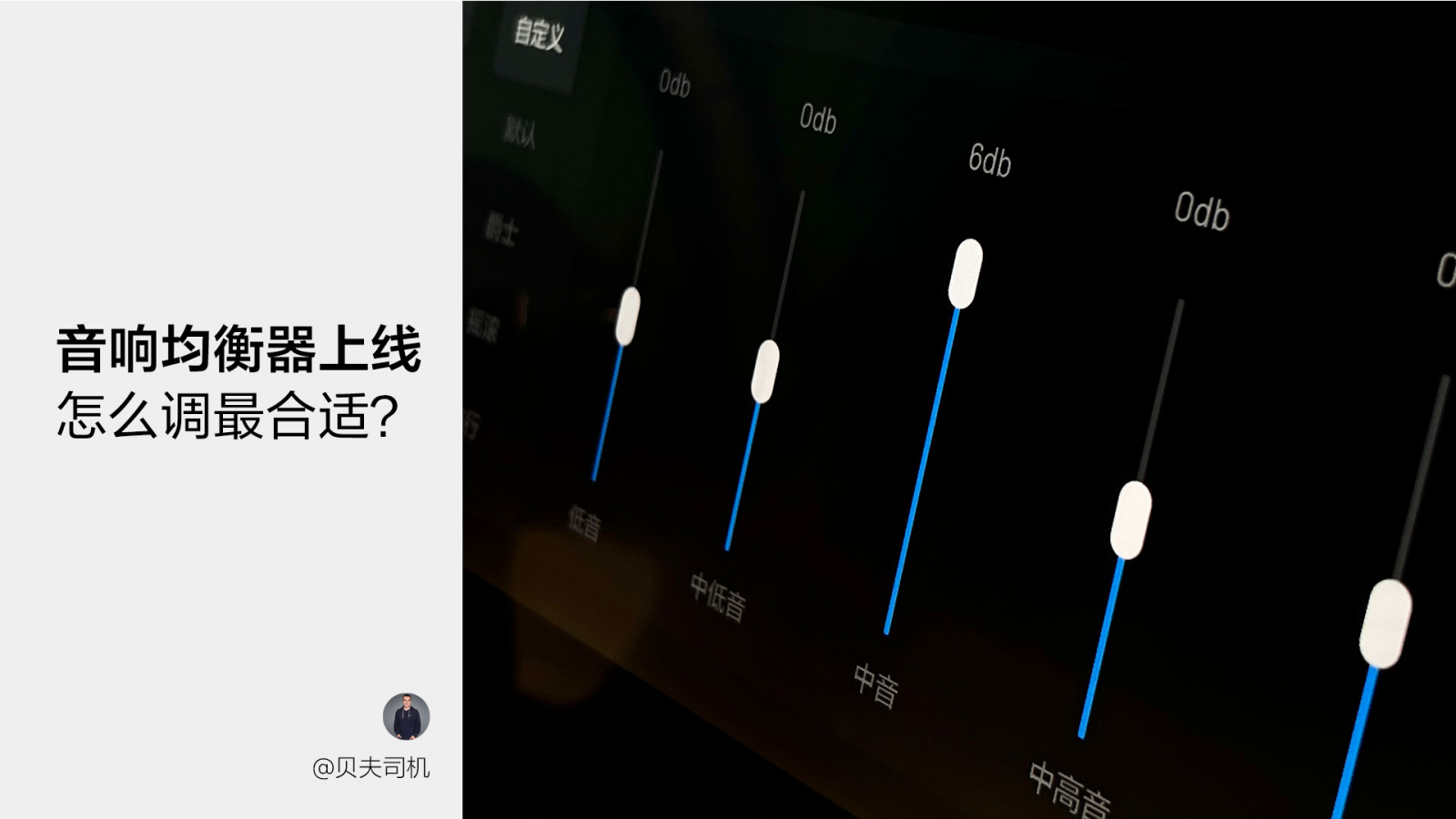
With the release of OTA 3.1, I finally have the opportunity to talk about the audio system of the Ideal ONE, because the highly-anticipated equalizer is now online.

Actually, the evaluation of the Ideal ONE audio system among car enthusiasts varies, depending on their previous experience with car audio systems and their level of research on audio systems. As a non-audio enthusiast, and having not previously owned a branded audio system in my previous cars, my evaluation of the Ideal ONE audio system is mediocre and basically meets the standard for this price range.
But does the Ideal ONE audio system have the potential to be further developed? The answer is yes. In fact, when we delivered the first batch of vehicles at the end of 2019, the audio quality was worse than it is now, but later the HiFi mode was optimized, and with the support of lossless music from NetEase Cloud Music, the audio quality was improved to a new level.

Now, with the addition of the equalizer function, there is a further improvement in audio quality, so today we will focus on talking about the equalizer. Because the equalizer itself has a geeky quality, I will first recommend some audio settings for you. If you are a car enthusiast who wants to have a basic understanding of acoustics, you can continue reading.
Audio System Recommended Settings
- Listening to pop music
Sound field: The whole car
Sound effect: HiFi
Equalizer: Pop
Volume: 40

- Watching movies & TV shows
Sound field: The whole car
Sound effect: Surround
Equalizer: Pop

- Equalizer: the filter for sound
Before discussing the equalizer, let’s first understand what the goal of the audio system is, summed up in one sentence: to truly restore the world of sound.
Note the word “true”. Does true necessarily mean what you like the most? Actually, it doesn’t necessarily mean that. For example, Apple’s camera aims to restore the most true-to-life color world, while Huawei’s camera algorithm enhances the colors of the photo to make it more pleasing, so most people would prefer the photos taken by Huawei, but there are also people who prefer more true-to-life photos. So this is a matter of personal preference and there isn’t necessarily a right or wrong answer.# Back to the equalizer in the audio field, to use an inappropriate analogy, it is like Meitu Xiuxiu in the field of photography. By adjusting the high, medium and low frequencies, you can achieve the effect of “Photoshopping”, just like adjusting the saturation and contrast of a picture, the goal is to create a sound that you like. This is the value and role of the equalizer, to meet the personalized needs of the sound.
What are the characteristics of low, medium and high frequencies?
In the ideal ONE equalizer, the audio items that can be adjusted are very straightforwardly displayed, a total of five, namely low, mid-low, mid, mid-high, and high. Unlike other software, there is no reference to hertz mainly to help everyone better understand what low, medium and high frequencies represent.

Because the range of frequencies that the human ear can hear is limited, the sensitivity of the human ear to low, medium and high frequencies is different. Generally speaking, people are more sensitive to mid-range frequencies, and low-frequency and high-frequency to be strengthened to achieve the same effect as mid-range frequencies.
Therefore, in the past when there was no equalizer, increasing the overall volume was a way to make the sound system more effective, because raising the low, medium and high frequencies made the sound heard by the human ear more full, and after the equalizer, the intensity of the low and high frequencies could be adjusted separately (the db values shown in the figure represent the gain effect, which can be negative), achieving a similar low-frequency and high-frequency effect as raising the overall volume.

What feeling does bass give people? Bass has no directionality, so bass does not affect the image (the general idea is that the position where the sound is emitted). Strong bass can cause the sensation of resonance in human tissue and organs, such as vibrating during a concert, which is caused by the stimulation of the bass. If we talk about the sound waves coming at you, this is referring to the bass.

Medium-range frequencies are the most common audio range people encounter in their daily lives because human voices are generally in the mid-range frequency range. Singing can reach mid to high frequencies, while speaking is in the mid to low frequency range.

High frequencies mainly allow people to hear details and play an amplifying role, such as the sound of teeth when singing. However, if the high frequencies are adjusted improperly, the sound can be as piercing as the sound of fingernails on a chalkboard, and just writing about it gives me goosebumps.Actually, the cleanliness of everyone’s ear canal can affect how they perceive the same audio. Age also affects the high and low sounds. Children are more sensitive to low or high sounds than adults.
To summarize in one sentence, high notes are bright, mid-range notes are mellow, and low notes are thick.
Multiple Choices in the Equalizer

In the ideal ONE equalizer settings, there are five combinations of popular, classical, rock, jazz, and dance, and their names alone indicate that they correspond to different music genres.

After a long period of A/B testing, I found that the V-shaped equalizer setting is the best choice for listening to music. It increases the gain of both low and high frequencies by 6db, while also softening the gain of mid-range frequencies by 3db, which makes the transition very natural and compensates for the lack of low notes. Of course, this is my personal preference. You can switch between multiple combinations in a song to compare and listen.

In the ideal ONE sound settings, you can also choose surround or HiFi. Surround, as the name suggests, is a surround sound effect that makes you feel like you are in a sound field with sound all around you. HiFi refers to high fidelity, which will weaken the surround effect but give you a stage-like sound experience, meaning the singer is standing in front of you singing to you, and the sound comes from the front.
In terms of listening to music, HiFi is more suitable, while for watching movies, surround is more suitable. Generally, you can refer to my recommended settings at the beginning of the article.
Finally, I will provide you with a small playlist of music with good sound quality that I found on NetEase Cloud Music. You can try listening to them and adjust the volume to 40 to experience the sound of ideal ONE.

That’s all about the equalizer. Acoustics is a relatively deep and complex subject that can’t be explained in a few words, and there are some inaccuracies in the article. However, I aim to provide you with a basic understanding and hope it will be helpful to you. You are also welcome to share your opinions in the comment area.
This article is a translation by ChatGPT of a Chinese report from 42HOW. If you have any questions about it, please email bd@42how.com.