The 2020 NIO performance report
2020 passed quickly, but thinking back to the end of 2019, it seems like a long time ago.
I believe that for everyone who experienced a lot in 2020, especially NIO, there is such a feeling.
On March 2, 2021, NIO released its financial results for the fourth quarter and full-year of 2020. The data is no longer described as “good” as it is remarkably positive. In the words of Song Dandan, it is “quite good”. So now, let’s take a look at this beautiful financial report.
Gross profit for 2020 turned positive, with cash reserves of RMB 42.5 billion
In 2020, NIO delivered a total of 42,728 vehicles, a year-over-year increase of 107.8% compared to the 20,565 vehicles delivered in 2019.
In Q4 2020, NIO’s revenue was RMB 6.174 billion, an increase of 44.7% over Q3, and a year-over-year increase of 130.0% over Q4 2019.
NIO’s total vehicle sales revenue in 2020 was RMB 15.1825 billion, a year-over-year increase of 106.1%.
The gross profit margin for Q4 2020 was 17.2%, and the gross profit for the whole year of 2020 was 11.5%, far exceeding the full-year negative 15.3% in 2019.
NIO’s net loss for 2020 was RMB 4.608 billion, a 58.4% decrease compared to the net loss of RMB 11.296 billion in 2019.
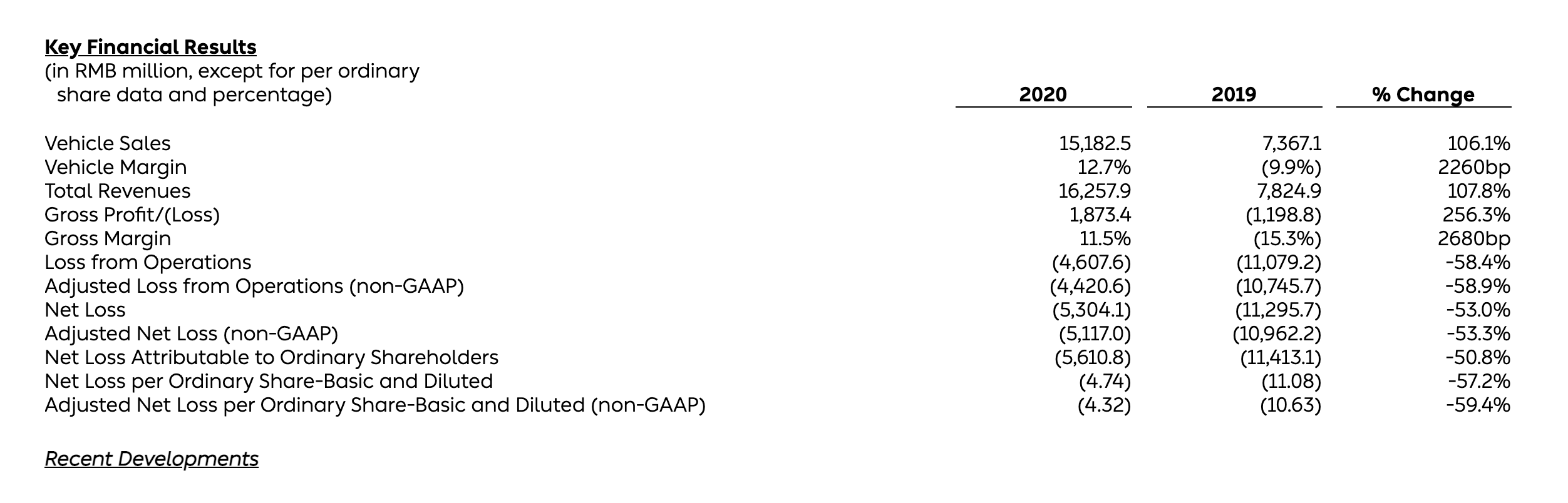
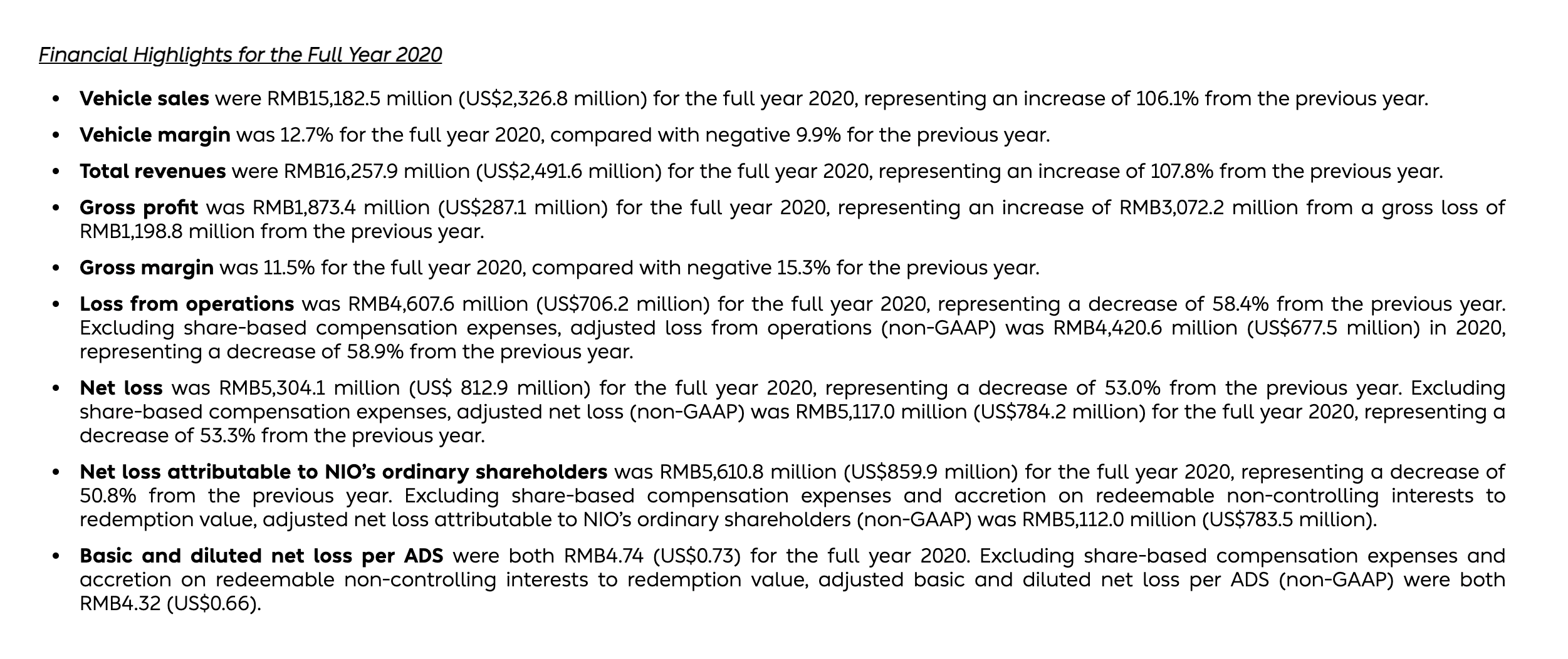
These are NIO’s achievements in 2020.
A year of continuous growth in sales and stock prices may have caused many people to become numb to the data of the surge, forgetting how miserable NIO was at the end of 2019. Of course, many of us are included. So, I reviewed NIO’s third and fourth quarters of 2019.
At that time, comments around NIO included “bankruptcy,” “intensive care unit,” “last year,” and other ominous terms. “Insufficient cash balance to provide the necessary operating and working capital for the next 12 months” appeared twice in NIO’s quarterly financial reports.
NIO’s cash flow was always tight last year, depending on issuing convertible bonds every month to make ends meet. It wasn’t until the Hefei 7 billion investment was in place in April that NIO really got out of the intensive care unit.
Those who have experienced a near-death experience often cherish life more, and plants that have experienced a near-death experience are often more resilient, and this also applies to NIO.
After getting rid of the financial crisis, NIO did two things:
-
Open more stores and sell more cars;
-
Save money and work hard to increase vehicle gross profit margins.The delivery volume of NIO in 2020 has doubled compared to 2019.
Except for the low sales caused by the pandemic and the Spring Festival in Q1, the delivery volume of Q2, Q3 and Q4 have all exceeded 10,000 vehicles, and even in the last month of Q4, the monthly delivery volume has exceeded 7,000 vehicles.
After browsing through the media reports in the past year, “new record” and “historical record” are both highly frequent terms.
With the overall sales growth and the increase in the proportion of ES8 sales, NIO’s average transaction price has increased by RMB 10,000 compared to Q3.
In the past year, NIO’s overall gross profit has been upgraded from negative gross profit to nearly 20% gross profit, which is not bad even compared to the entire industry.
During the conference call, Li Bin also stated that currently out of 88,000 NIO users, the option rate of NP (including small and large NPs) is about 50%, and NIO will introduce some policies to stimulate the option rate of large NPs to further enhance the gross profit margin.
At this point in time, it is not very meaningful to trace and analyze the reasons for the surge in sales a few months ago. NIO has already realized a positive cycle of sales and financial data, as mentioned in our analysis of the financial report.
What we are more concerned about is what will NIO do next, with double-digit gross profit and cash holdings of 42.5 billion.
Continue to sell cars and increase investment in research and development.
Delivery volume doubles in 2020, no new products for 2021
In the financial report, NIO has given a delivery guidance of 20,000-20,500 vehicles for Q1 2021.
It is worth noting that the first quarter has always been the off-season for China’s auto market, but NIO still gave a very high delivery guidance, which means that NIO’s delivery volume this year is likely to exceed 80,000 vehicles, doubling on the basis of 2020.
After attending the NIO Day 2020, seeing everyone’s high praise for ET7, me and a old friend who attended together raised my concerns.
ET7 is expected to be delivered in the first quarter of 2022, so for NIO, the whole 2021 will be the first year without new product launch after the release of ES8 in 2017.# NIO’s Current Situation and Future Expectations
Looking back over the past three years, NIO has experienced a surge in sales during each year’s new product delivery period, with new products becoming pivotal to their sales success. However, in 2021, this support is not present.
The question then becomes: will NIO’s delivery volume remain the same as 2020 or experience some decline? Additionally, what are NIO’s sales expectations for 2021?
During a conference call following the announcement of their quarterly financial report, Li Bin stated: “From now until the delivery of our ET7, we will mainly rely on our three current models, the ES8, ES6, and EC6. Our EC6 began delivery in September of last year, we delivered the new ES8 in March of last year, and the ES6 began delivery in the second half of 2019. Looking at each product’s life cycle, they are still highly competitive, with enough competition compared to other electric cars and gasoline cars of the same price on the market.”
I concede that the product strength of the ES8, ES6, and EC6 still outperform many old gasoline cars on the market currently. However, I remain skeptical if this advantage will translate into delivery volume.
Nevertheless, my concerns were completely dispelled after seeing the February delivery volume and delivery guideline information in the financial report.
Traditionally, the first quarter includes China’s Lunar New Year, and most people who plan to buy cars in the near future would complete their purchases before the holiday, leading to a certain amount of purchasing power being released beforehand. Furthermore, since cars cannot be delivered during the long holiday, there will be a certain decline in delivery volume, even for Tesla.
What’s more, on January 1st, Tesla announced the price of its locally produced Model Y and concurrently began delivery. Everyone believed that the release of this car, which competes with NIO’s ES6 and EC6 in product positioning, would seriously impact NIO’s sales.
However, based on this foundation, NIO’s January delivery volume exceeded 7,000 vehicles, and the February delivery volume remained over 5,500 vehicles. NIO is still confident in achieving a 7,000+ delivery volume in March.
To continue growing, NIO has done a lot of things, which can basically be divided into three categories: expanding store coverage, increasing infrastructure, and improving production capacity.
Where there are BBA and Lexus 4S auto dealerships, NIO will build offline stores as well. During the financially tight times of 2019-2020, NIO gave up continuing to operate NIO Houses and chose to allocate more funds to the creation of cost-effective and efficient NIO Spaces.On this conference call, Li Bin stated that in 2021 NIO will build 20 new NIO Houses and 120 new NIO Spaces in cities where there are Mercedes-Benz, BMW, and Audi 4S stores. Regardless of the building cost being lower for NIO Space, NIO Car’s CFO, Feng Wei, also stated the importance of NIO House on the conference call.
“NIO House is an important channel for order conversion, which helps to improve brand awareness, expand user touchpoints, promote sales conversion; It also has strong brand communication functions. Against the backdrop of rapid growth in sales revenue, we believe that increasing a certain amount of brand communication investment is advantageous to long-term interests of the brand and sales. NIO House is also an important venue for user system and community operations, providing activity space for offline user connections and brand promotion.”
Therefore, NIO has restarted the construction of NIO Houses this year, but obviously the strategy has become more “economic”.
Feng Wei also added on the conference call: “We have accumulated rich experience in the process of operating offline networks in the past, and have stronger control over site selection, planning, and cost-effectiveness. The investment amount and operating costs required for a single store are much lower than before. One reference figure is that the current average single-store investment is 40% of the original investment, and the rent and operating costs are 50% of the original.”
Of course, in addition to domestic store expansion, global layout is also in progress. NIO specifically stated that it will begin sales and services in Europe this year. SAIC MG EZS, which has already attacked the European market, has sales of nearly 4,000 in a city in Norway per year. NIO, as a representative of Chinese luxury, can also be expected to have similarly promising sales.
500 battery swap stations, 600 supercharging stations
If the policy of expanding stores above is to allow more users to come into contact with NIO cars, then the policy of expanding swap stations is to make it more convenient for more car buyers to replenish energy. Although a large proportion of NIO users have home charging conditions, with the growth of sales, an increasing proportion of users do not have home charging conditions.
Therefore, NIO’s plan for this year is to increase the number of battery swap stations to 500, the number of supercharging piles to 600, and the number of destination charging piles to 15,000. Li Bin mentioned on the conference call: “Our battery swap station solution combined with BaaS and our complementary charging network, as well as our intervention in third-party charging networks, is the best experience for Chinese users.”
Achieve single-shift capacity of 150,000 vehicles and double-shift capacity of 300,000 vehicles early next year.Last year in the second half of the year, NIO’s monthly delivery volume was maintained at the level of 4,000 to 5,000 vehicles. The official explanation from NIO was that the production capacity was limited by the capacity of the industry chain and the maximum capacity limit of shared circuit board. The production capacity bottleneck was 5,000 vehicles.
It was not until December 2020 that NIO gradually transitioned to double shifts, and production capacity increased to 7,500 vehicles.
Starting from July 2021, with the increase in the production capacity of the entire supply chain and the expansion of the JAC factory, NIO aims to achieve production capacity of 150,000 vehicles on a single shift and 300,000 vehicles on double shifts early next year.
This is not only to prepare for the delivery volume in 2021, but also to prepare for the delivery of the ET7 starting in Q1 2022.
In the post-earnings conference call, Li Bin revealed that the order volume for the ET7 after its release exceeded that of any of our previous cars. As a car with a starting price of 448,000 yuan, we believe that its performance exceeds our expectations.
R&D investment of 5 billion yuan strengthens technological barriers
Lastly, let’s talk about R&D.
NIO’s R&D expenses in 2020 were 2.4878 billion yuan for the full year. In 2021, NIO plans to invest 5 billion yuan in R&D, which is twice as much as 2020.
This 5 billion yuan will mainly be used to improve the R&D and mass production of core technologies and new models, including the NT2.0 platform, NAD, ET7, and 150 kWh battery.
As early as 2017, NIO launched the first generation of NIO Pilot, which was the strongest set of hardware for assisted driving on the market at that time, with Mobileye EyeQ4 chips, three cameras, and 5 mm wave radars.
With the rapid development of the past two years, although NIO’s hardware still dominates most models, from the perspective of the industry leader, it is no longer a “flagship.”
At NIO Day 2020, NIO officially released the NAD autonomous driving technology. The ET7 and NAD technologies were analyzed in detail in our previous article on NIO Day, so we won’t go into too much detail here.
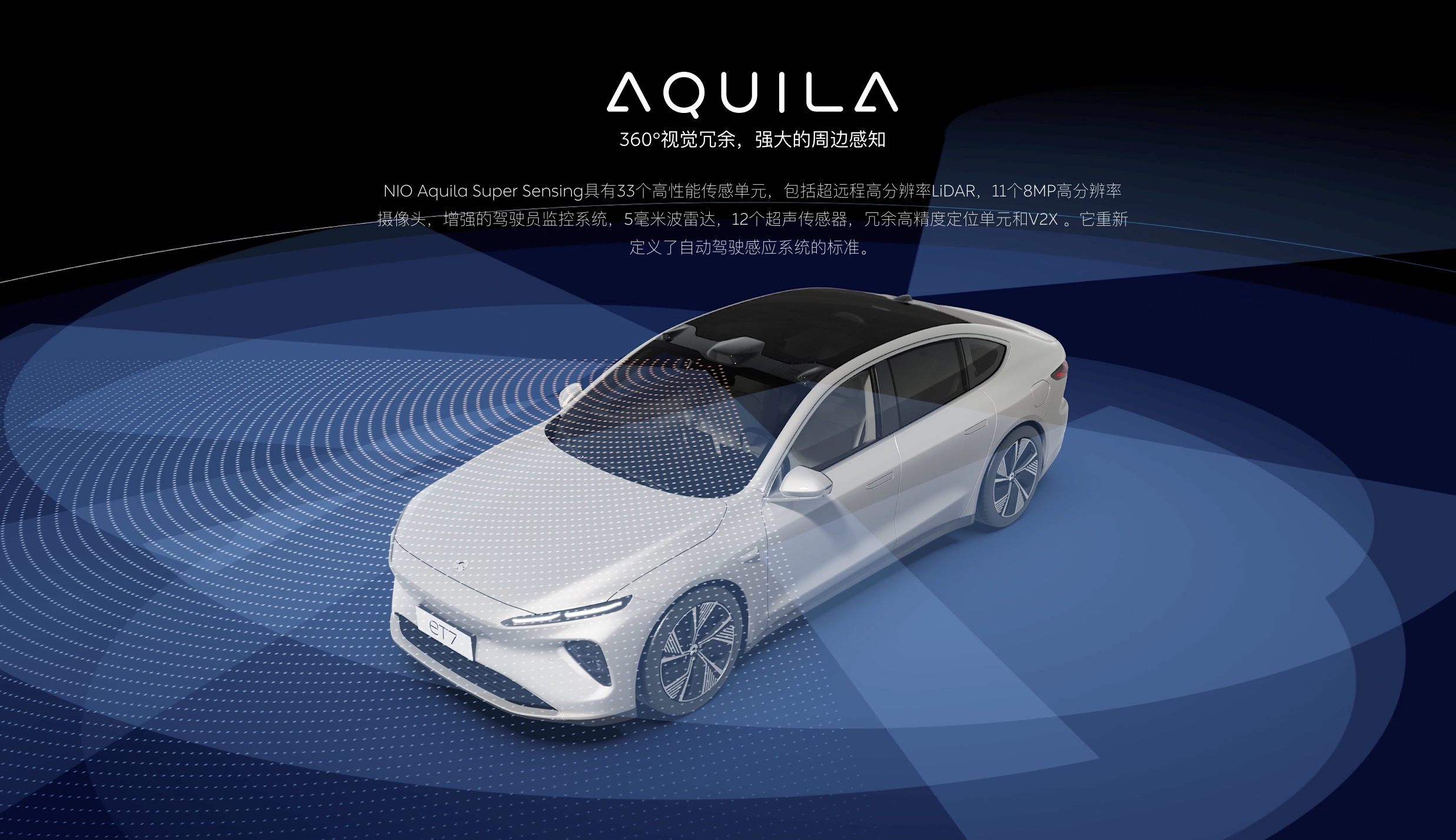
It is worth mentioning that the NAD autonomous driving technology installed on the ET7 will be developed entirely in-house by NIO, which means that NIO needs to invest a large amount of capital to support the technological barriers of the next-generation autonomous driving platform.
Conclusion
In conclusion, NIO has already entered the right track in terms of both sales volume and gross profit. If NIO a year ago was a critically ill patient lying in the ICU, now NIO is a teenager running on the playground.We hope to see this sprinting energetic youngster bring some fresh blood to the whole industry with his upcoming performance.
This article is a translation by ChatGPT of a Chinese report from 42HOW. If you have any questions about it, please email bd@42how.com.