Author: Chris Zheng
As the end of the year approaches, summarizing the events that have occurred in the automotive industry’s capital area over the year can be described as “exciting.”
Against the background of the traditional electric and intelligent transformation of large factories, Tesla, NIO, Li Auto, and XPeng have highly unified strategies: comprehensive expansion and intelligent breakthrough.
In less than ten days, Tesla, NIO, Li Auto, and XPeng have launched a fierce fundraising arms race.
In less than ten days, fundraising exceeded 105.6 billion yuan
For new carmakers headed by Tesla, to accomplish the historic mission of reshaping the entire automotive industry, the key concepts of expansion and intelligence cannot be ignored. Whether it is expansion or intelligence, there must be massive capital reserves to support it.
Let’s take a look at the fundraising dynamics of the four companies mentioned above:
Li Auto
On December 2, Li Auto announced that it plans to issue 47 million American depository shares (ADS) with a net financing amount of approximately $1.602 billion. If the underwriter exercises the over-allotment option, Li Auto will raise up to $1.8 billion.
Tesla
On December 8, Tesla submitted documents to the SEC (US Securities and Exchange Commission) to issue up to $5 billion in stocks.
XPeng
On December 9, XPeng announced that it plans to issue 48 million American depositary shares (ADS) priced at $45 per ADS. Therefore, XPeng’s proposed total fundraising amounts to US$2.16 billion, which is the largest-ever stock offering in the history of Chinese concept stocks.
NIO
On December 10, NIO announced that it plans to issue 60 million American depositary shares (ADS). In addition, the underwriters will have a 30-day option to purchase an additional total of nine million ADS.
According to the highest amount of this round of financing, the combined fundraising scale of these four companies will exceed RMB 100 billion.
CITIC Securities statistics show that Li Auto has carried out four rounds of financing this year, raising a total of RMB 20.7 billion; XPeng has financed three rounds, with a total of RMB 28.5 billion; NIO has four rounds of financing this year, with a total financing scale of RMB 32.8 billion; Tesla has financed three times this year, with a total fundraising scale of USD 12.3 billion (approximately RMB 80.6 billion).
Why fundraise? In addition to the enterprise’s own demand to accelerate expansion and intelligent processes, Wall Street’s sustained bullishness on the concept stocks of intelligent vehicles is also an important factor not to be ignored.# Tesla CEO Elon Musk’s unwritten rule: the dilution of existing shares by the issuance of new shares should not exceed 1%. Meanwhile, XPeng Motors CEO He XPeng advised not to dwell on valuation and to dare to raise money when the opportunity arises.
Over the past year, the stocks of four companies have risen several to ten times, making equity financing very cost-effective for management.
Let’s take a look at Tesla’s history of equity financing since its establishment.
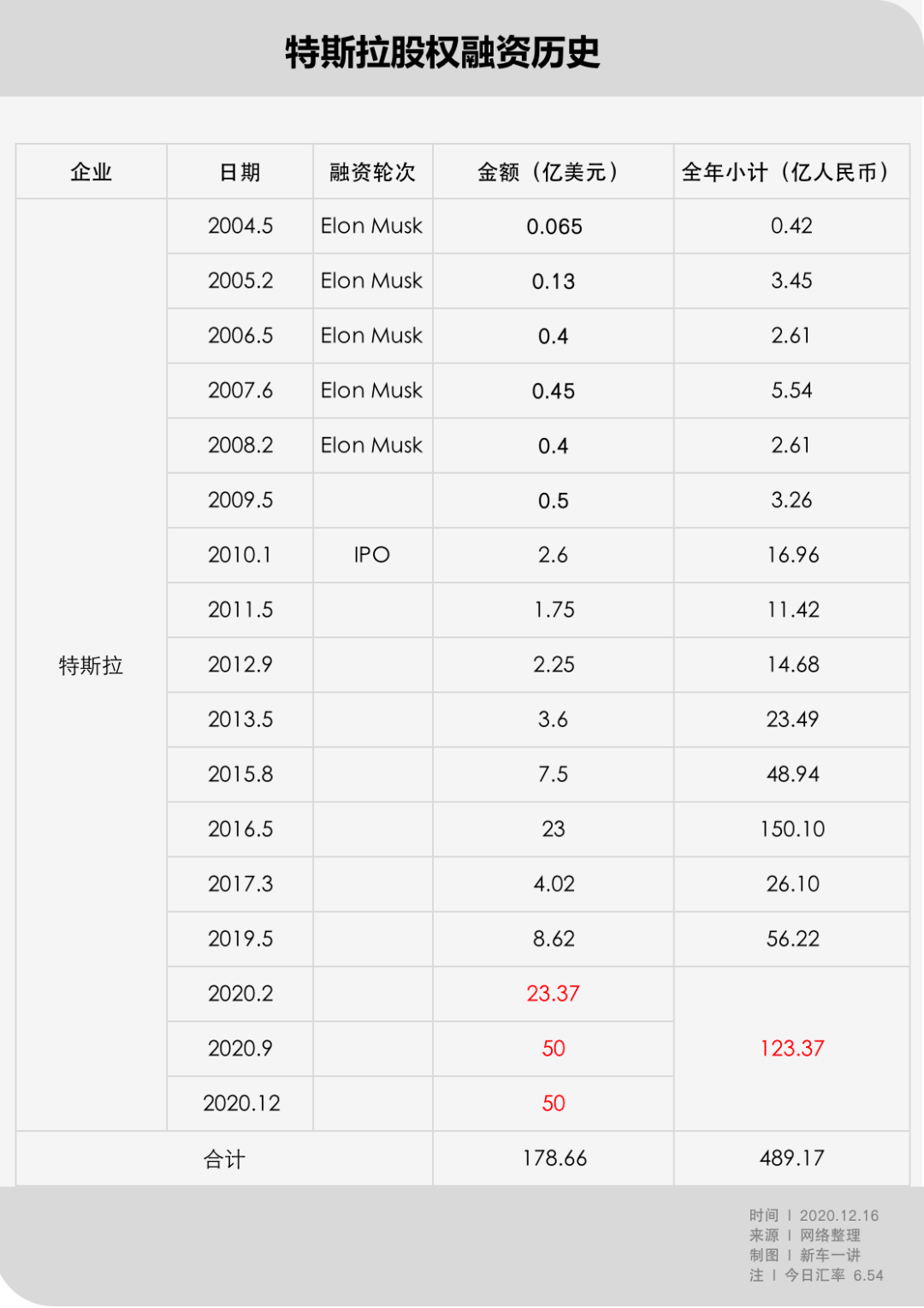
Although Elon Musk is not the true founder of Tesla, judging from the first five rounds of financing for Tesla, he fully subscribed to or led the investment in each of them. The statement by early employees that “there would be no Tesla without Elon” is not unfounded.
Secondly, as of July 1, 2003, Tesla has conducted a total of 17 rounds of equity financing, raising a total of $17.8655 billion, of which $12.337 billion was raised in 2020 alone.
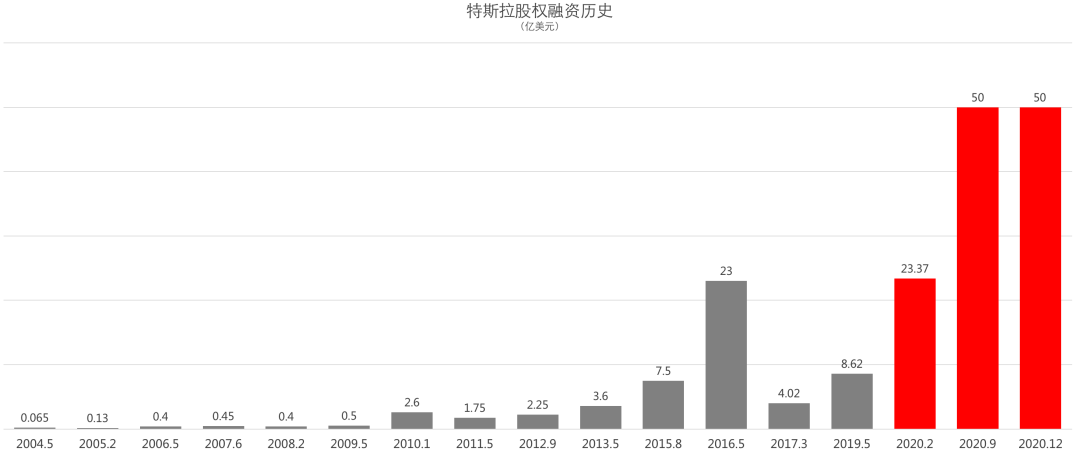
Wait, did Tesla raise more money in 2020 than in the past 16 years combined?
Most of the time, Tesla chooses between equity financing and debt financing, depending on market conditions. In times of financial stress and a weak stock market (which are generally positively correlated), Tesla will choose the higher cost-effective debt financing option. As of now, Tesla’s debt financing has also reached $8.35 billion.
Now let’s look at the Big Three Chinese startups that have emerged to challenge Tesla’s dominance. First, the data: as of now, the three startups have collectively raised RMB 127.484 billion (about $19.7 billion), surpassing Tesla’s cumulative equity financing total.
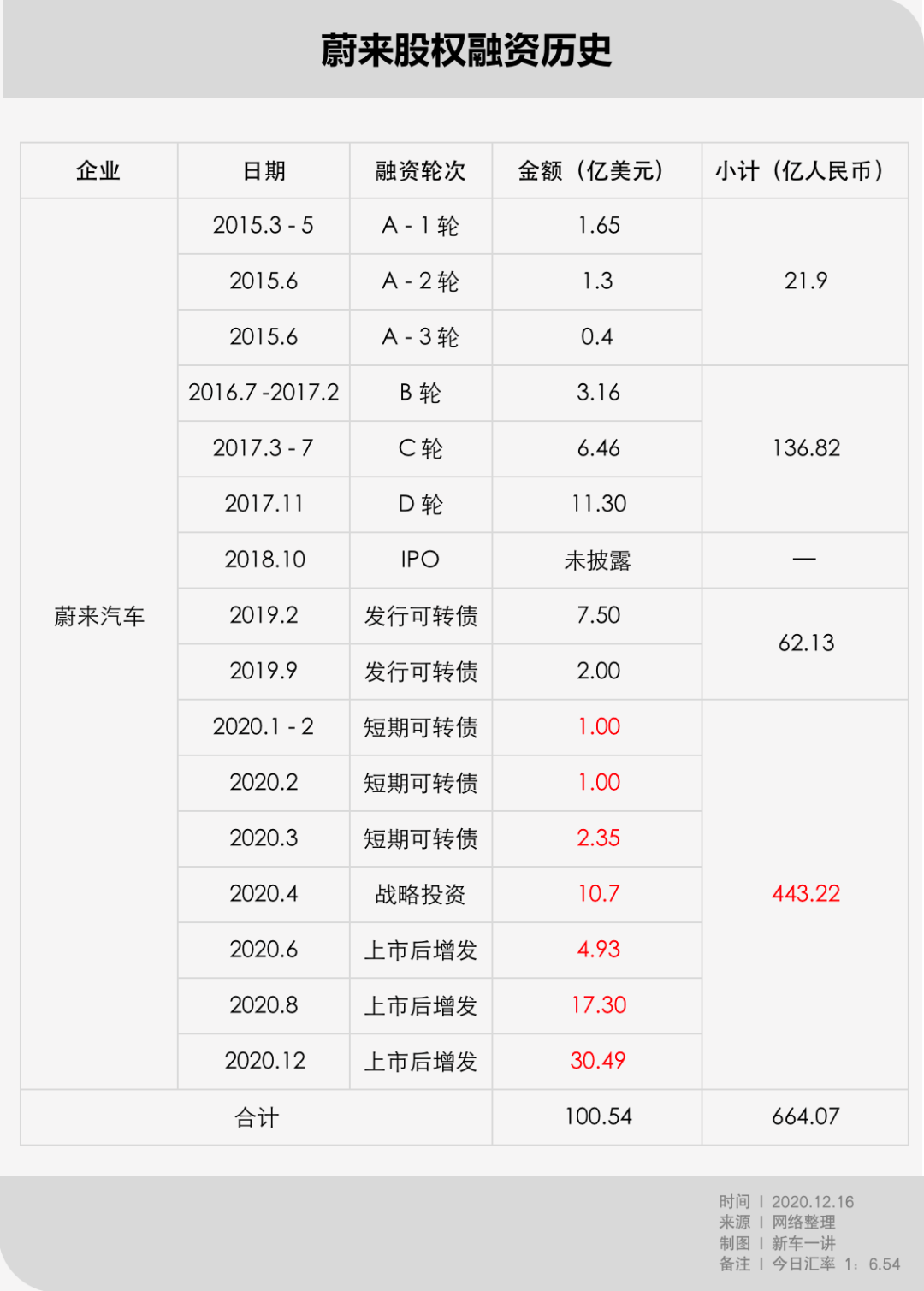
Since its establishment in 2014, NIO has raised a total of approximately RMB 66.407 billion (about $10.3 billion).
This includes NIO’s recent announcement of a new share issuance. NIO completed the fundraising in just three days, with all of the oversubscribed 10.2 million shares fully allocated. Ultimately, NIO’s current fundraising round reached $3.049 billion.
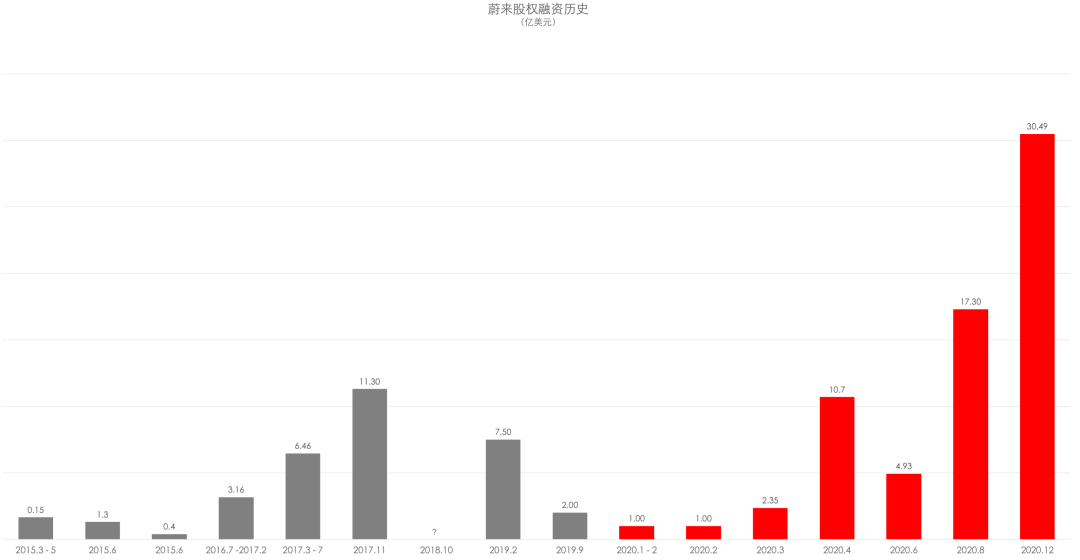 Even without the additional funding raised on December 10th, NIO’s financing scale in 2020 has reached RMB 14.225 billion, which is almost equivalent to its accumulated financing total in the previous four years.
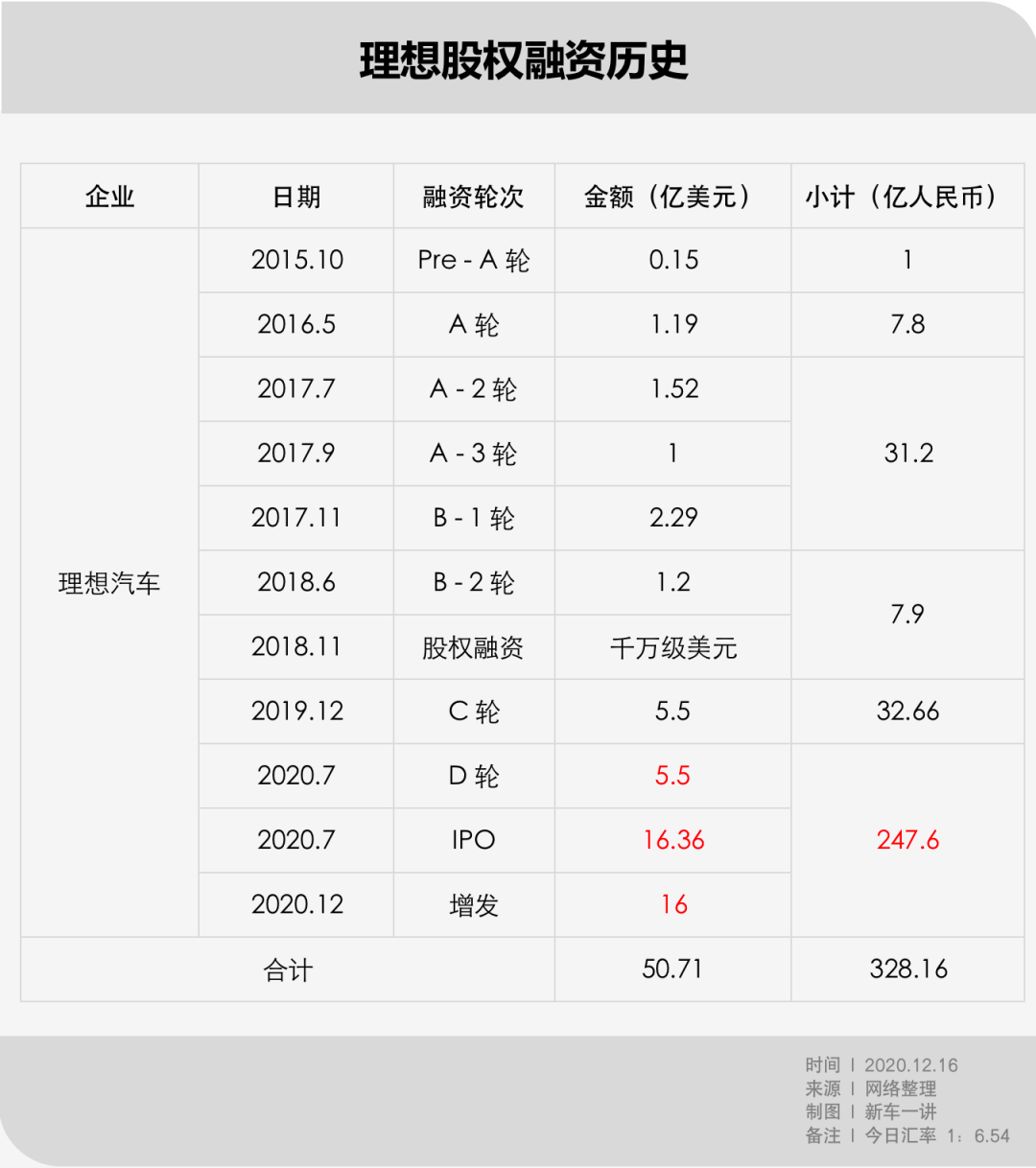
The total financing amount of Ideal Motors is about RMB 32.626 billion, and the total financing amount before its listing was only USD 2 billion. However, just in 2020, Ideal’s financing scale has reached USD 3.786 billion (about RMB 24.754 billion).
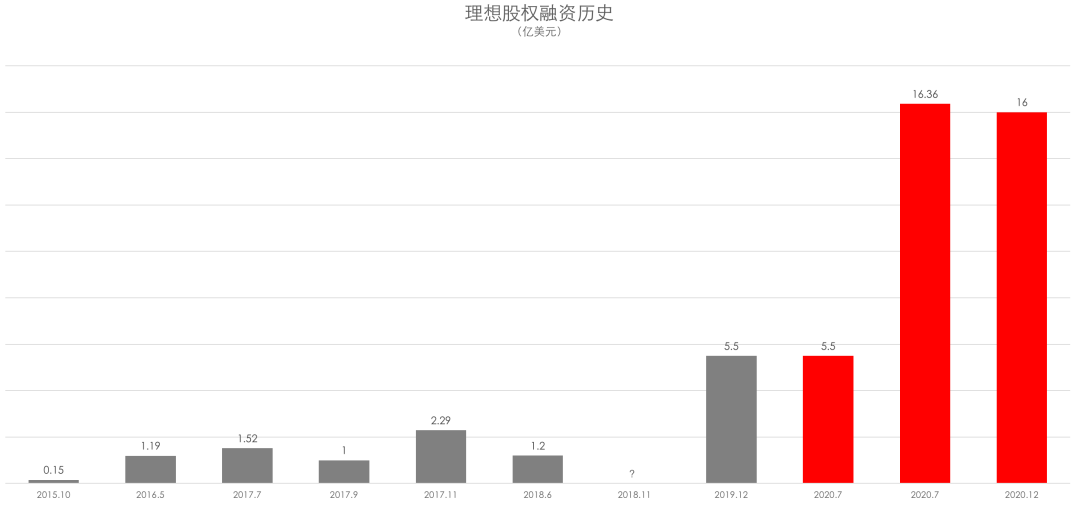
If divided on an annual basis, Ideal Motors’ financing in 2020 accounts for more than half of Ideal’s total accumulated financing amount.
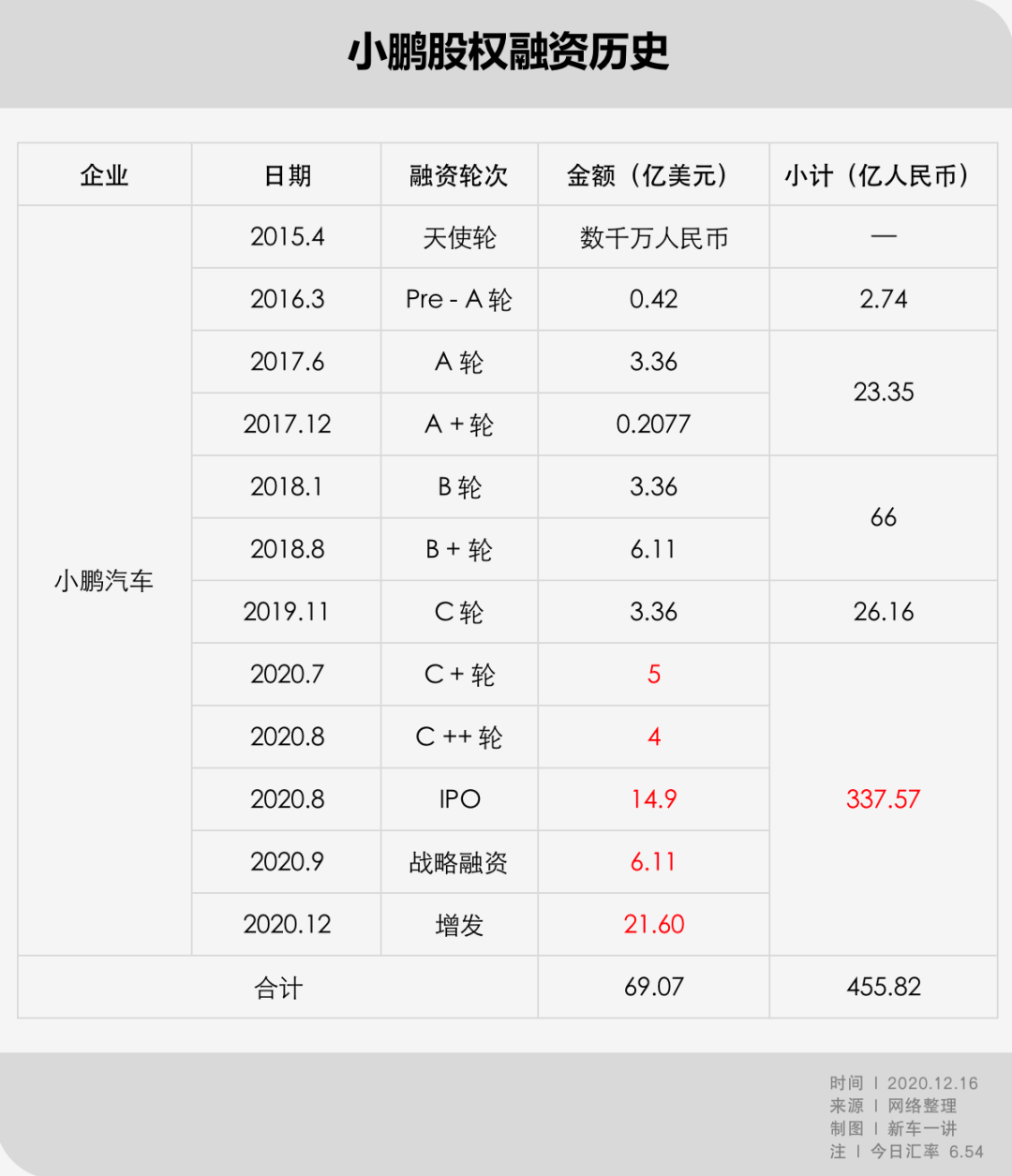
XiaoPeng’s total financing in the past six years was USD 6.16 billion (about RMB 40.336 billion). In 2020 alone, it raised RMB 28.645 billion.
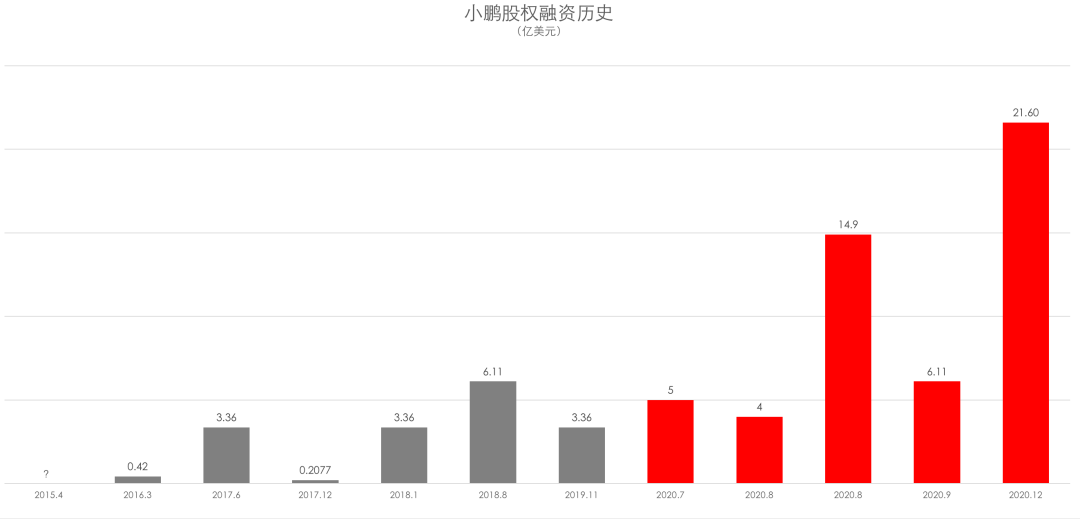
This is consistent with the strategy mentioned earlier by He XPeng, which is to “be brave in taking risks when there is fundraising opportunity.”
Let’s compare the use of funds mentioned in each company’s fundraising announcement:
-
Ideal: Research and development of autonomous driving technology and solutions; research and development of next-generation electric vehicle technology, including high-voltage platforms, high-charge and discharge batteries, and ultra-fast charging; research and development of the next BEV (Battery Electric Vehicle) platform and future models; the balance is used for general corporate purposes.
-
NIO: 60% will be used for research and development of new products and next-generation autonomous driving technology; 30% will be used for sales, service network expansion, and market penetration; the remaining approximately 10% will be used for general corporate purposes.
-
XiaoPeng: Research and development of intelligent electric vehicles, software, hardware, and data; sales and marketing, expansion of sales and service channels and super charging network, expansion into international markets, potential strategic investment in core technology for intelligent electric vehicles.
Consistent with our earlier statement – whether it is the research and development of next-generation models/technology, general corporate purposes, or international markets, it can be summarized in two words: expansion; and the highlight for all companies is: autonomous driving.
Next-Generation Autonomous Driving Technology
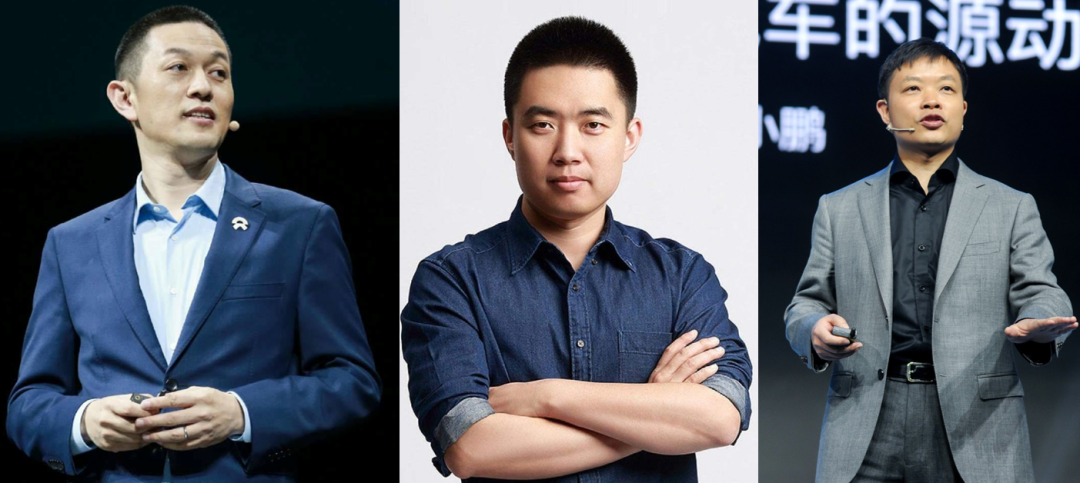
The Importance of Autonomous Driving Technology in the Eyes of Elon Musk, Li Bin, Li Xiang, and He XPeng
Both Elon Musk, Li Bin, Li Xiang, and He XPeng have repeatedly emphasized the importance of autonomous driving technology to their respective companies.
Let’s take a look at their future plans for autonomous driving:
Tesla
Tesla is undoubtedly leading the forefront, which is closely related to its extremely forward-looking strategic layout. Key milestones include:
- In January 2016, the official launch of the FSD autonomous driving chip development project.
- In October 2016, the Tesla Autopilot 2.0 hardware model equipped with 360° visual perception coverage was launched in batches.
- In April 2019, the Tesla Autopilot 3.0 hardware model based on the FSD chip was launched in batches.
- In October 2020, Tesla’s FSD Beta software version was launched in small batches.
At this point, Tesla has finally unleashed the full power of the hardware system that started installing in cars four years ago.
After that, Tesla quickly entered a rapid iteration mode of pushing updates every 5-10 days.
Former Baidu Deep Learning Research Institute founder and Horizon Robotics CEO Yu Kai once said, “The correctness of Tesla’s gradual roadmap is becoming clearer, and car companies must catch up.”
With high computing power support, the entire data closed-loop is Tesla’s online AI evolution system, which compares and predicts “shadow” driver behavior, uploads data to the cloud for training in a few seconds, and generates updated autonomous driving models, and then deploys new OTA updates. Millions of vehicles share road experiences and evolve together.
Don’t underestimate the speed of AI evolution. Next year, Tesla will launch training chips deployed on virtual chips in the cloud, or universal GPU chips. If it is a dedicated chip, it can at least increase tenfold and efficiently absorb big data AI evolution.
Therefore, do not question Tesla’s approach, and follow it. If you don’t follow, it will be quite dangerous in the next five years, equivalent to using weapons from the era of cold weapons and missiles to compete.
Li Xiangs’s Ideal Motors
At the closed-loop development stage of the company from 0 to 1, the first product of Li Xiang’s Ideals Motors, the Ideal ONE, is not superior in the hardware of the assisted driving system. If it comes to the year 2021 or even 2022, this shortcoming will be further highlighted in the fierce market competition.According to Li Xiang, in the new five-year plan from 2021 to 2025, IDEAL will enter a new stage from one to ten. That also explains why IDEAL significantly increased its investment in intelligence in 2020.
On September 15th, IDEAL announced that the former Chief Architect of Magna Electronics, Wang Kai, has taken on the position of CTO with the company, and will be responsible for the R&D and mass production of intelligent vehicle related technologies, including electronic and electrical architecture, intelligent cockpit, autonomous driving, platform development, and Li OS real-time operating system.
IDEAL’s next generation autonomous driving system will adopt NVIDIA’s Orin chip, with a computing power of up to 200 Tops, and the upper-layer algorithm of the entire system will shift towards full-stack self-research.
Li Xiang stated during the Q3 financial report conference call, “By 2021, the IDEAL autonomous driving team will triple in size, and by 2022, a new generation of vehicle architecture will be launched, equipped with upgraded hardware architecture, which can meet the L4 Level autonomous driving capability.”
Xpeng
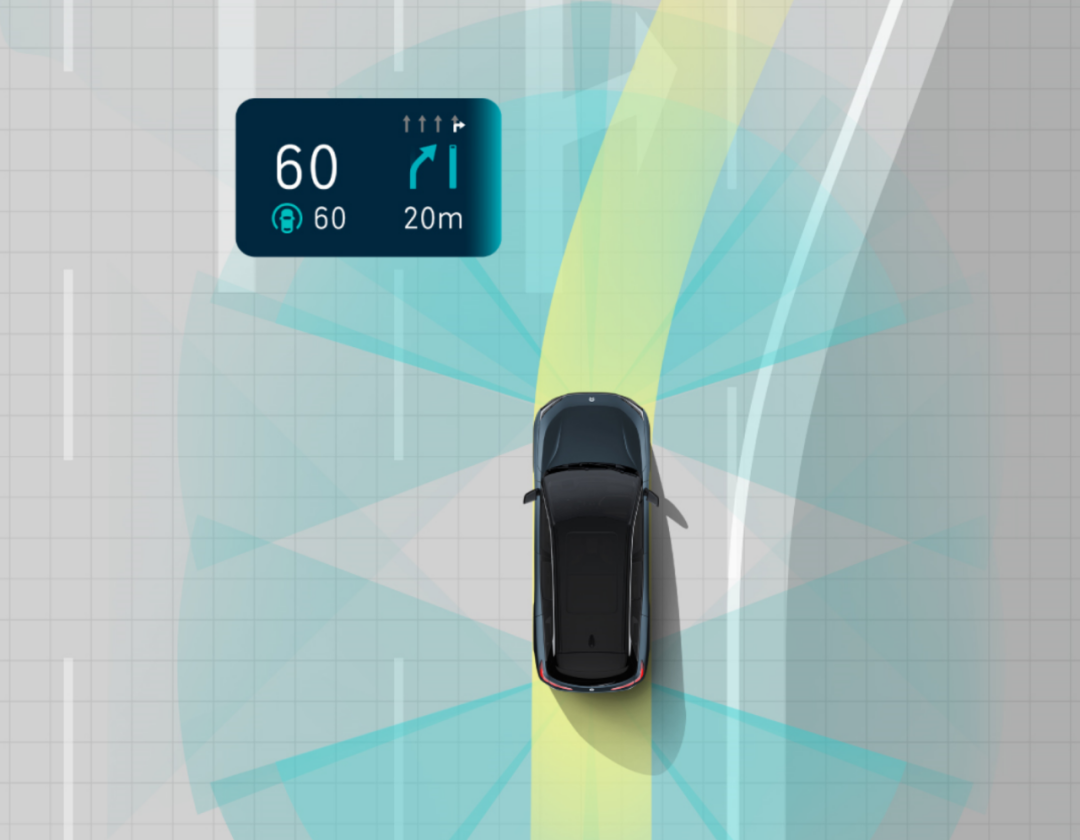
XPeng P7 is equipped with NVIDIA’s Xavier chip, a perception architecture with double 360° coverage of visual radar, and far-superior high-precision positioning capabilities, which makes XPeng P7 far ahead of its competitors in the domestic advanced driver assistance system competition.
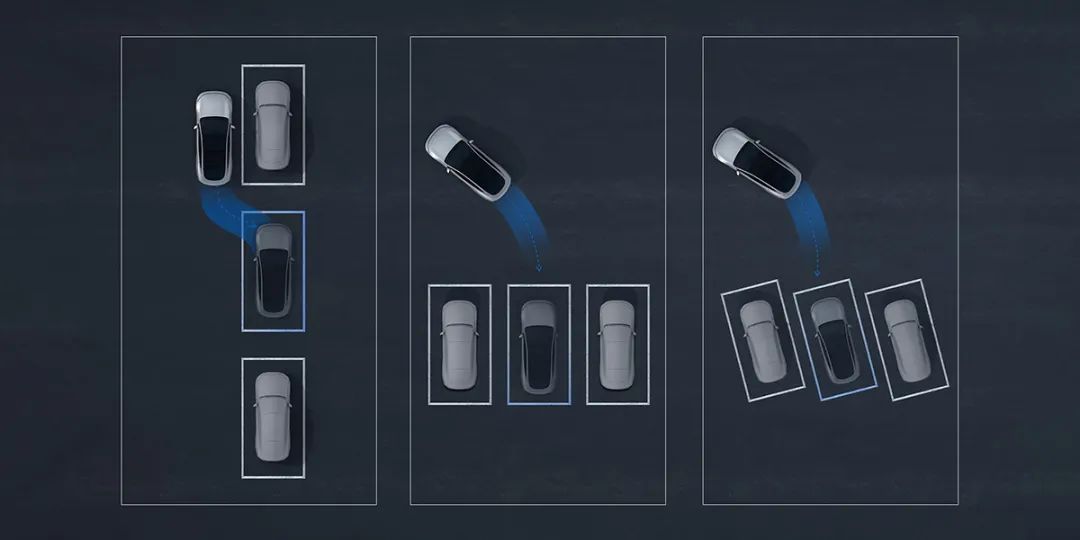
On October 24th, XPeng invited some media, including Xinche Yijian, to test drive the high-speed autonomous navigation function (NGP) which is still in the beta stage. Judging from the performance on site, the full-stack self-research algorithm system demonstrated high maturity.
According to XPeng, in the next generation system’s sensor architecture, XPeng will further enhance the system’s perception ability of the vehicle’s surrounding environment by installing a LIDAR.
He XPeng said, “This vehicle will be the world’s first production vehicle equipped with LIDAR.“
NIO
NIO’s autonomous driving strategy was once in an extremely passive state. In November 2019, under financial pressure, NIO signed a cooperation agreement with Mobileye to entrust the R&D of the automatic driving software and hardware of the next-generation platform to Mobileye.
Entering 2020, with NIO’s overall company operations and financial capabilities bottoming out, NIO’s autonomous driving strategy has undergone a complete reversal.
Sources revealed that Li Bin attaches great importance to NIO’s next-generation autonomous driving system, and has established an autonomous driving confidential group internally.Now, NIO’s autonomous driving department has two assistant vice presidents. They are veterans of the autonomous driving team, Zhang Jianyong, and Ren Shaoqing, former executive director of R&D at Monenta who joined NIO in August this year. Both report directly to NIO CEO, Li Bin.
Li Bin has publicly stated that in the long term, “There are four aspects to improving the overall ability of the entire autonomous driving system: chips, systems, algorithms, and data. We must establish full-stack capabilities.”
NIO has recruited Bai Jian, former general manager of Xiaomi’s chip and forward-looking research department, as the vice president of hardware for its autonomous driving department, and has initiated the development of autonomous driving chips. From this perspective, NIO’s autonomous driving self-research strategy is most similar to Tesla’s.
From the plans of the three companies, although they have not yet stepped out of using third-party solutions, there is a clear signal of “self-research”.
All three companies will start with full-stack algorithms and gradually transition to self-research of the entire software system, and even further into some hardware self-research. This process will span 5-10 years.
This long-cycle interdisciplinary technology transition is not only a challenge to the company’s capital, research, and engineering capabilities, but also a huge test for the management, headed by the founders and their long-term strategic planning and foresight in technology.
This is just the beginning.
This article is a translation by ChatGPT of a Chinese report from 42HOW. If you have any questions about it, please email bd@42how.com.