


NIO Proposes Sharing Swap Network and BaaS with Automakers at Power Day
Last night, I drove my NIO to Dishuihu for the NIO Power Day event. After checking into the hotel and swapping a battery at the nearby second-generation swap station, I returned to my room and lay in bed reflecting on the day.
As a user without a home charging pile who could not afford the Energy As You Go service, my experience with the compact NIO EV over the past year has been one of "bitterness giving way to sweetness." When I first took delivery of the car, the nearest swap station was 18 kilometers away at Qichebolangongyuanzhan. Later, it moved to about 5 kilometers away at Shengnuoyazhan. Now, it is just 300 meters away at Hengjiuyouyichengzhan. By NIO community standards, I have essentially become a resident of an "electric zone house." On another note, I have personally witnessed the development of NIO Power over the past year.
To this day, charging remains the primary concern for potential electric vehicle buyers. However, someone must solve this problem. Beyond infrastructure built by third-party operators such as Guojiadianwang, Teld, and Xingxingchongdian, I believe that original equipment manufacturers (OEMs) should also participate more actively, as this is fundamental to increasing market share.
Tesla and NIO have set a good example for the industry. So, what exactly did NIO unveil at today's NIO Power Day? Let us review the highlights below.
01Charging > Range
Recently, with rumors circulating that NIO would establish a new brand and launch the Gemini model next year, combined with the ET5, which I consider to have little suspense left in it, I assumed this year's NIO Day would certainly be rich in information. Did NIO Power Day intend to unveil the third-generation battery swap station or new high-power charging piles?
In fact, neither of those expectations materialized. Looking back at the entire event, it felt more like a presentation and "sales pitch" from NIO to the outside world regarding NIO Power.
"To solve the range and charging anxiety associated with electric vehicles, we must start by analyzing user scenarios. A high-quality service system is a combination of measures designed to meet users' diverse needs across different scenarios," Qin Lihong explained regarding the foundational thinking behind NIO Power's establishment. In simple terms, I believe their goal is to achieve 'seamless' energy replenishment.
When discussing energy replenishment scenarios, two factors are inevitably involved: location and time. According to data from NIO's approximately 120,000 delivered owners, urban driving accounts for about 60%, suburban travel for 30%, long-distance suburban travel for 6%, and intercity travel for roughly 4%. Among these, most trips cover distances between 200 and 400 kilometers.
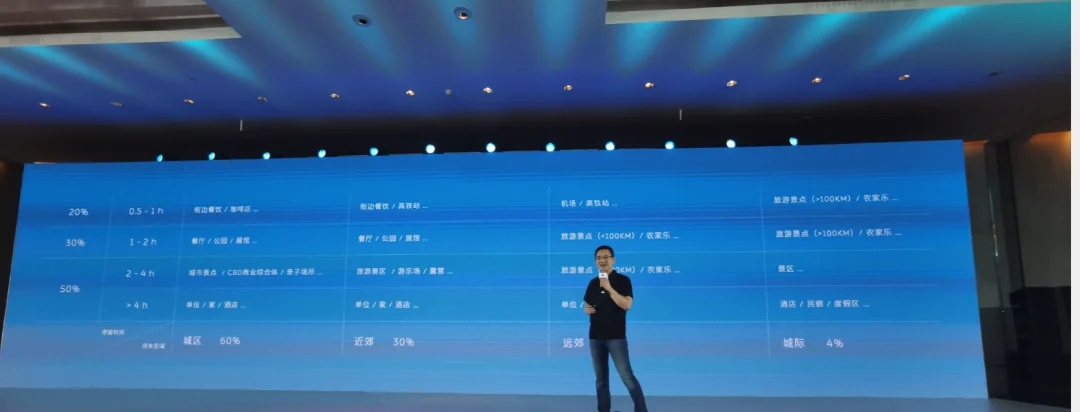
Next, these are further divided by estimated dwell time into 0.5–1 hours, 1–2 hours, 2–4 hours, and over 4 hours. The reason for this classification is that when the two axes intersect, it becomes clear that most long-term EV users can easily deduce their specific usage scenarios.
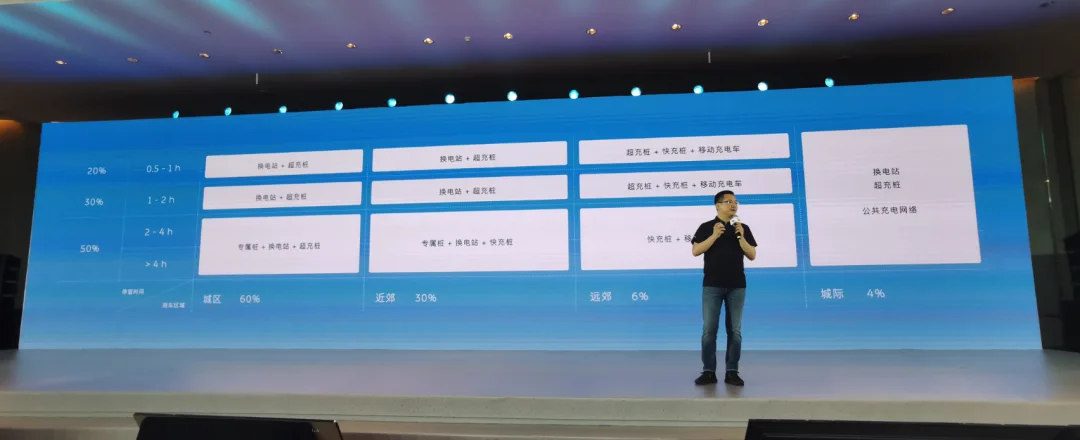
After identifying user scenarios, NIO matches corresponding energy replenishment resources based on cost-benefit analysis. This constitutes NIO Power's deployment plan. While I find this calculation rule straightforward and accessible, the real challenge lies in the requirement for automakers to make continuous investments and deploy richer energy replenishment measures to address varying user scenarios. Therefore, NIO Power's solution is described as 'vehicles, chargers, stations, people, and cloud.'
In short, this refers to mobile charging vehicles, charging piles, battery swap stations, 'power delivery specialists,' and cloud-based big data. I should briefly mention the early viral 'nanny car' incident.
Because the historical ES8 once "burned 35 to 40 liters of diesel per 100 kilometers," for many people, this was a significant negative. But frankly speaking, this was actually a major factor that prompted me to delve deeper into NIO. It needs to be clarified that it is not that I found such an electric vehicle cool; rather, what struck me as incredible was that in a commercial society, there would be an automaker willing to provide user services regardless of cost. This left me somewhat disoriented at the time, having just finished "tearing apart" (arguing with) a 4S dealership.
Of course, mobile charging vehicles have not only generated significant online traffic for NIO in the early stages but also provided essential energy replenishment for many users in relatively extreme scenarios.
02Is Your Home an 'Electric Zone' Property?
Aside from mobile charging vehicles, a distinctive feature of the NIO Power system is its battery swap stations, which have so far completed nearly 3 million swaps and delivered over 130 million kWh of energy. Shen Fei, Vice President of Energy at NIO, shared the story behind these stations with us.
Shen Fei explained that the initial concept for swap stations involved building large facilities at the four corners (north, south, east, west) of a city, storing 2,000 to 3,000 batteries. The plan was to collect empty batteries during the day, charge them using off-peak electricity at night, and distribute them to every corner of the city the next day. Fortunately, thanks to computers, they abandoned this idea after cost calculations showed it wasn't viable.
The concepts of decentralization and distribution from the book Losing Control then inspired their current thinking on swap stations. They quickly shifted to more compact, small-scale swap stations, which reduced costs and better matched the pace of a startup. However, by pursuing extreme compactness too aggressively, the first-generation stations could not increase operational capacity by adding more battery reserves. This became a significant liability for NIO last winter when the number of owners surged.
Low winter temperatures reduced vehicle range, driving a surge in battery swap demand. At the same time, cold weather slowed charging efficiency. As a result, many NIO owners in the Jinghu region experienced long queues at swap stations last winter. Beyond the queues, the experience was particularly poor on rainy days, especially when low temperatures combined with rain. Every time I stepped out, I would tiptoe ('Lingbo Weibu') and rush into the staff's work vehicle with all speed to seek warmth from the heater. I believe many others have had similar experiences.
Therefore, when designing the second-generation swap station, NIO increased the maximum battery reserve to 13 units. This improved operational efficiency and added automatic parking functionality, aiming to allow users to swap without leaving their cars. In fact, part of the driving force behind NIO Power’s development has come from user complaints.
Shen Fei, the 'straight-talking boy,' also addressed the issue of swap station failure rates that concerns NIO users. He acknowledged that with over 10,000 swaps per day and continuous operation, mechanical failures are inevitable. Currently, the swap process takes about three minutes. Moving forward, they will focus heavily on improving reliability to reduce failure rates. As someone who was 'forced' to walk half an hour around the Auto Expo Park due to a previous incident, I can say: I really don’t want to visit the park!
Shen Fei also shared his views on whether battery swapping targets consumers (to C) or businesses (to B). He argued that while it is undeniable that the to B market can quickly achieve economies of scale, the to C market has a greater need for battery swapping. This is primarily because a significant portion of users lack fixed parking spaces, private cars are used more frequently for long-distance travel, and they are on the road for longer hours.
Against this backdrop, they first selected a more reliable bolted structure to ensure a longer service life and structural safety. Second, the location of battery swap stations must be close to users. Regarding the new term "electric zone housing" coined by the NIO community, NIO officially defined it today as "residences within 3 kilometers of a swap station." As of today, approximately 29% of users live in such electric zone housing.
Finally, Shen Fei also set a small goal: to have 90% of NIO users utilizing the electric zone housing by 2025.
Of course, here is a little story to share with everyone. At the launch ceremony for NIO's first second-generation swap station in Beijing, the live-streaming vendor advised NIO to use pre-recorded footage because the vendor feared that a malfunction at the swap station could cause the "live stream to go wrong."
NIO rejected this suggestion, reportedly because it "did not align with their values." However, as the supplier noted, a small vehicle did indeed flip over during the live broadcast. It got slightly stuck for a moment; excluding the time spent entering and exiting the spot, the entire process took about 6 to 7 minutes. Fortunately, the full procedure was completed successfully, so it can be considered a minor incident.
But I believe all of this is merely a prologue.
03This Is Their True Objective
Beyond the foundational charging infrastructure, NIO also placed emphasis on its cloud-based content, such as calculating power replenishment demand through big data to ensure higher service efficiency and real-time monitoring of each vehicle's battery system for early alerts. However, I do not believe these aspects are particularly central.
As I mentioned earlier, NIO Power Day was not just an informational briefing; it was also a "sales" event. To understand why, see the image below.
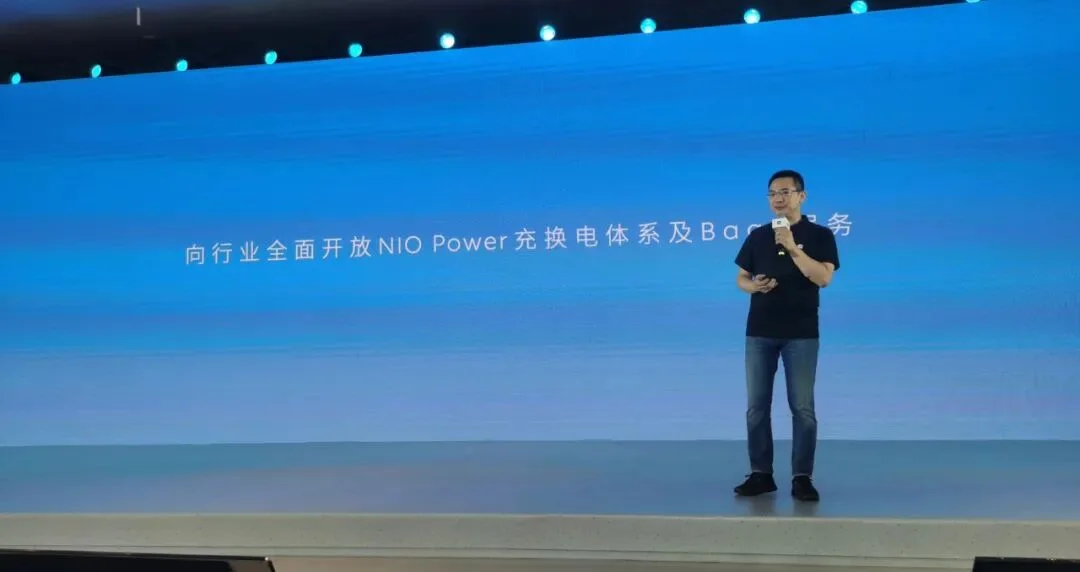
This is likely the first time NIO has officially communicated to the industry that both NIO Power and its Battery-as-a-Service (BaaS) offerings are available not just for consumers, but also for other automakers. Aside from this, William Li casually mentioned it during the launch event for the first second-generation battery swap station.
William Li and Qin Lihong have mentioned more than once that "over the years, regarding the sharing of battery swap stations, we have had discussions with various peers to varying degrees." Judging from the current situation, it is likely that these discussions ultimately led nowhere. By raising this issue now, NIO may be hoping to disseminate the message through the media.
I will take up this challenge.
Objectively speaking, I believe that for other automakers to cooperate with NIO Power would be a difficult decision. The difficulty lies not merely in the costs associated with modifying vehicle chassis to accommodate battery swapping. If another automaker were willing to cooperate, NIO might even share its design blueprints to assist in the necessary structural adaptations.
From the current situation, energy-related collaborations include Ford discussing shared use of NIO Power superchargers with NIO, and XPENG purchasing NIO’s vehicle pickup/delivery and tire repair services. It should be noted that these brands are actually procuring services that are relatively peripheral within NIO Energy and Service Worry-Free. While cost factors may play a role, ultimately I believe there is some underlying concern along the lines of: 'You earn money from me, yet you help expand my scale.'
In the short term, automakers partnering with NIO swap stations can save significant infrastructure costs and quickly improve the charging experience for their users. This is undoubtedly beneficial for sales. Qin Lihong noted today that the number of swap stations in highway service areas by year-end will be four times higher than at the beginning of the year. This may help automakers increase sales volume and achieve scale.
However, such cooperation does raise concerns among automakers of being "held hostage." If high-power fast charging becomes the mainstream energy replenishment method in the future, a problem arises: the commercial value of battery swapping would significantly diminish. As Qin Lihong stated, "If that really happens, I'll simply dismantle the swap stations and convert them all into supercharging piles. We already have the land and capacity." In this scenario, the impact on everyone remains manageable. Over the past few years, these partnerships have addressed users' energy replenishment pain points, achieved scale, and gained a certain degree of market presence. For cooperating automakers, they essentially become just one player in NIO's battle for land and capacity. The key consideration for these automakers is whether the costs associated with partnering with NIO on swap stations can be covered by the profits generated from creating differentiated products.
Yet, there is a worrying possibility: if battery swapping remains a critical energy replenishment measure for a long time to come, it will intensify the unease among cooperating automakers. After all, collaboration implies that their products must differ somewhat from NIO's current lineup, putting them at a disadvantage in product planning. Moreover, to any observer, this partnership hardly appears equal.
Nevertheless, I believe NIO has realized that relying solely on NIO Power may not be attractive enough for automakers. This time, they proactively mentioned that Battery as a Service (BaaS) is also open to other automakers. While I still struggle to fully accept the purchasing logic behind BaaS, the data speaks for itself. William Li mentioned during an earnings call that NIO's BaaS user base has exceeded 50%. Clearly, lowering the barrier to entry for vehicle purchase holds significant appeal for consumers.
In conclusion, collaborating with NIO brings short-term benefits, but long-term risks remain unknown.
Final Thoughts
After the live broadcast ended, there was a Q&A session. During this segment, NIO PR representative Ma Lin drew parallels between the logic of building swap stations and JD.com's decision to build its own logistics network. Regarding JD.com's logistics, I feel compelled to share some thoughts, given my past connection with Liu Qiangdong—back then, we were considered 'brothers.'
When JD.com decided to build its own logistics system, it faced strong opposition from within the company, public opinion, and the investment community. Given the massive investment required and the prevailing trend advocating for asset-light operations at the time, JD.com carved out a unique path amidst skepticism.
In early interviews with the media, Liu Qiangdong repeatedly asked, "So what if we burn cash? Didn't we create value? Didn't we enhance the customer experience?" Looking back from today's perspective, JD.com's self-built logistics system indeed became one of its core competitive advantages.
At JD.com Group’s fifth Old Employee Day last year, Liu Qiangdong again praised the company’s logistics system in an internal letter, reaffirming the correctness of its decision to build its own logistics network. He stated, "A product or service that fails to solve industry pain points has no commercial value; it is the first pig to fall after the wind blows."
Looking back at NIO Power, I believe they are walking the right path by addressing these industry pain points.
Written by: Mai Baicai de Huang Laoban Edited by: Daji