


NIO's Third-Generation Battery Swap Stations: A Strategic Pivot for Scale and Grid Integration
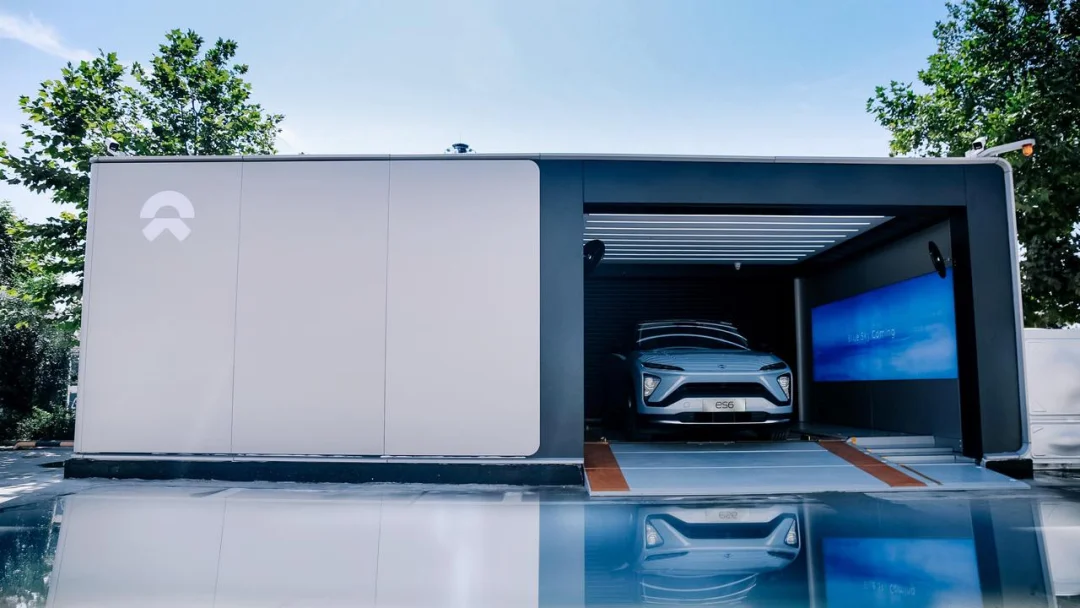
NIO reported on April 3 that users have completed a cumulative 20 million battery swaps, with more than 45,000 services provided daily. On average, one vehicle completes a swap every 1.9 seconds.

This data partly validates a statement by Shen Fei, Senior Vice President of NIO Energy: many users chose NIO vehicles specifically for the battery swap capability. Indeed, the swap infrastructure has significantly influenced the purchasing decisions of many NIO owners.
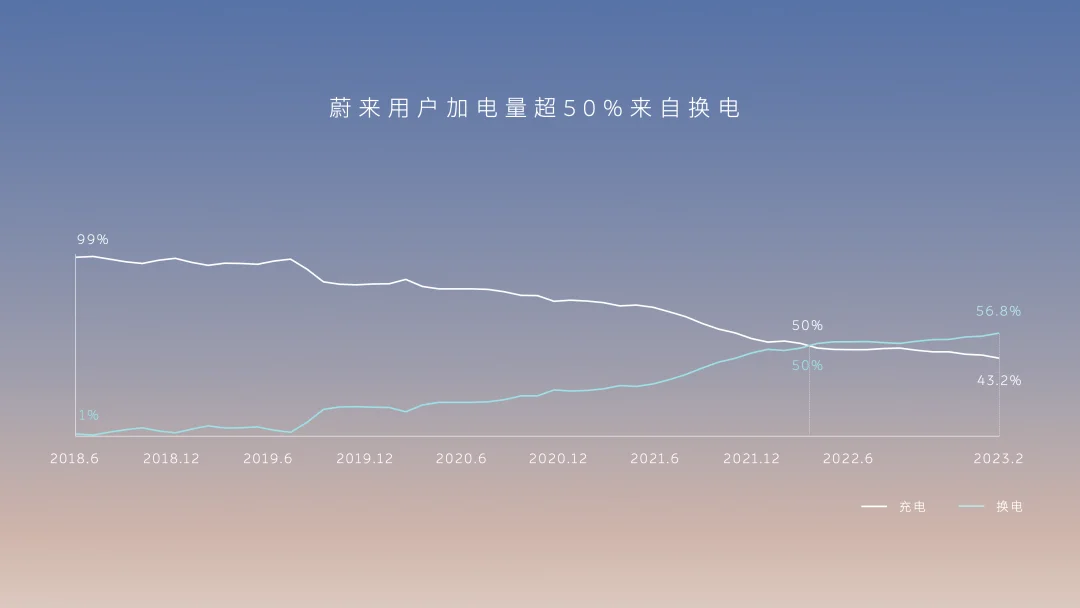
Regarding energy replenishment, over 50% of the electricity used by NIO owners comes from battery swapping. The chart also shows a clear trend: the proportion of swaps among NIO users is continuously rising. In terms of penetration, approximately 80% of NIO users have tried the battery swap service.
In fact, nearly five years have passed since NIO opened its first battery swap station in Nanshan District, Shenzhen, on May 20, 2018. Over this period, NIO’s energy management business has evolved into a structured company known as NIO Power.
Notably, on March 28, NIO announced the official launch of its third-generation battery swap stations. The first station, located next to the Shangri-La Hotel in Haikou, Hainan Province, is now operational, and the initial batch of ten third-generation stations will go live simultaneously across ten locations nationwide.
As the third-generation swap station rolls out, we sat down with Shen Fei, Senior Vice President of NIO Energy, and Yang Chao, Head of Product Development at NIO Energy. The conversation revealed a key insight:
The swap station is merely a strategic pivot within the broader ecosystem. Through this pivot, NIO Power aims to unlock significant future potential.
01What are the highlights of the third-generation NIO swap station?
For NIO, which emphasizes system integration, the swap station is a critical component of NIO Power and is closely tied to the company’s product roadmap. We examined improvements in three areas—user experience, compatibility, and perception—to outline how the third-generation station has evolved and the logic behind these upgrades.
In terms of user experience, 'comfort' and 'speed' are the two defining keywords.
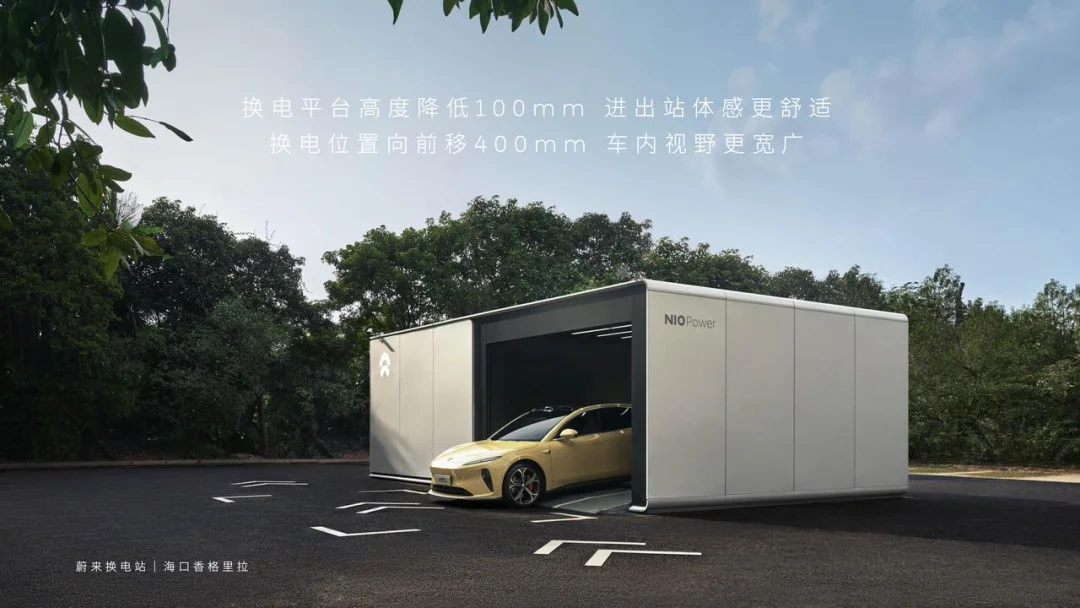
NIO owners are likely familiar with the slight incline required to enter and exit swap stations. The third-generation station lowers the swap platform height by 100 mm, reducing vehicle bounce during entry and exit. This adjustment also benefits models with lower ground clearance, such as the ET Xilie series, and vehicles without air suspension. Additionally, the swap position has been moved forward by 400 mm, providing a wider field of view for occupants during the swap process. These changes represent the third-generation station's enhancements in comfort.
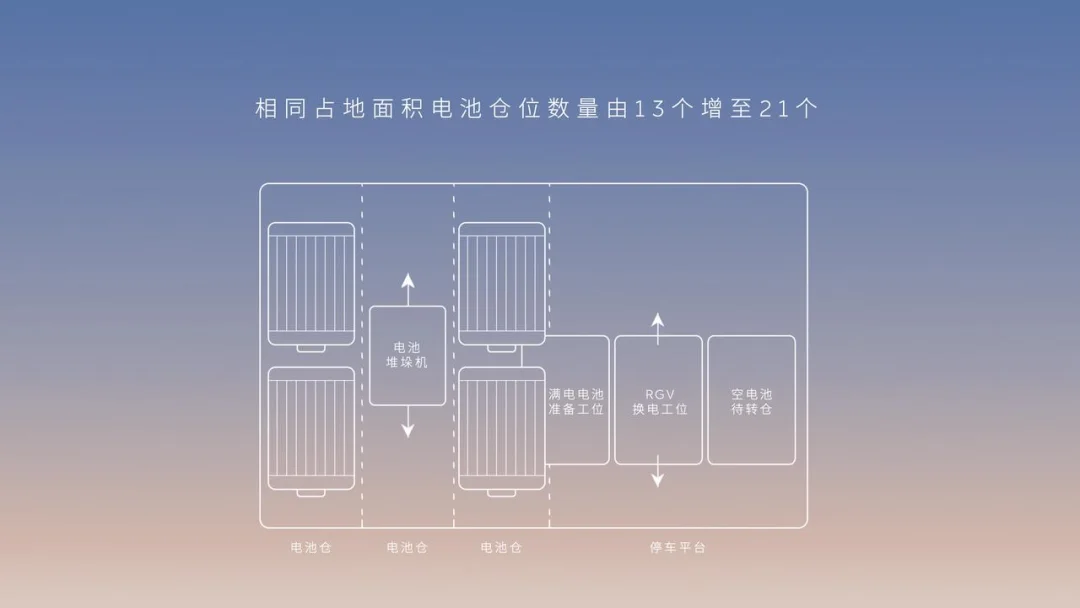
The term "more convenient" refers to the improved battery swap speed at third-generation stations. NIO has added a new bay on the right side of its third-generation stations. Compared to previous workflows, after the depleted battery is removed, it is placed in this new space while the fresh battery from the left is moved directly into the central installation slot, eliminating the wait time for shifting the battery leftward. Furthermore, the station synchronizes the swap operation with certain self-check procedures, further reducing idle time during inspections.
From a results perspective, the single-vehicle battery swap time at third-generation stations has been reduced from 5 minutes and 40 seconds to 4 minutes and 40 seconds.
Notably, in response to numerous owners reporting that "the current battery swap failure rate is too high," Shen Fei and Yang Chao provided answers on site:
"This software update will bring significant optimization, essentially resolving 99% of the issues. We have also built a dedicated battery swap station at our Hefei factory for colleagues responsible for testing new models."
Additionally, while occupying the same footprint as second-generation stations, third-generation stations have increased their battery storage capacity from 13 slots to 21. Battery charging power has risen by 50%, and these stations now support 800 V electrical architectures. The faster charging speed at the station end effectively reduces waiting times for swaps.
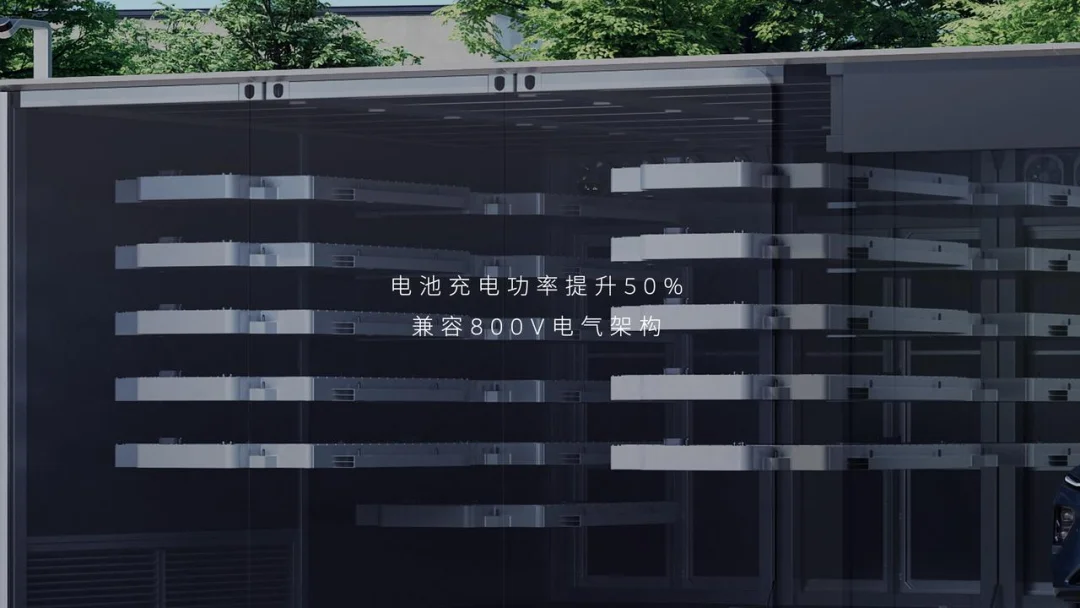
The "compatibility" of third-generation stations lays the groundwork for NIO's multi-brand strategy.
During a previous exchange session, Shen Fei explicitly stated that "new brands can 100% share NIO's battery swap system," which strongly implies that the new brand codenamed "Aerbeisi" will be capable of battery swapping.
According to current plans, NIO aims to deploy 1,000 third-generation battery swap stations by the end of 2023, comprising 400 on highways and 600 in urban areas. Even if only these third-generation stations are compatible with battery swapping for Aerbeisi models, this fledgling new brand will possess charging resources that competitors find difficult to match.
Meanwhile, the third-generation swap station achieves a high degree of flexibility in its mechanical structure. The compatible wheelbase range has expanded from 2,800–3,100 mm in the second generation to 2,800–3,300 mm, while the maximum supported outer wheel track width has increased from 2,500 mm to 2,800 mm. The ET7 currently features a wheelbase of 3,060 mm; if NIO plans to release flagship models with even longer wheelbases, first- and second-generation stations would not be effectively compatible.
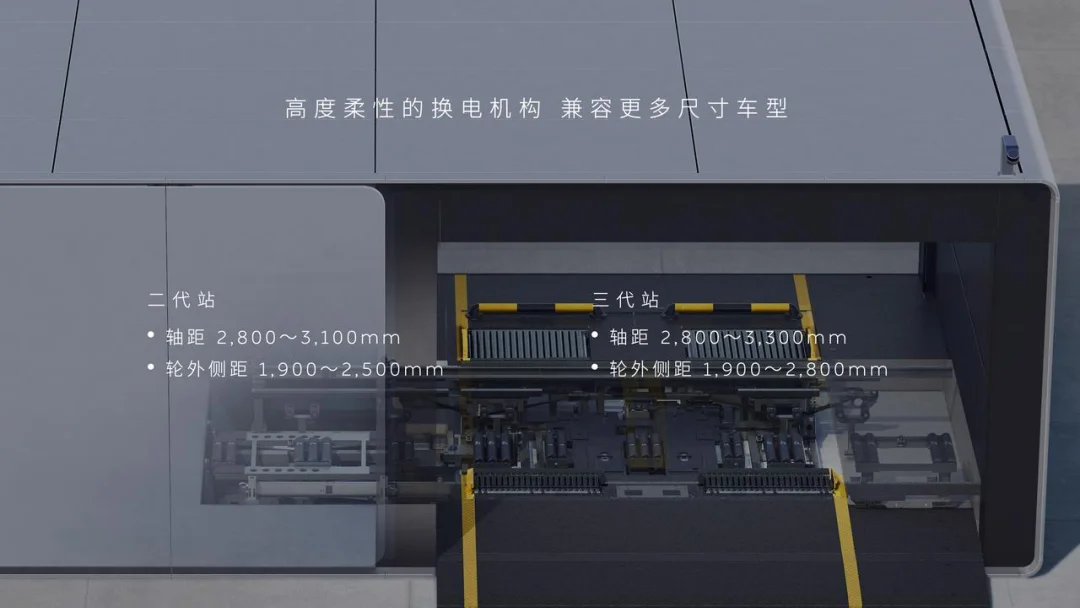
Speculation arises from prior reports suggesting that the NT 3.0 Pingtai’s first product, the NIO ET9, will serve as the family’s ultra-luxury flagship. Rumors have even claimed it targets Maibahe. The fact that third-generation stations support longer wheelbases seems to corroborate this speculation.
Regarding "perception capabilities," many recall NIO’s announcement at NIO Day that third-generation stations will be equipped with two LiDAR units and two Orin X chips, delivering a total computing power of 508 TOPS. It is important to note that NIO does not plan to equip every third-generation station with this hardware configuration.
The purpose of installing Orin chips and LiDARs on swap stations is twofold. First, NIO intends to enable "pilot swapping" at highway service area stations in the future; this hardware provides supplementary perception and computing power. Second, it offers perceptual blind-spot coverage for first-generation platform vehicles and sub-brand models, which have weaker perception capabilities, aligning with broader product planning strategies.
More importantly, NIO hopes to increase the number of unmanned stations by enhancing station-side perception capabilities, thereby reducing operational costs for swap stations.
Thus, the upgrades to third-generation stations are largely about "laying the groundwork for the future."
Whether it is greater compatibility or enhanced station-side perception, NIO continues to uphold the unique "charge-and-swap" advantage for both the NIO brand and its sub-brands, while exploring how to unify the battery-swap experience across different platforms and brands.
02What Imaginable Space Can This 'Fulcrum' Leverage?
Integrated Charging and Swapping: Doubling Efficiency
As ultra-fast charging becomes more widespread, does the convenience of battery swapping become less significant?
Under 42HOW Auto's report on NIO's third-generation swap stations, many readers posed this question.
Battery swapping is indeed a strong label for NIO, but many overlook that NIO also operates the largest network of self-built public charging piles among automakers: NIO's total number of public charging piles has reached 14,405. The point here is that NIO's "energy replenishment system" does not rely solely on swap stations; "integrated charging and swapping stations" is the accurate term.
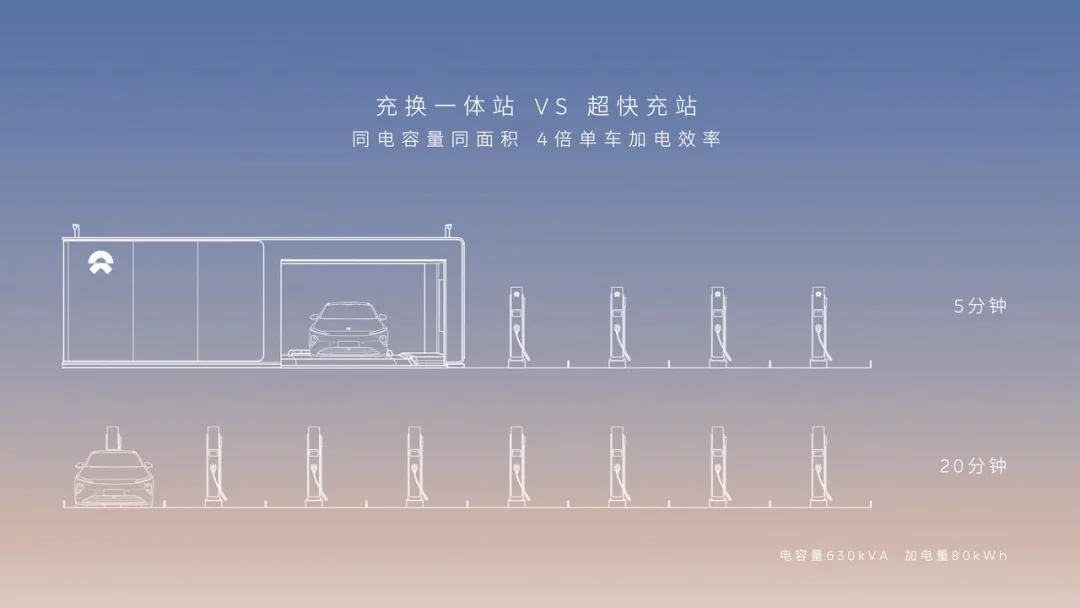
Furthermore, under conditions of equal electrical capacity and area, the energy-replenishment efficiency of an "integrated charging and swapping station" far exceeds that of an ultra-fast charging station. We examine this from two perspectives: "single-vehicle power-up efficiency" and "maximum service capability."
With an electrical capacity of 630 kVA, one can choose either a configuration of one swap station plus four supercharging piles, or eight supercharging piles. For a single vehicle, using battery swapping to replenish 80 kWh takes five minutes, whereas using a supercharging pile takes 20 minutes.
Starting from the perspective of "maximum service capacity," a combined model of battery swap stations and superchargers can serve approximately 16 vehicles per hour at full load, whereas a pure supercharging station serves about 8 to 10 vehicles per hour. This represents an efficiency increase of 1.6 to 2 times.
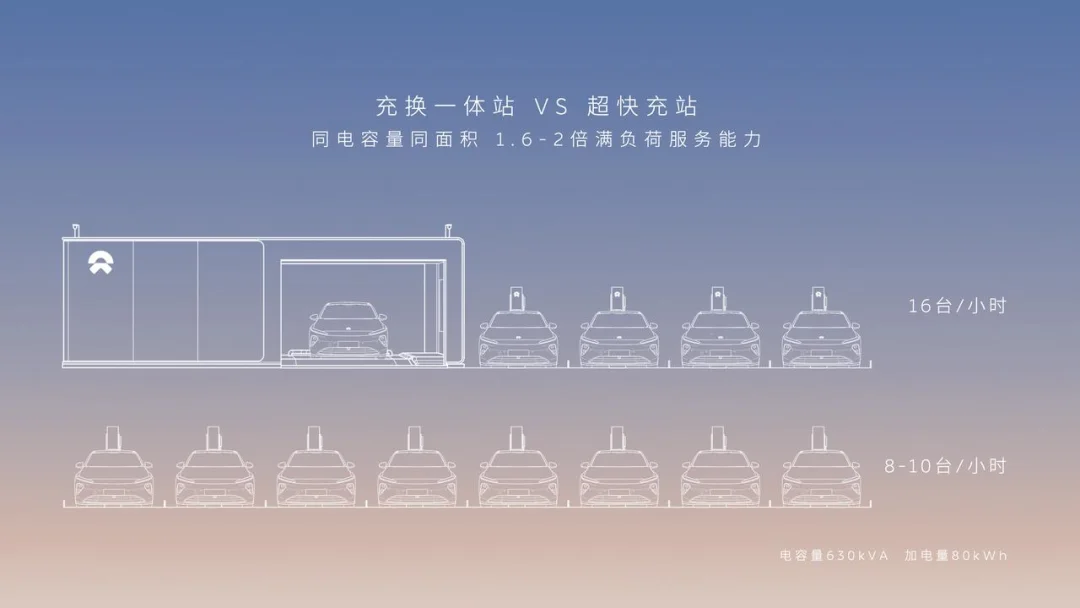
This is easy to understand. Charging piles remain idle when not in use, while battery swap stations keep batteries in their storage bays continuously charging. On one hand, for energy service providers, higher utilization of electrical capacity leads to higher returns; on the other hand, in extreme cases where there are long queues for swapping, the time required to charge at a 500 kW supercharger may even be shorter than the queue wait time.
If a vehicle joins the swap queue during the charging process, the battery currently on the charger has already received some charge. After being swapped into the station, the remaining charging time is significantly reduced. Through this flexible combination, NIO maximizes the utilization rate of electrical capacity.
Swap stations can also freely combine superchargers based on local electrical capacity reserves. Depending on the approved capacity ranging from 630 kVA to 2,000 kVA, a single station can be equipped with 4 to 20 superchargers or fast chargers.
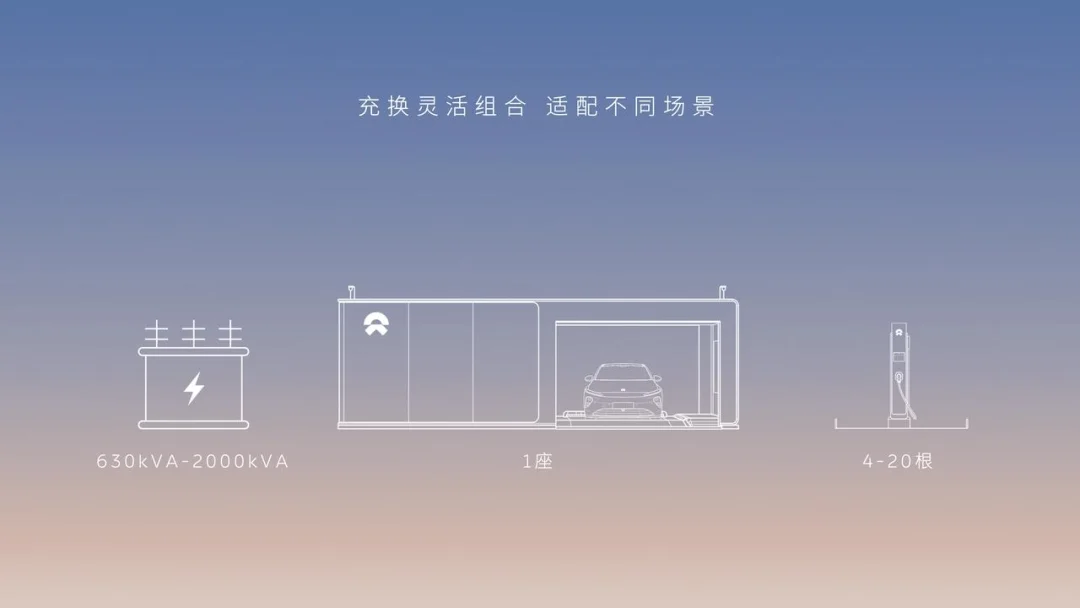
Based on demand, 500 kW chargers can be freely combined with 200 kW chargers. We have also experienced the trial operation of 500 kW superchargers firsthand. On NIO's 500 kW supercharger, an ET5 with a 75 kWh battery started charging at a state of charge (SOC) of 13% and reached a peak power of 143 kW; for the ES8 with a 100 kWh battery on the NT 1.0 platform, the peak power reached 90 kW.

According to data revealed by William Li at NIO Day, charging an ET7 with a 100 kWh battery for 20 minutes adds approximately 400 km of CLTC range.
Thus, the charge-and-swap station we tested uses a combination of two 500 kW chargers and two 200 kW chargers. For first-generation platform models, the 200 kW chargers provide more than sufficient replenishment speed; for NT 2.0 platform models, the 500 kW chargers enable even faster energy replenishment.
However, we hope that new vehicles featuring NIO’s 800 V architecture will be unveiled soon, as the 400 V platform cannot fully exploit the efficiency potential of 500 kW chargers.
Another Possibility: Interaction with the Grid
Before discussing, let us first clarify the concept: What is a VPP?
A Virtual Power Plant (VPP) is an energy management concept that integrates distributed energy resources—such as solar panels, wind turbines, and energy storage systems—into a single network. Its goal is to improve overall system efficiency, reduce reliance on traditional power plants, and balance grid load.
In plain terms, the grid aims to keep the electricity demand curve as smooth as possible, avoiding significant fluctuations that could lead to power shortages or overloads. Energy storage devices integrated into a VPP act like a reservoir for the grid: they supply power during peak demand periods to prevent sudden voltage fluctuations or equipment damage caused by rapid load changes, and they absorb excess energy during low-demand periods to reduce waste.
For NIO, which currently operates more than 1,000 battery swap stations, these facilities are an ideal fit for joining Virtual Power Plants (VPPs).
"More than 70 swap stations in Zhejiang have already been directly connected to the provincial power dispatching center via VPPs. In North China, Shanghai, and other regions, we have been participating in demand-side response over the past few years," Shen Fei stated. Energy internet has always been Shen Fei's research focus, and he noted that NIO will continue to study the interaction models and business models between swap stations and the grid, both now and in the future.
Vehicle-to-Grid (V2G) is another important interaction mode between new energy vehicles and the grid that cannot be overlooked. V2G involves connecting electric vehicles to the grid, allowing them to supply power to the grid when needed or charge from it. This interaction can effectively balance power system loads and improve energy utilization efficiency.
At the parking lot of NIO's Shanghai headquarters, there is a pilot program with 15 bidirectional charging piles supporting V2G. These piles can charge vehicles and discharge power back to the grid. For example, a car owner could charge their vehicle at night for RMB 0.3 per kWh and sell the electricity to the grid during the day at a price of RMB 1.3 per kWh. With a price difference of RMB 1 per kWh, owners can earn substantial incentives through this mechanism.
A major obstacle to the widespread adoption of V2G is battery degradation. For new energy vehicle owners without swap capabilities, frequently using their vehicles as energy storage devices for charging and discharging inevitably accelerates battery wear. However, for NIO, which has a battery swap system, this concern is mitigated because the risk of battery degradation and depreciation is transferred to NIO Power.
Whether VPP or V2G, the essence of both is to allow energy storage devices—such as electric vehicles and swap stations—to interact with the grid, ultimately achieving peak shaving and valley filling.
Many may still recall NIO's off-peak charging practice in the Beijing-Tianjin-Hebei region: from December 8, 2020, to April 30, 2021, users in this area received activity rewards for charging at home between 0:30 and 7:00 daily, earning 1 NIO point per kWh.
By the time the activity ended in April 2021, the 4,528 participating car owners had cumulatively used 2.93 million kWh of electricity, reducing carbon emissions by 1,465 tons. A closer look at participation rates reveals that among car owners in the Beijing-Tianjin-Hebei region with home charging piles, the participation rate was as high as 58.5%, while in Beijing, it reached 65.7%.
Although this is an experimental activity focused on energy replenishment, I believe that without the influence of the NIO community and its points system, the initiative would not have achieved such results. From this perspective, NIO may be the automaker with the strongest ability to mobilize owners when collaborating with power grids.
03NIO Has No Way Back
Regarding NIO battery swap stations and its entire energy replenishment system, there is a question that cannot be avoided: How can costs be reduced?
Shen Fei’s answer is that the third-generation station has managed to accommodate more batteries within the station without significantly increasing costs, while reducing the quantity of wiring harnesses inside the station by 30–40%, which will further lower costs. As the proportion of unmanned stations increases, overall operational costs in the future will also be lower.
"Everyone doesn’t need to constantly focus on the cost line or keep asking about it. All battery swap stations are built with NIO’s own funds; we worry about this aspect far more than others do. William Li sets higher performance targets for us every year, and the battery swap model does not bear the burden of losses."
During the interview, when faced with reporters repeatedly asking about the "costs" of battery swap stations, Shen Fei spoke frankly. "We consider the long-term and the big picture. NIO has always emphasized value orientation: how much value can we actually create?"
Looking at the present, the long-term and comprehensive value that NIO refers to remains uncertain. At present, all we can see is that battery swapping has brought a significant improvement in users’ energy replenishment experience—but in the future vision painted by NIO, battery swap stations also have the potential to operate as virtual power plants on a large scale from the grid side, develop into new business models, and bring substantial social benefits.
So, can this vision become reality?
It remains to be seen. But for NIO, battery swap stations have become the fulcrum of its entire energy system. William Li and Shen Fei have no way out; they must continue to invest heavily on the basis of the existing more than 1,300 swap stations, using them to leverage the imaginative potential of the entire NIO energy system to make it a reality.
Written by: Mingming Edited by: 308