


Mercedes-Benz Unveils AMG EQE, Spy Shots of EQE SUV Emerge; NIO Teases ES7 Details; Tesla Recalls Model 3 and Y in China
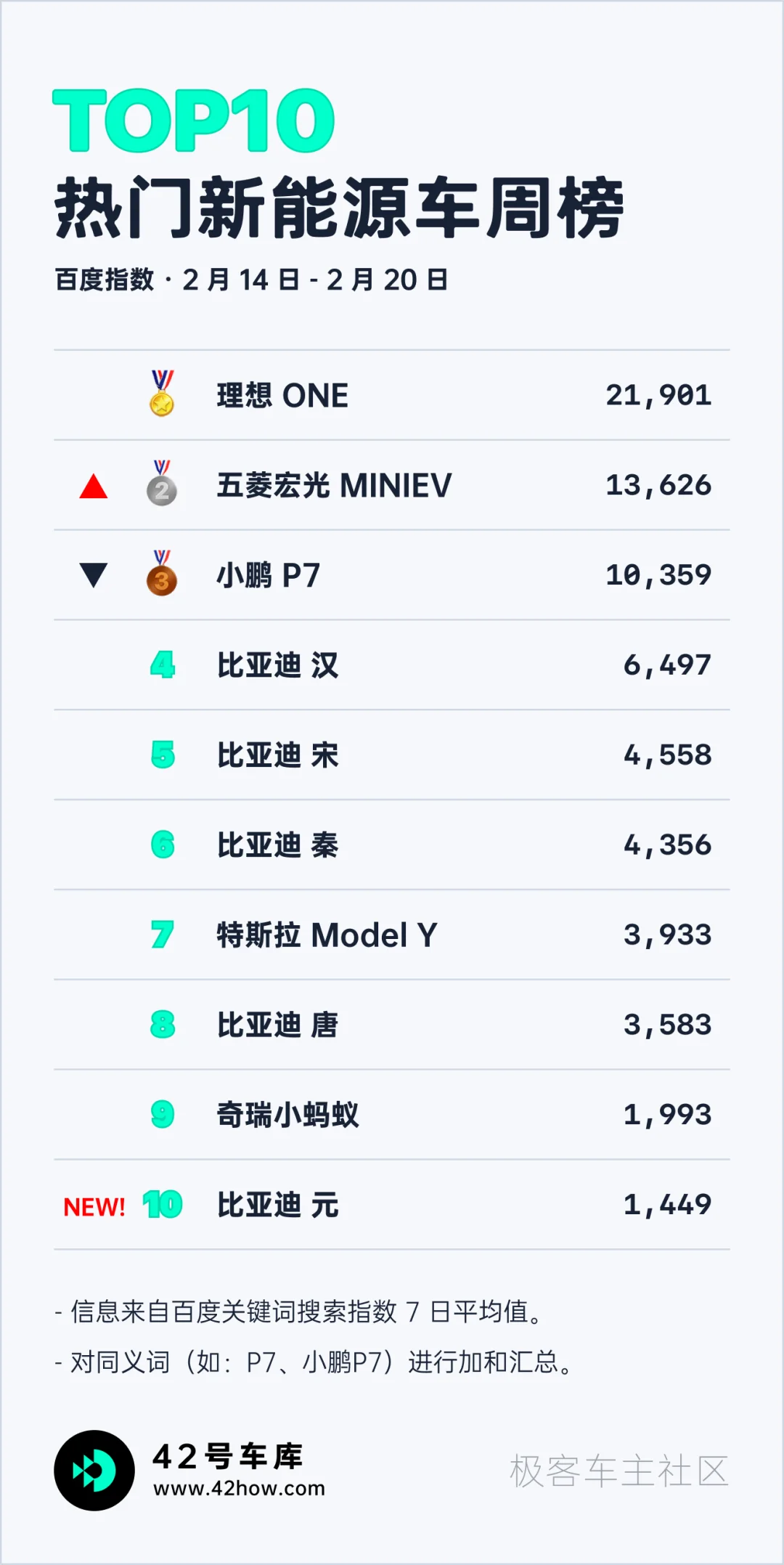
01Weekly Index
02Weekly News
Mercedes-Benz Unveils AMG EQE; EQE SUV Spotted
On February 16, 2022, Mercedes-Benz unveiled two new AMG all-electric models: the EQE 43 4MATIC and the EQE 53 4MATIC+.
AMG EQE 43 4MATIC:
The dual-motor all-wheel-drive system delivers a maximum power output of 350 kW and a peak torque of 858 Nm.
Zero to 100 km/h acceleration takes 4.2 seconds, with a top speed of 210 km/h.
The WLTP range is rated between 462 and 533 kilometers.
AMG EQE 53 4MATIC+:
The higher-performance variant features a dual-motor all-wheel-drive system with a maximum power output of 460 kW and a peak torque of 950 Nm.
This model accelerates from zero to 100 km/h in 3.5 seconds and reaches a top speed of 240 km/h.
With the optional AMG Dynamic Plus package, power increases to 505 kW and torque reaches 1,000 Nm, enabling a zero-to-100 km/h acceleration time of 3.3 seconds;
WLTP range is 440–518 km.
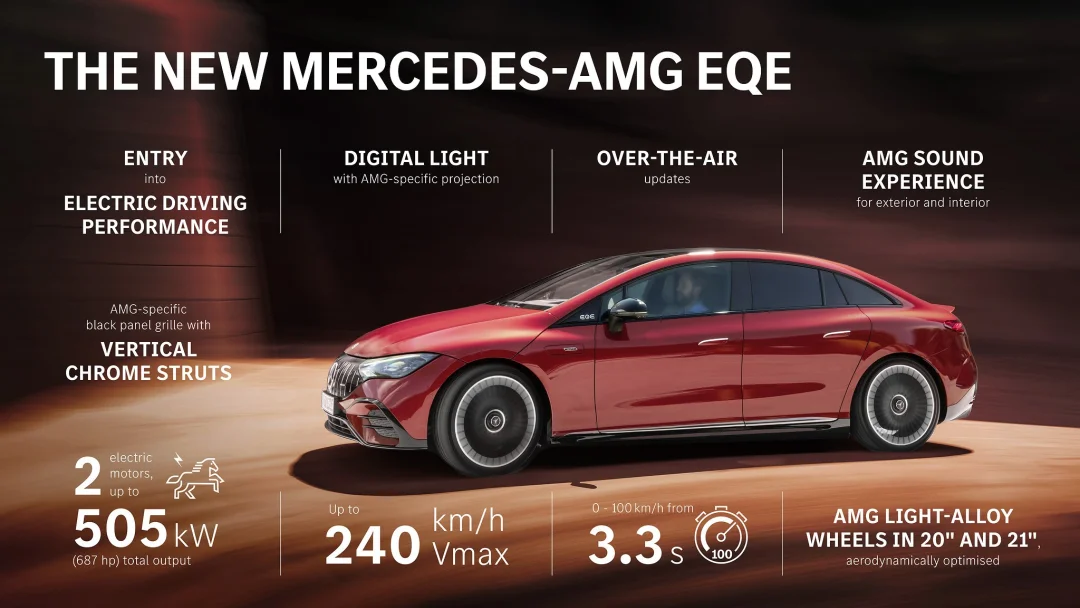
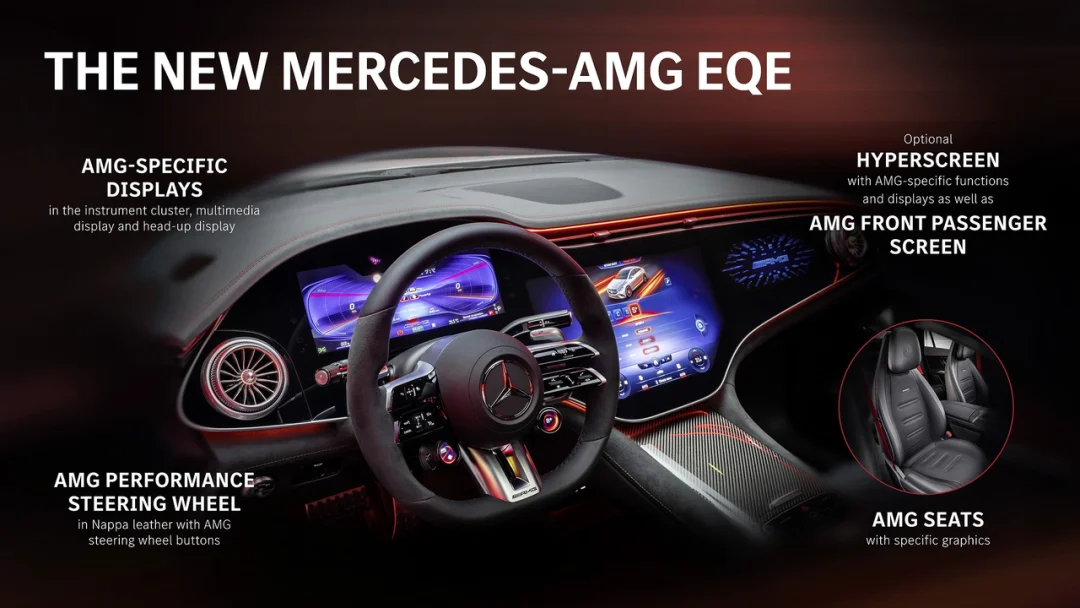
The AMG EQE features a 328 V battery pack with 90.6 kWh of usable energy, composed of 10 modules and 360 cells. The Battery Management System (BMS) supports Over-The-Air (OTA) updates for software upgrades throughout the vehicle’s lifecycle. The EQE 53 4MATIC+ utilizes dedicated AMG wiring harnesses to enhance current-carrying capacity. The battery chemistry employs an NCM 8:1:1 nickel-cobalt-manganese formulation.
Additionally, foreign media have revealed camouflaged test mules of the Mercedes-Benz EQE SUV. Road tests were conducted near the AMG headquarters in Affalterbach, Germany. Based on the wheel design and testing location, the vehicle can be identified as an AMG-powered version of the EQE SUV.
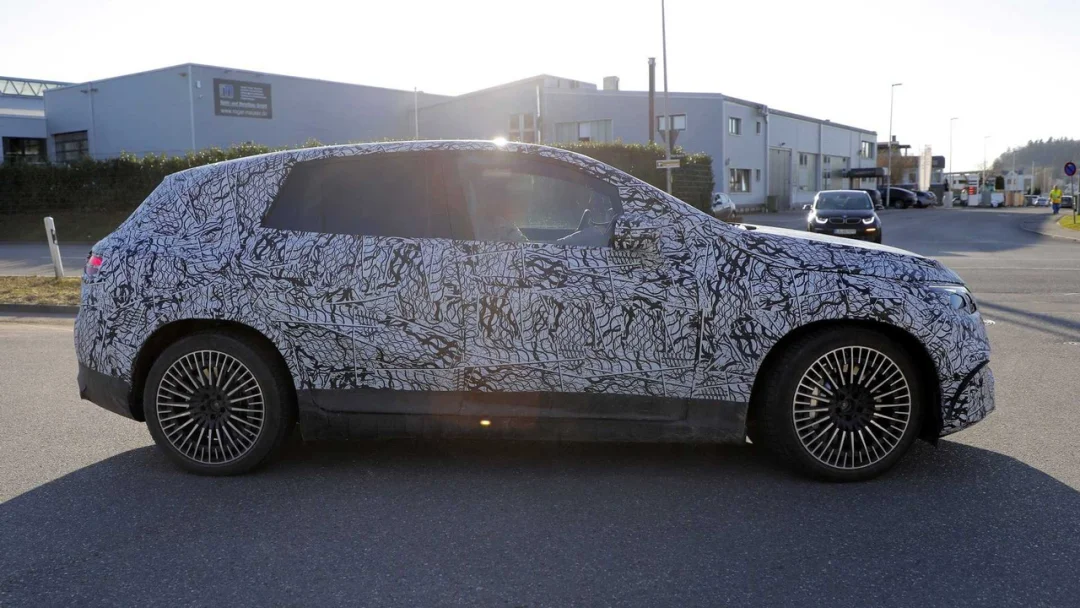
Like the EQE sedan and EQS, the EQE SUV will be built on the EVA 2 platform. Mercedes-Benz plans to launch both the EQE SUV and EQS SUV this year. The company has already registered a series of digital trademarks for the EQE lineup in local jurisdictions, ranging from 250 to 600. This indicates multiple powertrain variants will be available. AMG-specific designations such as 43, 53, 55, and 63 have also been registered, covering both the sedan and SUV models.
Quick Review:
As the second all-electric production vehicle from AMG following the EQS, the AMG EQE spans two distinct performance tiers. The EQE 43 4MATIC serves as the entry point for AMG electric driving dynamics, while the EQE 53 4MATIC+ is engineered to deliver more aggressive sportiness.
For the broader fanbase, however, the more pressing concern is likely the import price of the EQE AMG. In terms of performance specifications, the AMG EQE trails the Tesla Model S Plaid, which is scheduled for delivery in 2022. The Model S Plaid boasts a maximum power output of 750 kW (1,020 hp), accelerates from zero to 100 km/h in 2.1 seconds, supports 250 kW fast charging, and carries a price tag of approximately RMB 800,000. What will be the domestic pricing for the AMG EQE?
The overall design of the EQE SUV retains echoes of the EQC. Despite camouflage, the front end reveals Mercedes-Benz’s latest family grille design. Detailed exterior styling and technical specifications for the EQE lineup will be unveiled this year. It remains unclear whether the EQE SUV will be imported into China through Beijing Benz.
NIO ES7 Official Teaser
On February 15, NIO hosted an all-day marketing workshop at its NIO House in Shanghai MixC. During the event, NIO summarized service highlights from the Spring Festival period and revealed details about the upcoming ES7 during the media Q&A session.
In the Q&A segment, Qin Lihong confirmed that the product previously rumored under the codename 'Twin Stars' is indeed the ES7. He provided preliminary information, stating that the ES7 will be a five-seat mid-to-large SUV positioned between the ES6 and ES8.
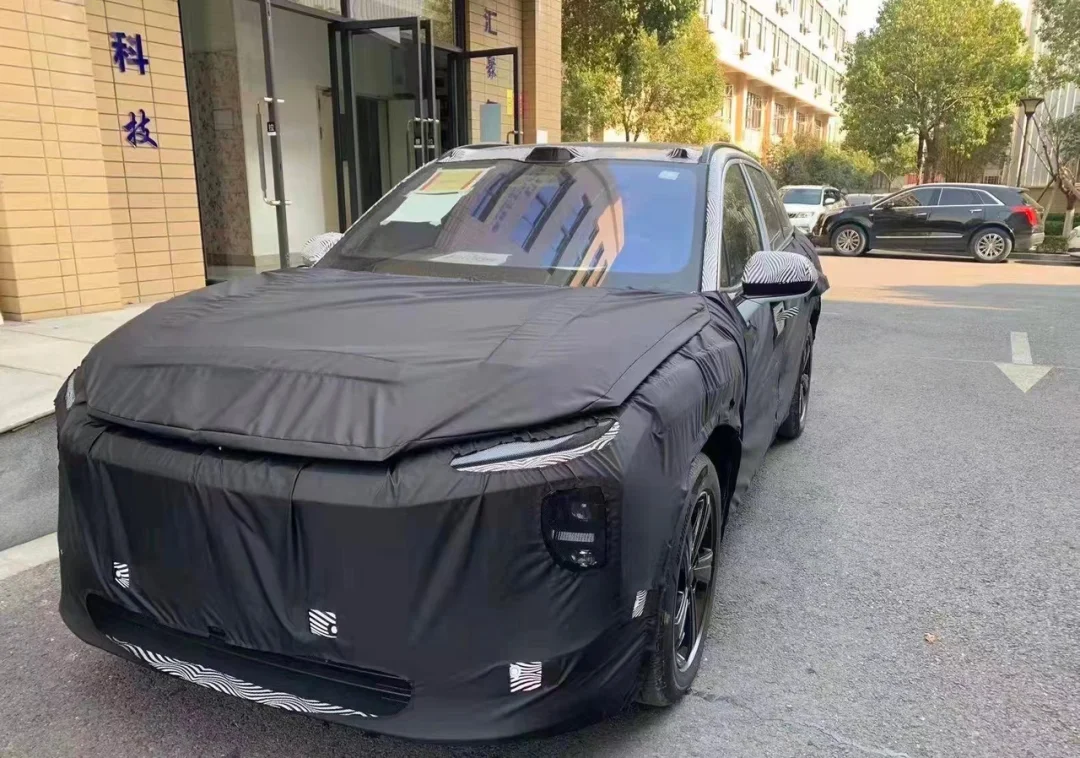
The ES7’s main competitor is the upcoming BMW X5L from Brilliance Auto. It is reported that the ES7 will offer improved comfort. Built on NIO’s NT 2.0 platform, the ES7 is expected to make its official debut in April.
Quick Review:
With the conclusion of this workshop, more suspense remains. The ET7 and ET5 are scheduled for delivery later this year, and the arrival of the ES7 expands NIO’s product lineup. Meanwhile, the improvement of stores and charging infrastructure will further enhance NIO’s influence in the new energy vehicle market this year. It is evident that competition in the new energy vehicle market this year will be exceptionally fierce.
Tesla China Recalls Some Domestic Model 3/Y Vehicles
The State Administration for Market Regulation has just issued a statement announcing that Tesla (Shanghai) Co., Ltd. is recalling some domestically produced Model 3 and Model Y electric vehicles.
The vehicles involved in the recall are a total of 26,047 partially domestically produced Tesla Model 3 (12,003 units) and Model Y (14,044 units) electric vehicles manufactured between December 28, 2020, and January 15, 2022.
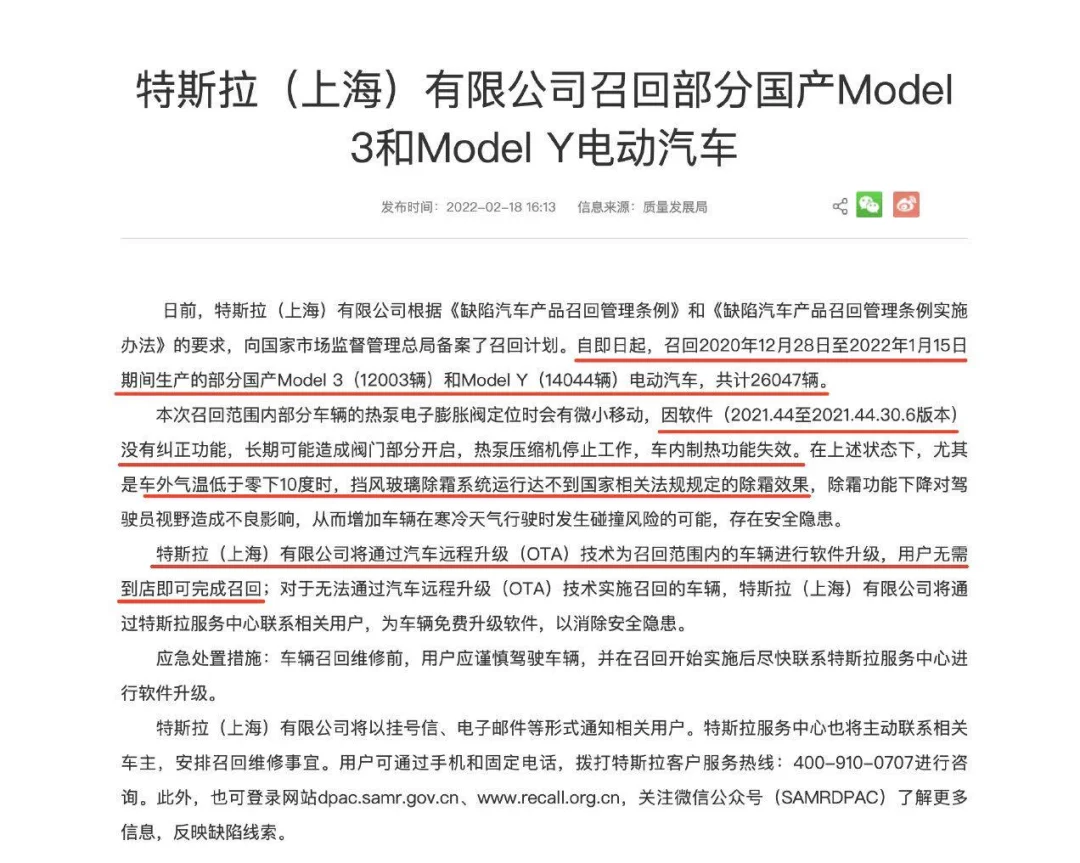
The recall is due to a minor shift in the positioning of the electronic expansion valve in the heat pump system in some vehicles produced during this period. Because the software (versions 2021.44 to 2021.44.30.6) lacks a correction function, long-term operation may cause the valve to remain partially open, leading to the heat pump compressor stopping and the cabin heating function failing. Windshield defrosting systems in affected vehicles do not meet the defrosting effects required by national regulations, which could adversely affect the driver’s field of vision.
Quick Review:
Tesla will perform software upgrades on vehicles within the recall scope via over-the-air (OTA) updates, allowing owners to complete the recall without visiting a service center. For vehicles that cannot be upgraded via OTA, Tesla will contact affected users through its service centers.
Previously, on December 3, 2021, Tesla announced a recall of some 2021 Model Y vehicles because the suspension links could detach from the steering knuckles under extreme loads. On December 31, 2021, Tesla recalled some imported 2018–2019 Model 3 and domestic 2019–2020 Model 3 vehicles due to front trunk component failures that could cause the hood to open and obstruct the driver's view.
Vehicle recalls are relatively common. Generally, if the issue is not a hardware defect, Tesla opts for an over-the-air (OTA) software update. Historical recall records also show that defects in Tesla's battery, electric motor, and electronic control systems are rare, indicating that its core components have reliable quality.
Positioned Above Haitun and Yuan Pro, BYD Yuan PLUS Launched
On February 19, BYD Yuan PLUS was officially launched, with prices ranging from RMB 131,800 to RMB 159,800. Two range versions are available: 430 km and 510 km.
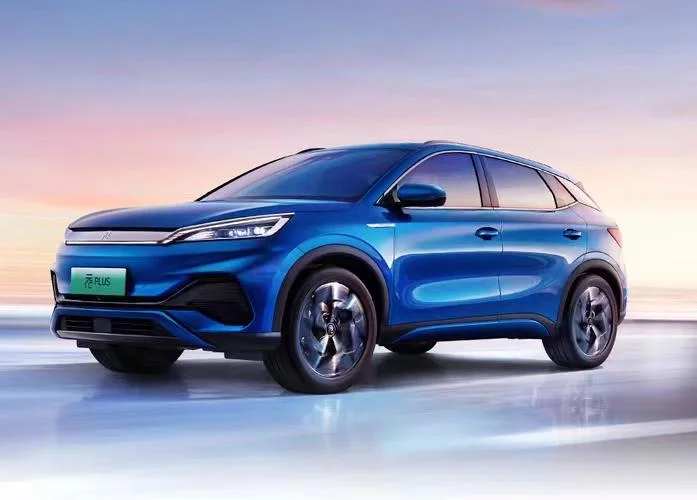
The specific configurations are as follows:
430 km Luxury: RMB 131,800;
430 km Premium: RMB 138,800;
510 km Premium: RMB 141,800;
510 km Flagship: RMB 151,800;
510 km Flagship PLUS: RMB 159,800.
The official range rating for the Yuan PLUS has been switched from NEDC to CLTC. The 430 km version is equipped with a 49.92 kWh battery, while the 510 km version features a 60.48 kWh pack.
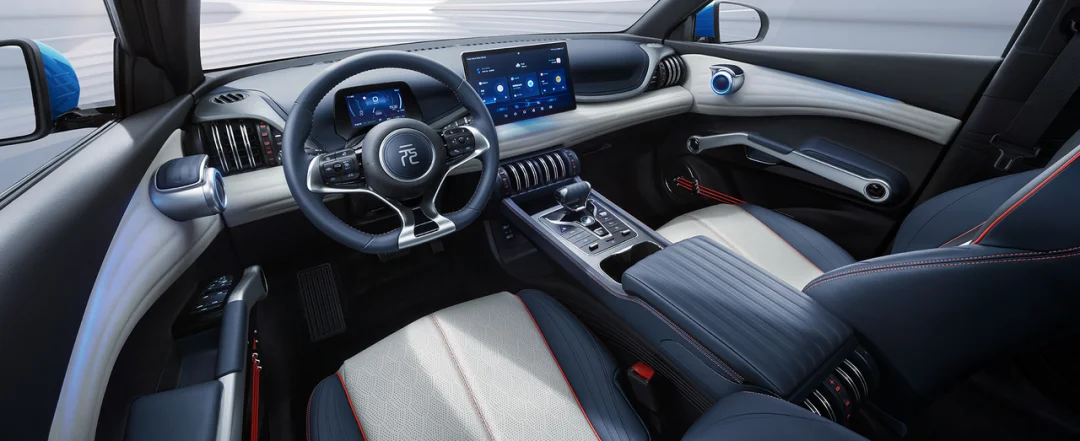
Heat pumps are standard across all trims. Every model uses a 150 kW front-wheel-drive single motor paired with 215-series tires in either 17- or 18-inch diameters. Official figures cite an energy consumption of 12.1 kWh per 100 km; we will test real-world efficiency once we have a vehicle on hand.
Quick Review:
The Yuan PLUS series is built on BYD’s e3.0 pure-electric platform. Although it remains front-wheel drive, its rear axle structure differs from that of the Haitun model, which also uses the e3.0 platform. The torsion beam has been upgraded to a multi-link suspension, which is expected to improve ride quality.
In China’s domestic market for pure-electric vehicles priced slightly above RMB 100,000, high-volume models have long been scarce due to cost constraints and the positioning of fuel-vehicle competitors.
BYD gained confidence from the strong sales of the Haitun since its launch. In terms of pricing, the Haitun was actually intended to replace the older Yuan EV. The new Yuan PLUS is positioned higher, offering better space and overall practicality.
With virtually no direct competitors in this price range, the vehicle is expected to become another best-selling pure-electric model for BYD.
Zeekr Global Flagship Store Enters Shanghaizhongxin; Live User Q&A
On February 18, the Zeekr Center Global Flagship Store officially opened in Shanghai. During Zeekr’s first brand event of 2022, the company introduced the recently released major OTA upgrade and announced favorable updates, including a new lock-in policy and accelerated delivery timelines. Below are the key points from the announcement:
Component shortages have eased slightly; air suspension supply can now meet production schedules for orders placed before mid-September last year.
Delivery acceleration. Users who place a reservation deposit between January 1 and January 31 and lock their order between February 19 and February 21 can complete delivery before July 30;
In 2022, Zeekr will expand its nationwide store network to more than 300 locations;
On February 12, Zeekr pushed the ZEEKR OS 1.1.1 update, adding features such as a Bilibili app for the infotainment system, driving mode memory, and manual control of the automatic doors;
On February 15, Zeekr pushed ZEEKR OS 2.0 Beta to a select group of internal testing users, including the first batch of driver assistance features such as adaptive cruise control with queueing functionality, AEB automatic emergency braking, and lane departure warning;
The vehicle's infotainment system will receive five major version updates this year;
Physical keys are still not available; the company has only stated that it is "in intensive R&D."
The 8155 chip is undergoing testing, and the rearview camera system has also been optimized.
Quick Review:
Based on currently released information, Zeekr has significantly accelerated its offline store expansion. There are five Zeekr Centers under construction, with an additional 15 to 20 expected to open before the end of the year. On the product front, the upcoming new round of order locking indicates that Zeekr’s non-air-suspension models have passed their initial production bottlenecks. Meanwhile, the air-suspension versions appear to still be facing parts shortages.
The recently pushed version 1.1.1 update was not extensive, but it addressed the most urgent bug related to the automatic doors. After all, if opening the doors is problematic, subsequent features cannot function properly.
The promised beta version of the 2.0 update, originally slated for late December, finally arrived in February. It introduced the highly anticipated partial driver assistance functions. According to Xie Baojun, Vice President of Smart Technology at Zeekr, Adaptive Cruise Control (ACC) and Automatic Emergency Braking (AEB) are the two most critical driver assistance safety functions for users. After multiple rounds of simulation testing, these features have entered the beta phase.
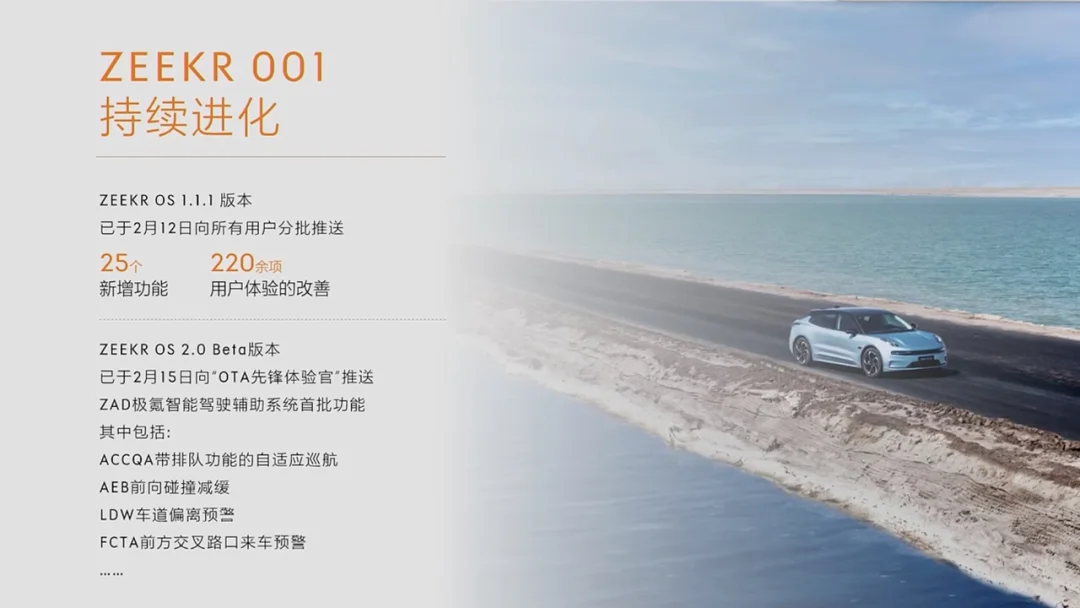
In terms of update speed, Zeekr has fallen significantly behind its projected plan from 2021. The 2022 roadmap stipulated that the Zeekr 001 would receive at least five major version updates. We hope Zeekr can stick to its 2022 schedule.
Written by: Ming Ming Edited by: Liu Guangding