


Oil Giants Expand Non-Fuel Retail and Multi-Energy Services as EV Adoption Accelerates
In 2017, Fan Bodeng, CEO of Helanhuangjiakepai, excitedly told the media that he had just purchased a Mercedes-Benz. Given his income level, it was naturally a Mercedes-Benz S-Class sedan. However, he was not showing off; what he truly wanted to highlight was that he had bought a plug-in hybrid version, the Mercedes-Benz S500e.
Fan Bodeng stated at the time that he was deeply concerned about global warming. He argued that to keep the Earth's average surface temperature rise within 2 degrees Celsius, it would be necessary to continuously promote electric vehicles, hydrogen fuel cell vehicles, and natural gas vehicles. When these words came from an oil company executive, the tone felt somewhat incongruous, despite him being an owner of a plug-in hybrid model.
Fan Bodeng did not merely talk the talk. In September of that same year, Helanhuangjiakepai began installing ten fast-charging stations for electric vehicles at select gas stations in the UK, with charging speeds reaching up to 50 kW.

As electric vehicles developed rapidly, last year Helanhuangjiakepai also built a large-scale wind power station in the Netherlands and announced plans to delay new oil field development in the Gulf of Mexico and the North Sea. BP took an even more radical stance, stating directly that it would no longer explore for oil in any new countries.
The rapid development of electric vehicles is undeniable. Yet, the number of internal combustion engine vehicles currently on the road remains massive. What exactly is driving this transformation among oil giants? What lies behind these changes? This is what I am curious to understand.
01Don't Fight Against Revenue
Since I bought an electric vehicle, I still visited gas stations a few times last year. This is because gas stations remain the most convenient public restrooms and convenience stores available on the road.
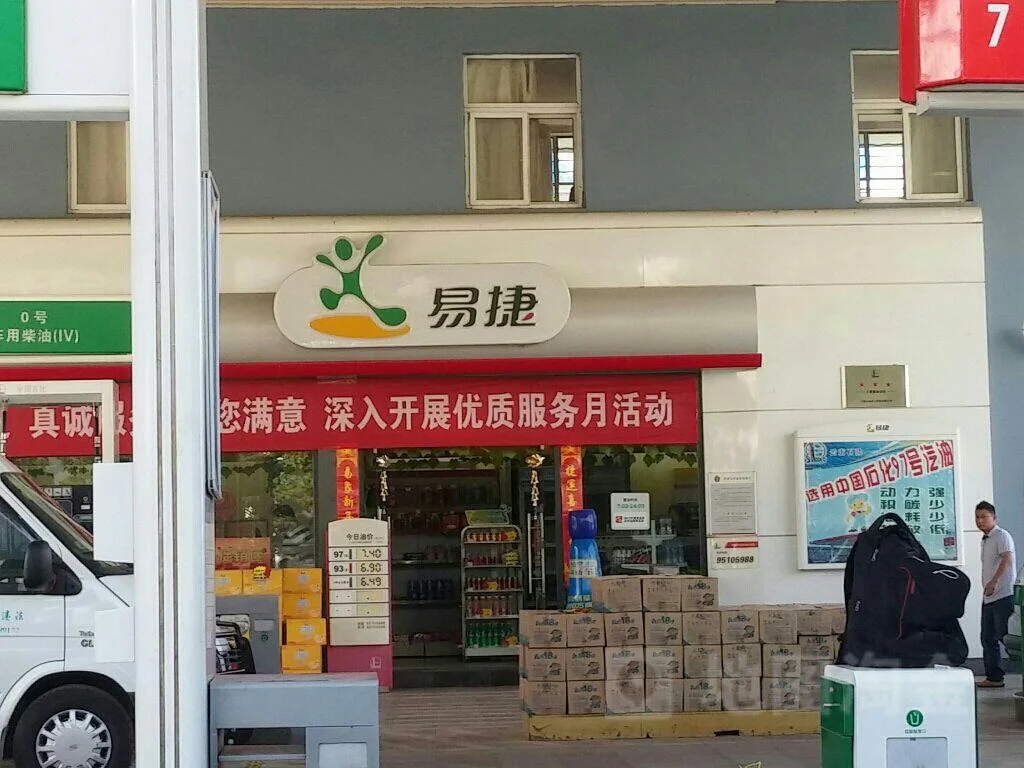
It is necessary to mention Yijiebianlidian, under Zhongshihua. For a long time, I did not realize this was a convenience store brand, as its service level was no different from neighborhood mom-and-pop shops, especially those in highway service areas.
Yet this "mudslide" of the convenience store industry reached a scale of 27,699 stores by July last year, ranking first in China for the number of convenience store locations. According to public information from Zhongshihua, the company formally established its non-oil business division in 2008, with Yijiebianlidian as its core component.

In the year it was founded, Zhongshihua's total non-oil business revenue was RMB 1.1 billion. Over the following decade, as the store network expanded rapidly, Zhongshihua's non-oil business division achieved annual revenue of RMB 51.95 billion in 2017. In that same year, Yonghuichaoshi's annual financial report showed that its "Food and Supplies" and "Fresh Processing" segments accounted for 90.99% of its total revenue, amounting to only RMB 53.313 billion. Do you still consider Yijiebianlidian merely a "small convenience store"?
In subsequent years, according to Zhongshihua's full-year financial report released in 2019, "Other Operating Income" once reached RMB 65.705 billion, representing 2.22% of overall revenue. However, this growth momentum "hit the brakes" last year. Due to the pandemic impact, Zhongshihua's full-year "Other Operating Income" in 2020 shrank to RMB 56.528 billion, but its proportion of total revenue increased further to 2.67%. From a trend perspective, non-oil business is poised to become a significant component of revenue growth for oil companies in the near future.
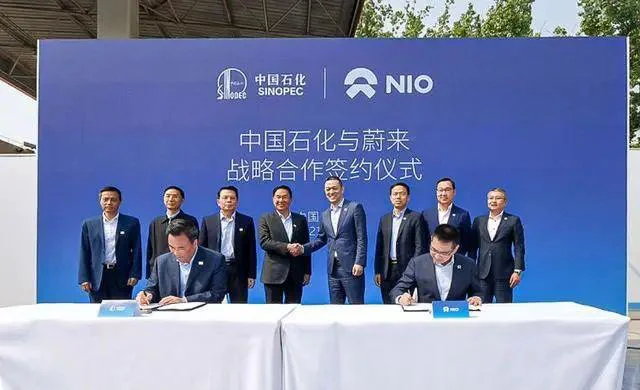
At a recent strategic agreement signing ceremony between NIO and Zhongshihua, William Li also noted that in European and American countries, the revenue and profit share of non-oil businesses among petroleum energy companies are higher than those of domestic enterprises. Therefore, domestic oil companies urgently need to expand their non-energy businesses, given the natural intersection between gas stations and fuel-vehicle users. How to effectively utilize this fragmented time has always been a challenge for oil companies to overcome.
This is evident from Zhongshihua's emphasis on Yijiebianlidian. Although Zhongshihua is a state-owned enterprise, its capacity for innovation exceeds conventional perceptions of such companies, particularly in the realm of Yijiebianlidian.
Last year, Zhongshihua launched a 'grocery shopping at gas stations' service in collaboration with Hemaxiansheng. Users can select groceries via the Yijie Refueling App and drive to the station the next day; staff then place the items in the vehicle's trunk, providing a seamless experience where customers do not need to exit or open their windows. While meals are a daily necessity, refueling is not.
Consequently, Zhongshihua partnered with Dada and Meituan to offer one-hour delivery within a 3-kilometer radius in Beijing. Orders are placed through the Yijie Refueling App, with couriers delivering directly to customers' doors. These efforts to monetize traffic generated by Yijie Refueling App users resemble typical internet business models. Is this really the oil company you know?
Thus, oil companies actually place greater importance on 'traffic' than we might imagine.
02Do Not Go Against Traffic
Yijiebianlidian is described as an anomaly in the convenience store industry because its strategy differs fundamentally from competitors. While other convenience stores pursue refined operations, Yijiebianlidian remains rugged and bold. For instance, its coffee offerings lack the spacious, elegant ambiance found at Starbucks.
This is because oil companies recognize that their core business remains refueling vehicles, or more broadly, providing energy replenishment. No one expects to spend one or two hours enjoying coffee at a gas station; therefore, a refined approach is unsuitable. Here, efficiency and convenience are paramount. When large numbers of customers arrive in bulky vehicles, the priority for oil companies is how to quickly load bulk items like bottled water and rice from the station into these 'shopping carts'.
But this all hinges on one condition: you have to go to the gas station. As electric vehicles (EVs) develop rapidly, each EV sold means a user’s connection to gas stations becomes more distant. In March this year, the sales share of new energy vehicles broke through 10%, and industry observers widely consider this an important historical turning point; in the coming period, the popularization of EVs may accelerate further.
Furthermore, with most countries worldwide setting timelines for banning the production of internal combustion engine vehicles, transformation is inevitable for oil companies. The risk here lies in determining 'which will be the mainstream energy source in the future.' Consequently, most oil companies have converged on the same path: transitioning from supplying only refined petroleum products to providing multi-energy solutions.
Among these, electricity, hydrogen, and natural gas are key areas where oil companies are focusing their efforts. Influenced by Europe's strict carbon emissions trading system, BP announced last year that it plans to invest USD 5 billion annually in its renewable energy business over the next decade, while cutting oil and gas production by 40%. This transformation has already taken off in Europe.
As giants in the oil industry, Shell and BP in Europe are both attempting to redefine their corporate positioning during this era of change, shifting their image from oil drilling companies to environmentally conscious power providers.
In China, Zhongshihua has also taken early concrete action. At a transportation and energy transition industry seminar held in Beijing yesterday, Zhongshihua Chairman Zhang Yuzhuo stated that the company is accelerating its new energy transition. It plans to build 1,000 hydrogen refueling stations or oil-hydrogen combined stations, 5,000 charging and battery-swapping stations, and 7,000 distributed photovoltaic power generation sites by 2025.
I originally thought that once I bought an EV, I would never need to visit an oil company again. However, judging from current development trends, there will still be many opportunities to enter gas stations in the future.
One aspect remains puzzling: the refining and manufacturing of refined petroleum products have a long history, and their massive scale keeps supply chain costs low. In the short term, the revenue and profit margins of the electricity segment are certainly inferior to those of the oil segment for oil companies. So why has the transformation begun now?
03Don't Fight Capital
I often think of a quote by the renowned American author Nathaniel Hawthorne: 'There is no such thing as an unshakable resolve to do good or evil in human nature, unless one is standing on the scaffold.'
The capital market is always the first to sense changes. In 2020, the market capitalization of electric vehicle (EV) companies grew at a high rate, driven by a consensus among investors in primary markets. While capital favored EVs, large amounts of funds were withdrawn from oil stocks. Over the past few years, oil stocks, once the backbone of the stock market, have experienced multiple fluctuations. This was particularly evident during the pandemic when oil demand plummeted; the overly single revenue structure of oil companies undermined investor confidence.
Claudio Descalzi, CEO of Ainijituan, stated bluntly: 'In the past six years, we have seen extreme volatility in our oil commodity demand. We hope to build a business increasingly based on green energy rather than oil, which allows us to distance ourselves from that volatility and uncertainty.'
Michele Della Vigna, Head of Natural Resources Research for Gaosheng Europe, Middle East and Africa, told CNBC in 2019 that major oil companies had allocated half of their budget to low-carbon businesses such as natural gas. They did so due to pressure from regulators and shareholders.
No listed company wishes to be 'shorted' by the capital market. Therefore, under high-pressure government policies and the 'urging' of the capital market, the transformation of oil companies has been forced into an acceleration phase.
As mentioned above, for oil companies, the profit margins from supplying electricity are significantly lower than those from drilling for oil and natural gas. Consequently, clean energy sources such as hydrogen, wind, and solar power may become the new favorites for these companies. In Europe, where carbon emissions are strictly regulated, this shift can generate more predictable and stable income.
Furthermore, during the transition, oil companies maintain that investments in oil and natural gas remain necessary. The lower costs associated with oil and natural gas can yield higher returns, providing the financial foundation required to develop other clean energy sources in the future.
Final Thoughts
At a transportation and energy transition industry seminar held in Beijing yesterday, He Xiaopeng of XPENG stated that future mobility models will inevitably break away from current energy application paradigms, with electricity becoming the primary energy source for transportation.
For China, this presents an opportune moment. Researching next-generation energy supply systems and refining operational and R&D models based on new energy sources will help the country achieve its carbon peak by 2030 and carbon neutrality by 2060 goals.
The business model of gas stations is also set to undergo drastic changes due to the development of smart vehicles. For instance, on a future night, we might see autonomous electric vehicles driving themselves to Zhongshihua battery swap stations on empty roads.
Time passes silently, and era shifts often occur without fanfare. Fortunately, our generation has the opportunity to witness history.
Written by: Mai Baicai de Huang Laoban Edited by: Daji