


Buying a New Energy Vehicle for 500,000 RMB: BBA Was Never an Option | 42Talk Vol.22 Transcript
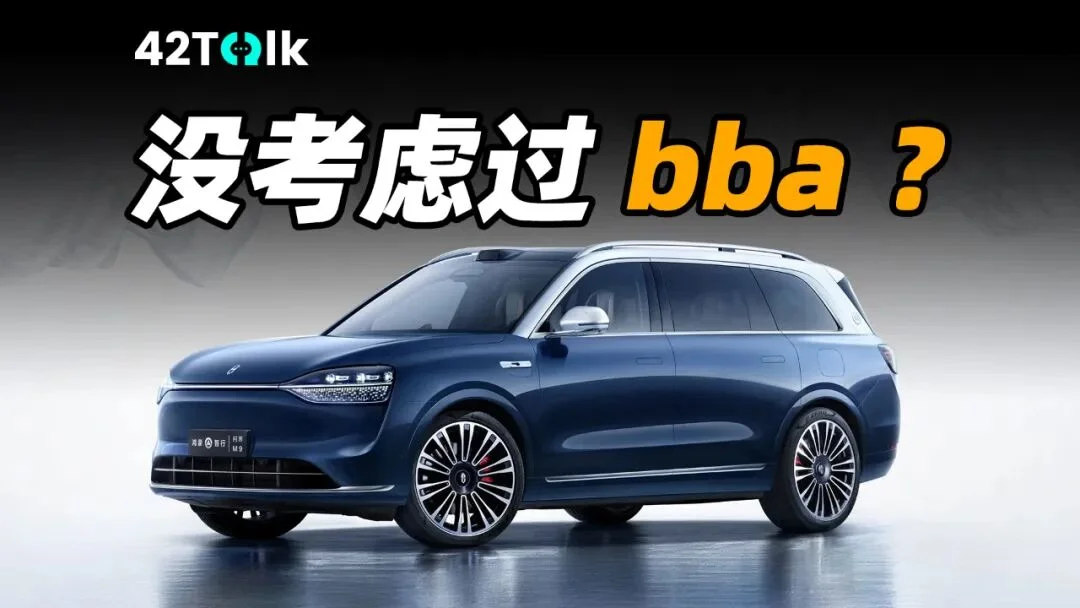
"42Talk" is an online chat show produced by 42HOW Auto, aimed at new energy vehicle (NEV) owners. We hope these authentic owner voices can help you choose the most suitable NEV.
42Talk: Discovering the Most Authentic Owner Voices.
Hello everyone, welcome to 42Talk.
AITO M9 sales have remained above 15,000 units since April, with July figures reaching 17,000 units. Since stable deliveries began, it has consistently ranked first in the SUV segment priced over RMB 400,000. This is indeed a very impressive result, and the momentum continues to grow.
In this episode, we spoke with an AITO M9 owner about his reasons for choosing the vehicle and assessed his satisfaction with the car during his ownership experience.
Guests for this episode:
Jixiang Tongxue: Shenzhen/Foshan, Guangdong; 36 years old; Owner of the AITO M9 Pure Electric Max Edition, equipped with the optional projection system
(For the podcast version, please click "Read Original" at the end of the article to access the "42Talk Channel" on the Xiaoyuzhou APP.)
01Basic Information
Ji Xiang Tongxue:
I have been driving for 15 years. My previous car was an Accord, which I sold last October.
After selling it, I waited more than two months for the launch of the M9. On April 17 last year, immediately after watching the launch event, I placed a blind order.
The AITO M9 is my first new energy vehicle (NEV). My family owns several other cars: my wife drives an SUV, and my parents drive an MPV, but all are internal combustion engine vehicles. Previously, our family's lineup consisted of an MPV, an SUV, and a sedan; now it is an MPV plus two SUVs.
02Why Buy a New Energy Vehicle
Ji Xiang Tongxue:
About three years ago, I saw a test-drive video of the Huawei intelligent driving system on a Jihu vehicle covering a Shanghai route. At the time, I found its autonomous driving capabilities quite impressive. Later, I looked up "why intelligent driving systems are easier to implement in new energy vehicles" on Baidu Baike. It may be because traditional internal combustion engine (ICE) vehicles have certain limitations, such as response times for the accelerator and brake pedals, as well as their power requirements.
That planted a seed in my mind: the next car I buy will be a new energy vehicle.
My home is in Foshan, and I work in Shenzhen. So I am in Shenzhen on weekdays and return to Foshan on weekends. Given this situation, when changing cars, I wanted to choose a model with strong intelligent driving capabilities.
I really dislike driving back on weekends because the one-way trip takes two or three hours, which is quite tiring. When I drove an ICE car, I mostly chose to take the high-speed rail. But now that I drive an AITO M9, I basically drive back every week, and it is quite relaxing.
03Did I Choose AITO Because of Huawei?
Ji Xiang Tongxue:
When choosing a new energy vehicle, I defined several key factors: six seats, intelligent driving, safety, and pure electric.
The first consideration for six seats was that I have three children.
Previously, whether driving a five-seat SUV or sedan, it was difficult to fit four people in the second row. At that time, we had to rely on my father’s MPV. Therefore, when making my choice, my first priority was to select a six-seater.
Among six-seaters, I could have considered an electric MPV. However, since I primarily drive the car myself on weekdays, using it only for family trips on weekends and holidays, I feel that driving an MPV is not suitable for daily commuting; it seems more appropriate for a chauffeur picking up a boss.
The second factor to consider is intelligent driving.
I also mentioned that my workplace is in Shenzhen, and I return to Foshan on weekends. Previously, when driving a gasoline car, each one-way trip took about two and a half hours, which was quite tiring. So I hoped that intelligent driving could help reduce this burden.
When I first started using intelligent driving, I was somewhat uneasy. But as I gradually learned more about the technology, I actively searched for introductions and case studies related to Huawei’s intelligent driving system across various platforms. I found that their performance in the industry is quite good. I believe it can handle urban scenarios well, so highway scenarios should be even easier.
This planted the seed for the AITO M9 in my mind.
The third factor is safety.
Regarding safety, my considerations are twofold: passive safety and active safety.
Passive safety is essentially about whether a car's materials are sturdy enough. In fact, many users cannot see this aspect, including myself; we can only rely on the enterprise's promotional claims.
When I placed my order on April 17 last year, I was primarily focused on the concept of active safety. The technical term for this is AEB, which means the vehicle can intelligently avoid potential collisions. For me personally, with three young children, this feature is a real necessity.
Its passive safety is actually something I had the opportunity to observe in December last year when I participated in a blind reservation owner factory tour organized by SERES. At that time, I was among the first to see the assembly of its entire production line at the factory and inspect the materials used in the chassis frame; overall, it appeared quite robust. At that moment, I thought to myself that I would immediately place a firm order after the press conference.
The fourth factor to consider is pure electric.
When choosing a new energy vehicle, I discussed the matter extensively with friends and family, including my father. Older generations tend to be more cautious about pure electric vehicles (BEVs). They often worry about range degradation, high electricity consumption on highways, and the high cost of replacing the entire battery pack. Consequently, they are more inclined to recommend extended-range electric vehicles (EREVs).
When I make my own choices, I actually tend to agree with the range-extended electric vehicle (EREV) approach. Before the AITO M9 was released, I also test-drove the Li L9. I generally approve of Li Auto's overall strategy of choosing EREVs.
I believe that in the current era, the optimal path to sway ICE vehicle users toward NEVs is range-extended electric vehicles (REEVs). This is because these users have limited exposure to NEVs and may still prefer more economical and cost-effective ways of using a car. In fact, REEVs generally have relatively low fuel consumption, and drivers can choose pure-electric mode for urban commuting. Therefore, I support this approach.
But the main reason I personally didn't choose it was also inspired by a friend of mine. I have a friend who drives the extended-range version of the AITO M5. While we were having a meal, he told me about a phenomenon: after buying the AITO M5, he only wanted to charge it and didn't want to use a single drop of fuel. Since charging at his company is free, he found that he basically had to charge every day or every other day, but he noticed that colleagues driving pure electric models around him only needed to charge once a week.
He explained that while he initially chose a range-extended electric vehicle (REEV) to avoid range anxiety, using it primarily in urban areas actually created more anxiety for him. Because he preferred to drive exclusively on electricity and avoided using gasoline, he found himself charging far more frequently. He shared this insight with me and advised, 'You need to think carefully: if you will be driving mostly in the Pearl River Delta or Guangdong Province, an all-electric vehicle is likely a better choice.'
When I was considering the AITO M9, although the all-electric version was more expensive, I decided firmly to go with it to avoid the situation he described after taking delivery.
I picked up my car on April 1, and it has been over four months since then. In practice, I have experienced no range anxiety at all. My longest trip was to Foshan, a distance of 460 kilometers, which I completed on a single charge without needing to stop.
When charging, each session lasts at most half an hour, and it can basically charge from 20 kWh to over 80 kWh, which is sufficient to meet my commuting needs. Therefore, I still believe that for users who drive mostly in urban areas, with highway trips accounting for only a few percent of their annual travel needs, pure electric vehicles remain the first choice.
Laven:
Yes, the phenomenon you mentioned—where REEV owners experience greater range anxiety—is something many users in online communities have also shared. Because the operating cost of electric vehicles is lower, once drivers get used to the pure electric mode, they are reluctant to refuel with gasoline.
Ji Xiang Tongxue:
Yes, actually, based on discussions I’ve seen in these communities, opinions on this issue fall into two camps.
One group of users reasons that since they have already purchased a vehicle costing over RMB 500,000, fuel expenses constitute a negligible portion of the total cost. In the past, accepting fuel consumption of more than ten liters per 100 kilometers was common; why should consuming only seven to eight liters be unacceptable? This represents one school of thought.
There is another school of thought, which I have summarized from their statements as "the optimal solution for choice." Once you have used an electric vehicle, you feel that its cost is very low—perhaps the travel cost per kilometer is one mao or even less. But if you use gasoline, the travel cost per kilometer might be eight mao or one yuan. The gap between these two is eight to ten times.
Many AITO M9 owners are relatively successful individuals who tend to seek the optimal solution. After experiencing EVs, they are likely to prefer "using electricity whenever possible and minimizing fuel use."
Laven:
The AITO M9 EV version displays a CLTC range of 630 kilometers. You mentioned earlier that you recently drove over 400 kilometers without recharging. What is the actual distance it can cover on a full charge?
Ji Xiang Tongxue:
It allows switching the display from CLTC range to comprehensive range, calculating a value based on your driving habits and energy consumption per 100 kilometers. For me, combining city and highway driving, the range is approximately 530 kilometers.
In pure highway scenarios, such as my previous trip to Shantou where 90% of the route was highway and I drove at the speed limit maximum, I could still achieve 480 to 500 kilometers, which is quite sufficient.
Why the Ultra Version Was Not Selected
Laven:
Why didn't you choose the Ultra version when buying the AITO M9? Because you added a projection system. These two versions aren't actually that different. Since you opted for the projection system, why not just buy the Ultra directly?
Ji Xiang Tongxue:
I went through several stages.
The first phase was when it announced the specifications; I was quite torn.
My dilemma is whether to spend around RMB 520,000 on the range-extender Ultra version or opt for the pure electric version with an added projection screen.
But deep down, I still preferred an all-electric model, so in the end I chose the pure electric version and added a projection screen as an option.
The second phase is vehicle delivery.
When I picked up the car, everything seemed fine. After delivery, I noticed that some features in the OTA update were still centered around the Ultra trim. For example, the 'Kunpeng Spreading Wings' welcome animation and the projection headlights, which may soon include light carpets and other special effects.
I discussed this with fellow owners. We all agreed that buying the top-tier version would prevent future regrets. By purchasing the highest spec, SERES and Huawei would be compelled to continue feature iterations for that trim. This way, we wouldn't have to agonize over decisions or feel envious of other owners.
At this stage, I felt a bit of regret. I thought to myself: if I had just added another RMB 60,000—or rather, an additional RMB 40,000—I could have selected the top-tier version.
By the third phase, my internal feeling was: 'That's it. I'll just have to accept it.'
Projection Usage Experience
Ji Xiang Tongxue:
Overall, I find the Max version quite satisfactory, especially since I also opted for a projector screen.
As a side note, among these optional features, the one I most wanted was the power doors. I have experienced power doors on other models, including Zeekr’s implementation. During my on-site test drive, I found that Zeekr’s power doors were quite heavy; you could only open them using the button, and pulling them manually felt particularly resistant.
However, the AITO M9’s power doors were much smoother. When I first experienced them at the SERES factory, I didn’t even realize they were power doors initially. As I pulled on the handle, it felt exceptionally smooth. Later, staff members explained that the doors had power-assist functionality and could also detect obstacles nearby.
At the time, I thought this performance was relatively advanced in the industry, so I was quite looking forward to it. But since power doors were not available as an option later on, it was a pity, and I ultimately did not select them.
Returning to the main topic, regarding the projector screen I just mentioned, one reason I chose it is that I have several children. Previously, when traveling in MPVs, they often needed to watch cartoons in the back, especially during long trips.
Of course, watching movies inside the car isn’t great for their eyesight, but sometimes there’s no alternative. On long drives, they might get fussy or cry, so I’d let them watch for a while. In the past, when driving MPVs, we used tablets for the kids. With three children squeezed into one spot trying to share a single tablet, it wasn’t ideal.
My wife then pointed out that the projection system works by projecting light from LEDs behind the screen onto the material, creating diffuse reflection. Unlike TVs and tablets, which are active light sources emitting direct light, this method offers some protection for children’s eyesight and is slightly better. After she mentioned this point, I decided to choose the projection system.
My actual experience with it has been quite good. Since I take naps in the car at noon and dislike wearing eye masks, I lower the projector screen, which serves as an effective light blocker.
There’s a third use case that many fellow car owners likely know about: camping. You can lower the projector screen, open the tailgate, and adjust the seats to a lower position. This allows us to view the projected content outside the vehicle while still hearing the audio coming from inside the car.
Overall, I think the optional projection screen is quite worth it.
Laven:
Is the display clear? How is the brightness?
Ji Xiang Tongxue:
It looks pretty good at night, comparable to mainstream projectors. During the day, the brighter ambient light outside makes the image appear a bit washed out, but if you hang up the side sunshades inside the car, the overall effect is still acceptable.
We also looked into other owners' experiences and did some research ourselves, finding that you can connect a Nintendo Switch as well. This allows kids to play Switch games on the projection screen; my child, for example, really enjoys playing Mario Kart in the car.
Laven:
If AITO included both a projector and a TV in its optional accessories, which would you choose?
Jixiang Tongxue:
I would still lean towards projection.
Laven:
Is it because the damage to eyesight is not that significant?
Jixiang Tongxue:
Yes. I think the TV solution can be addressed via a Pad, as the car is equipped with MagLink ports that allow the Pad to be mounted.
I visited the showroom to see the projection effect before I got my hands on the actual vehicle. At that time, I was quite concerned because the lighting in the store was bright, which resulted in a mediocre display effect. However, when I actually used it myself, the performance was acceptable.
Comparison Models
Laven:
Besides the AITO M9, have you compared other vehicles that meet your requirements? The NIO ES8 also appears to fit your needs.
Jixiang Tongxue:
Yes, I’ve driven my friend’s NIO ES8. The overall mechanical quality is quite good, but the in-car connectivity is a bit lacking. I drove the older model, which didn’t have a TV entertainment system; I’m not sure if the new version includes one.
Its infotainment system features a vertical screen. Given my background in the internet industry, I believe that vertical screens offer relatively lower applicability and software adaptability, which inevitably introduces certain limitations.
Since current internet applications have a landscape-oriented Pad version, while the portrait orientation is only available for the phone version, directly scaling up the phone version for use in an in-car system would result in unreasonable proportions. Therefore, I personally prefer a landscape layout.
I also saw and test-drove the Li L9 early on. I was quite hesitant at the time, but ultimately didn't choose it because it's an extended-range vehicle.
What car to buy if you don't get the AITO M9?
Laven:
If there were no AITO M9, what would you buy?
Ji Xiang Tongxue:
Without the AITO M9, I might consider the NIO ES8.
Laven:
But didn't you mention earlier that you weren't keen on its vertical screen?
Ji Xiang Tongxue:
That's true, but there are no other options. Looking at the factors I mentioned before—six seats, intelligent driving, safety, and pure electric power—it still barely meets my criteria. In terms of other experiential aspects beyond those four factors, it falls slightly short, such as in vehicle-machine interconnectivity and the user experience of the central vertical display.
Laven:
You have a very clear idea of what you need in a car, which narrows your choices significantly.
Ji Xiang Tongxue:
Yes. I’m actually somewhat unique in the AITO M9 owner community: I don’t own any Mercedes-Benz, BMW, or Audi vehicles, though I’ve driven friends’ BBA cars.
When I was looking to upgrade my car, I didn’t prioritize BBA brands because I don’t feel the need for a brand to define me.
I stick to my own clear selection criteria and don’t let brand premium be a core factor in my decision-making.
Laven:
I was actually going to ask why you didn’t consider those traditional brands with strong sales figures.
Before the AITO M9 was released, the BMW X5 was the best-selling model above RMB 500,000. I originally wanted to ask why you didn’t consider the BMW X5 or Mercedes-Benz GLC. But after hearing the factors you mentioned for choosing a car, I realized your selection criteria already had a fixed range.
Ji Xiang Tongxue:
Yes, actually my parents were inclined toward me checking out the BMW X5, but I didn’t choose it. I haven’t test-driven the X5 at a BMW dealership because the information I gathered online made me feel the car wasn’t in my consideration set; it didn’t meet the factors I mentioned earlier.
04Ownership Experience Sharing
Laven:
You picked up the AITO M9 on April 1 and have driven it for nearly five months now. Are you satisfied with it overall? Could you share any obvious pros and cons with everyone?
Ji Xiang Tongxue:
I’ve currently driven over 12,000 kilometers, and overall I’m quite satisfied. If the maximum score is 10, I’d give it an 8.5.
There are several aspects I’m satisfied with. First, the interior space is quite generous. I have the pure electric version, which also includes a front trunk (frunk). I keep camping gear like a mattress and a portable charging cable stored there long-term. The rear trunk capacity also meets our family’s luggage needs for trips.
Second, the connectivity between my phone and the vehicle’s infotainment system is convenient. I used to own both Apple and Huawei phones, but I’ve gradually shifted to using Huawei as my primary device, including their watches and MatePad tablets. The integration works well; specifically, the Super Desktop feature in Huawei phones and the Hongmengzuocangxitong allows me to easily connect phone apps to the central control screen.
I think this positive experience is largely because I use a Huawei phone myself.
Third, the intelligent driving performance is good. I feel confident relying on it, especially on highways.
Ji Xiang Tongxue:
As for the drawbacks. First, I believe urban intelligent driving has room for improvement, particularly in handling complex road conditions. When using the system, we can’t always predict its behavior. To build user trust, the system’s decisions need to align with those of a human driver most of the time. If that happens, I’d find the system more reassuring.
In city driving, some of its judgments don’t quite match mine. It would be better if it could learn from owner habits and simulate decision-making more effectively.
Laven:
Is it more conservative or more aggressive than how you drive?
Ji Xiang Tongxue:
It’s conservative in some aspects and aggressive in others, which differs from my own judgment.
For example, when multiple vehicles are turning left simultaneously, I would accelerate through if there is sufficient safety margin. The intelligent driving system selects a pre-calculated trajectory channel, where it may pass closer to adjacent vehicles.
If the adjacent driver is experienced and drives steadily, that’s fine. However, during turns, some drivers tend to leave extra space and adjust their trajectories accordingly. When their vehicle encroaches on your path, the intelligent driving system may respond by decelerating or coming to a complete stop.
From an experience standpoint, I believe there is room for optimization.
Ji Xiang Tongxue:
The second drawback is that the infotainment system in the previous update introduced a feature similar to Li Auto’s ‘Task Master,’ called ‘Mode Settings’ in the AITO M9. Having experienced Li Auto’s infotainment in a friend’s car, I found its Task Master to be more open and offer more mode options than those currently available on the AITO M9.
Third, the app ecosystem within the infotainment system is still somewhat limited. In the future, more applications need to be integrated to enrich the in-car app ecosystem and provide users with greater choice.
Laven:
Can you download all the apps from your phone directly onto the infotainment system?
Ji Xiang Tongxue:
It can be used via Super Desktop, but this essentially relies on the phone’s operating system and computing power. In simple terms, it functions as a screen-mirroring solution that has been adapted for the car’s display, though some differences remain.
This issue typically arises when the phone battery is low or when the device is charging and generating significant heat. If you attempt to mirror the screen under these conditions, the experience on the infotainment system will lag. It cannot match the smoothness of a native application installed directly on the car’s system.
05New Energy Vehicles 'Backstabbing'
Laven:
Many people are currently discussing the issue of 'backstabbing' by new energy vehicles, a topic that has long been debated. This often refers to situations where buyers face price cuts shortly after purchasing a vehicle or encounter immediate model updates. Do you worry about this when buying a car?
Ji Xiang Tongxue:
I do not worry about this when purchasing a car.
First, smartphones also iterate quickly, with new models and features released almost every year. For myself, I consider my specific needs; sometimes I upgrade annually, while other times I wait two or three years.
New energy vehicles are similar today. The so-called 'backstabbing' only occurs during periods of rapid technological advancement, but behind this lies the high-speed development of China's new energy vehicle industry.
Functional innovation and continuous feature upgrades are inevitable. We cannot slow down the industry's progress simply to avoid being 'backstabbed.' If the industry moves slower, we might not be able to buy cars that better suit our preferences, nor enjoy superior driving experiences.
I do not dwell on whether a major facelift or update will occur one or three years after purchase.
I am relatively rational. When I had the funds to buy a specific car, I considered whether its price and functional experience matched my needs. If they did, I felt the money was well spent. I do not concern myself with future model updates; I only care whether the experience and satisfaction I received justify the expenditure.
I’ve discussed this point with other car enthusiasts, and my view might sound a bit too idealistic. If you consider the two paths available to the automaker you buy from: one is that the company continuously iterates its features to survive in the long term. Assuming your ownership cycle is 10 years, it remains viable throughout. That’s the first path.
The second path is that the automaker goes dormant after selling you the vehicle and stops all further iterations. It may be eliminated by the market and go bankrupt within two or three years.
Given only these two options, which path would you prefer the automaker to choose? Naturally, most users would choose the former. We need the company to remain operational so we can get maintenance and replace parts for the car two or three years later. If they choose the latter, the company will have gone bankrupt, making our cars less valuable and harder to repair.
Chinese new energy vehicle (NEV) automakers currently face this exact choice. We strongly hope they do not go dormant but instead continue to compete fiercely to ensure their long-term survival.
Laven:
Because the market is still in a rapid growth phase, companies must constantly upgrade models and employ marketing strategies to maintain their market share.
06On the Xiangjie S9
Laven:
The AITO M9 is Huawei's flagship SUV, while the recently launched Xiangjie S9, a collaboration between Huawei and BAIC, is positioned as Huawei's flagship sedan. What are your thoughts on this car? Do you think its sales will match those of the AITO M9?
Ji Xiang Tongxue:
I’ve also looked into the Xiangjie S9, which comes in both rear-wheel-drive and all-wheel-drive versions. Its total range is significantly longer than that of my AITO M9’s pure electric variant, so it likely faces even less range anxiety. If I were to choose a sedan, I would prioritize considering the Xiangjie S9, at least from a range perspective.
I also went for a test drive myself. At that time, the version I drove had not yet enabled ADS 3.0, so I can only speak to my overall experience. Although I haven't driven many cars, I found the Xiangjie S9 to have good quietness. I think the AITO M9 is already quite good, but I felt the Xiangjie S9 was even quieter.
The second point is the experience of driving over speed bumps. I entered the area in an AITO M9 and exited in a Xiangjie S9. While driving the Xiangjie S9, only a small amount of road noise was transmitted into the cabin, and the overall ride stability was very high. It handled continuous speed bumps with better stability than my AITO M9.
I've also driven the Zhijie S7, and I think it's quite good overall.
I also have friends who are considering sedans. Before the Xiangjie S9 came out, I was the first to recommend that he take a look at the Zhijie S7. At that time, my description of the Zhijie S7 was that although it costs two or three hundred thousand yuan, its entire three-electric system is almost identical to the pure electric version of the AITO M9. If you don't pursue more features inside the car, I would recommend him to choose the Zhijie S7.
Since I haven't compared the BBA 56E models, I used my AITO M9 as a reference. After comparing them, I found that the Xiangjie S9 is quite good.
It is currently available only in a pure-electric version. I believe users still need time to accept pure-electric vehicles and overcome their range anxiety.
First, more real-world tests of pure-electric models are needed so that automakers can clearly communicate to users how far the vehicle can travel on a full charge. Second, the charging network needs to establish the perception among users that charging is convenient and fast in their cities. Only then will I think we can alleviate user concerns.
The overall functional experience and intelligent driving capabilities are fine.
Laven:
Moreover, the Xiangjie S9 is currently offered only as a pure-electric model, which brings us back to the earlier discussion: many car owners transitioning from internal combustion engine vehicles to new energy vehicles tend to prefer extended-range models for their first NEV purchase. Therefore, let's see if the Xiangjie S9 will introduce an extended-range version later on.
Ji Xiang Tongxue:
Yes, I believe that if it does release an extended-range version, it should sell very well.
This content is compiled from the podcast program '42Talk'.
Click 'Read Original Text' below to unlock more past episodes