In the rapidly evolving landscape of intelligent driving, more and more automakers are defining products by their “capabilities”: computing power, model strength, and whether they support urban NOA. However, BMW believes these are not enough.
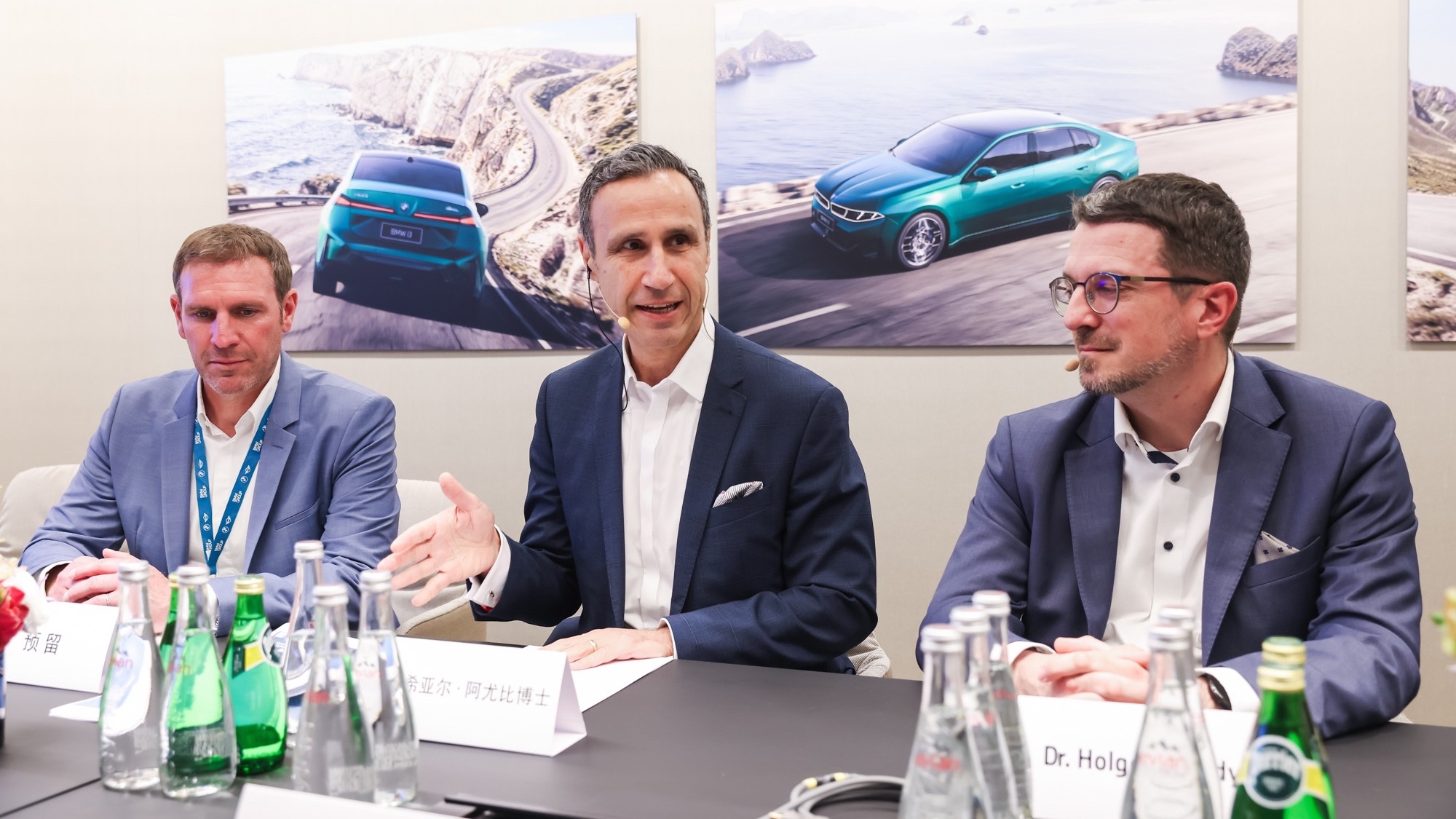
In discussions with Dr. Michael Ayoub, Senior Vice President of Driving Experience at BMW Group, and Dr. Holger Grandy, Vice President of Research and Development, Driving Experience at BMW China, a clearer vision emerges—BMW is bringing intelligent driving back to the driving experience itself.
No “Black Box”: BMW + Momenta Partnership Logic
When discussing the partnership with Momenta, BMW does not emphasize “leadership” or “benchmarking” but rather presents an intriguing combination: China’s innovation speed + BMW’s quality system. In BMW’s view, the advantage of Chinese intelligent driving companies lies in rapid iteration, while BMW’s value is in turning these capabilities into stable, controllable, and deliverable experiences.
A key prerequisite is: not accepting a black box.
BMW does not simply procure a complete solution and integrate it into the vehicle; instead, it insists on mastery over software and hardware architecture, deeply integrating the driver assistance system into its own control super brain. The direct result of this is consistency and controllability of system behavior.
For instance, a typical difference: many systems exit directly when the driver lightly taps the brakes or corrects the direction, whereas BMW expects the system to continue working, only making dynamic adjustments to reduce the feeling of being “interrupted.”
This seamless experience, according to BMW, is more significant than mere functionality.
Simultaneously, BMW repeatedly emphasizes driving dynamics—even in an assisted driving state, it must achieve:
- Smooth braking (imperceptible stops)
- Linear and natural acceleration and deceleration
- Seamless integration throughout the process
- This is not about a single functional point but rather the unified scheduling capability of the entire vehicle system. Hence, BMW insists on in-house development and deep integration, rather than relying on supplier modules.
- As for why they chose Momenta, BMW’s answer is equally measured: the key is not who is stronger, but who better fits BMW’s experience definition. Both parties participate in safety strategy and system integration, merging AI capabilities with traditional engineering systems, which is particularly crucial.
Even in the Autonomous Era, BMW Still Bets on Human Driving
A deeper question arises: as L3 and even L4 gradually materialize, is “driving” itself still important?
BMW’s judgment is: not only is it important, but it will also persist in the long term.
They have observed significant user differences: in Europe and the US, users prefer to control the vehicle, while Chinese users are more open to assisted driving. However, even so, a significant number of users only employ assisted driving in specific scenarios, such as for commuting, while opting to drive themselves on weekends. This means the future will not be fully autonomous but rather a state of long-term coexistence.BMW continues to prioritize driving control as a core capability—even with the integration of intelligent driving, the vehicle must still feel like a BMW.
When it comes to technical frameworks, BMW approaches the currently popular end-to-end solutions with caution. They argue that such models are essentially “black boxes,” making it difficult to ensure the reproducibility of results. However, in L3 scenarios, the system must meet a fundamental principle: the same input must yield the same output; otherwise, safety cannot be defined.
Therefore, BMW’s approach combines deterministic algorithms with AI models—leveraging AI’s generalization abilities while maintaining control within the engineering framework. Moreover, they emphasize the system’s “self-diagnostic ability” to prevent issues like lane misjudgment that go unrecognized.
In traditional domains such as chassis and braking, BMW extends this line of thinking. Take imperceptible braking as an example: its advantage lies not just in motor control but also in the deep coordination of the entire vehicle system. Such capabilities depend on the vehicle’s overall architecture rather than any single technological aspect.
Regarding air suspension and active chassis, which are favored in the Chinese market, BMW does not reject them but provides them selectively. They value the system’s controllability under various conditions over a single-dimensional comfort improvement.
Final Thoughts
From this dialogue, it is apparent that BMW’s approach to intelligent driving is not a function race but a choice more inclined toward engineering and experience:
- Avoid Black Boxes
- Emphasize System Integration
- Maintain Consistency in Driving Experience
- Adopt AI with Restraint
- In an era increasingly emphasizing automation, BMW still highlights a more traditional concept: a car must remain enjoyable to drive.
Appendix: Full Dialogue
Question: Regarding the partnership between BMW and Momenta, how do you perceive BMW’s distinction in intelligent driving compared to other brands?
Answer: I don’t want to discuss competitors, but I would like to talk about the partnership between BMW and Momenta. We have realized two things: China’s speed of innovation, combined with BMW’s legacy of quality. Our experience is about innovation with Momenta, and we are proud of the performance results we have achieved.
The second point is that we integrate it into BMW’s driving control system. For instance, we don’t want the driving assistance system to be disabled just with a slight brake. We want it to remain operational while allowing for adjustments. This differs from other companies.
Question: What do you believe is BMW’s advantage in this context?
Answer: Based on user feedback, there is sometimes concern that even slightly interacting with the system, whether through braking or a slight touch of the steering wheel, will disable the system, requiring a restart of the driving assistance.
I also like to discuss driving dynamics, such as imperceptible stops and smooth acceleration and deceleration. You don’t experience abrupt braking; instead, the drive feels smooth and seamless. I also want to explain BMW’s commitment to owning our software and hardware architecture so that we can integrate all systems cohesively. We do not simply purchase a system like a black box and place it into our cars.Our driver assistance systems and Driving Superbrain integrate seamlessly to deliver an exceptional driving experience to our clients. This is our unique strength.
Question: Why did BMW choose Momenta over Horizon, Huawei, or other Chinese intelligent driving operators?
Answer: The Chinese market features many innovative and exceptional partners, such as Huawei, Horizon, and Momenta, many of whom can deliver the innovation we seek. Our consideration involved many factors, and we wanted the right systems in the car to provide an experience synonymous with BMW characteristics and traits. Momenta’s performance aligns well with BMW’s needs.
From the outset, our collaboration with Momenta has been very productive, enabling us to jointly influence experiences in safety and system integration. This union allows us to merge AI capabilities with our expertise to shape the customer experience. We aim to deliver the genuine BMW driving experience, not just install a black box in the car.
Question: As we move into the L3 or L4 autonomous driving environment, high-end brands will continue to leverage driving control as a key selling point. How can this be reinforced as an evident value?
Answer: First, I would like to note that we’ve observed diverse customer behaviors varying by country. For instance, in Europe and the USA, customers prefer to have control over the vehicle and require executive systems to embrace driver assistance features. In Europe, after introducing L3 products, we found customers only use the L3 system on highways, preferring to drive themselves in cities. Some customers only use parking assistance and never engage L2 or L3 driving aids. These systems are utilized in varying scenarios by different users, such as weekend drives, creating a spectrum of usage patterns. In contrast, Chinese customers are more innovative and open-minded, showing a willingness to embrace driver assistance. This difference is crucial.
BMW has a long history with L3 driver assistance and understands the importance of safety. When discussing L3, we have dedicated driving systems and hardware that include redundancy to ensure safety, achieved through a failover between Hardware 1 and Hardware 2.
In the past, driving system algorithms were programmed to adhere to physical performance using deterministic approaches; this repeatability is manufacturable—identical inputs result in consistent driving experiences. Despite programming challenges, BMW’s robust engineering enables this. Presently, end-to-end technology is favored because it’s straightforward; however, it relies on a black box where inputs and outputs are known, but the internal computations are not. Regarding safety, “repeatability” is crucial; car responses should be consistent in identical scenarios. However, with AI, responses may vary, leaving safety to environmental conditions rather than system reliability. Therefore, we aspire to merge both technologies.However, currently, no driving system, whether AI-enabled or not, can completely avoid malfunctions. When referring to L3 driving assistance, such incidents are not permissible and cannot be tolerated. The performance and response of the system should balance safety, which is not related to hardware but rather the “brain” itself should be inherently safe. We do not tolerate “false positives.” For example, I recently tried a driving assistance system that led me into the wrong lane. If the system cannot recognize a lane error, an accident could occur—this is the self-diagnosis capability. Thus, the system’s self-awareness and self-diagnosis are crucial.
If we restrict the operational domain, such as on highways or other specific areas, L3 automated driving assistance can be achieved indeed, but accidents are absolutely intolerable. We are striving, but will never introduce immature options to the market because we are aware of potential risks.
Returning to your question, I believe there are definitely users willing to accept driving assistance systems, and we will explain BMW’s approach to them in detail. However, some users prefer manual driving; they might use assistance on the way to the office but choose to drive themselves when they want to experience BMW’s handling capabilities. These users will continue to exist in 2030 and beyond.
Question: My question is, with the rapid iteration and upgrades of electric technology, how will BMW maintain this advantage? Isn’t it hard to maintain?
Answer: There will always be innovators and followers. As for functionality, we don’t just buy from suppliers; we develop it ourselves. We integrate this into our driving systems. Whether seamless braking will be available on other models depends on the vehicle’s topology. If using an internal combustion engine, it might be a bit more challenging due to the stiffer transmission. However, our engineers are capable enough to innovate and integrate these systems, like combining seamless braking with driving assistance or integrating it with other systems in the future. So, we can still distance ourselves from competitors under current conditions.
Question: You mentioned in pursuit of better balance, many cars in the Chinese market use air suspension or adaptive chassis. Why does BMW insist on using mechanical chassis? Is there a future plan for this? Additionally, will the “driving control supercomputer” enhance fuel vehicles too or remain limited to electric vehicles?
Answer: This depends on user needs. Some users might focus more on comfort, such as in the 7 series, where we offer many systems, including air suspension and active compensation systems. However, we haven’t adopted a “fully active” chassis. A fully active chassis integrates roll control. We developed similar systems 20 years ago in our powertrain research.While it can enhance tire comfort and prevent continuous tire vibration, this type of system is typically only effective within a narrow frequency range. For example, around 15 Hz, the system becomes challenging to control and may even lead to vehicle body oscillation, which drivers can noticeably feel. Therefore, at that time, we opted not to equip such a system on our models. I want to emphasize that BMW provides a range of chassis options entirely based on customer requirements, including those that are more mechanically oriented as well as those that are more actively oriented. It ultimately depends on the customer’s needs. We have also noticed how much Chinese customers favor air suspension, which is achievable.
This article is a translation by AI of a Chinese report from 42HOW. If you have any questions about it, please email bd@42how.com.