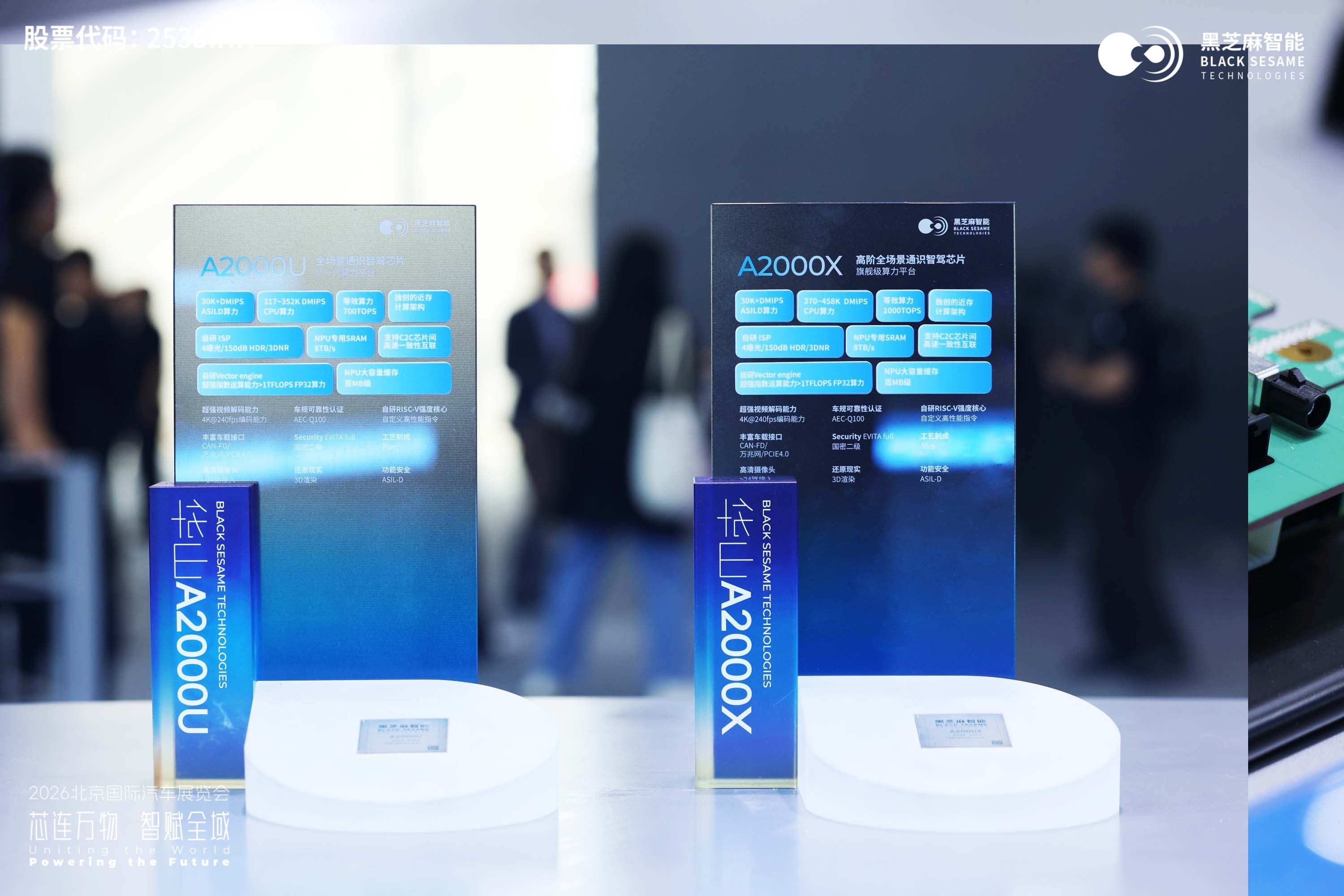
On April 24, Black Sesame Intelligence unveiled the “FAD Tianyan” L3 autonomous driving platform based on the FAD 2.0 open platform at the 2026 Beijing Auto Show. This launch marks the implementation of the FAD 2.0 open platform’s specific solutions and accelerates the application of the Huashan A2000 family of chips.
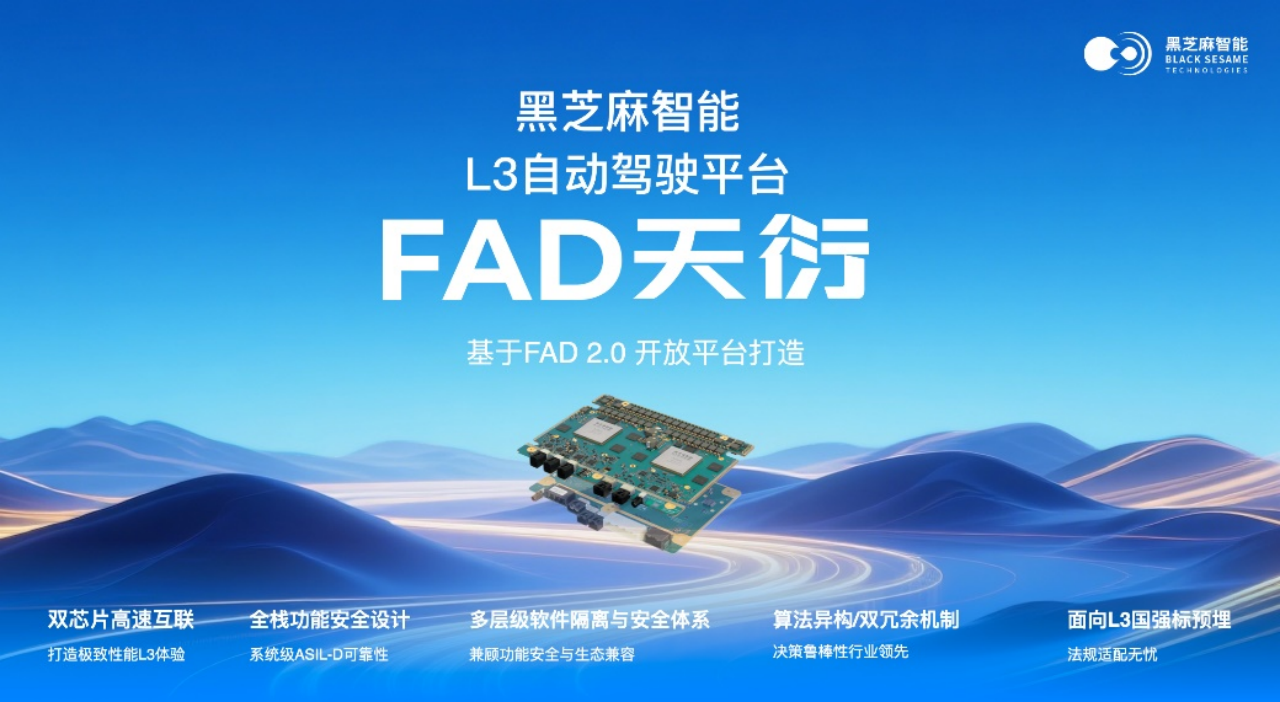
The FAD Tianyan platform is founded on the A2000U dual-chip design, offering an equivalent computational power of 700 TOPS, featuring a self-developed Jiuzhao NPU architecture that supports hardware acceleration for Transformers and mixed-precision computation. The two chips achieve low-latency, high-bandwidth data collaboration through high-speed interconnection technology, providing redundancy for each other. A single domain controller meets ASIL-D level requirements, realizing system-level ASIL-D reliability. On the software side, the platform constructs a multilayered software isolation and security system that balances functional safety and ecological compatibility. Once the MCU is isolated, its power supply, internal bus, and SoC achieve physical-level isolation, preventing shared hardware failure risks. The information security subsystem strictly adheres to the ISO 21434 standard, integrating national cryptographic algorithms, secure boot, and root certificate management, building an information security protection system. The functional safety subsystem, developed by Black Sesame Intelligence, is an ASIL-D level system. It incorporates the A2000 family’s exclusive chip security library, providing both software and hardware fault detection and recovery capabilities.
According to the national mandatory standard “Safety Requirements for Automated Driving Systems of Intelligent Connected Vehicles,” effective on July 1, 2027, L3 systems must be capable of executing all dynamic driving tasks, with a safety level no less than that of a qualified and attentive human driver. The FAD Tianyan platform is pre-embedded for L3 national mandatory standards, ensuring regulatory compliance with ease. The platform adopts algorithmic heterogeneity and dual redundancy mechanisms; the perception, planning, and control modules deploy dual-redundancy or heterogeneous algorithms, simultaneously running both sets and comparing results in real-time to effectively avoid the systemic risks of a single algorithm. To meet the safety needs of L3 autonomous driving systems, the platform boasts a dual-chip high-speed interconnection architecture, redundant power design, multiple sensor redundancies, strong isolation MCU, and a software layered isolation mechanism. It also establishes a hybrid safety base combining ASIL-D level firmware with an ASIL-B level Linux system.
This article is a translation by AI of a Chinese report from 42HOW. If you have any questions about it, please email bd@42how.com.