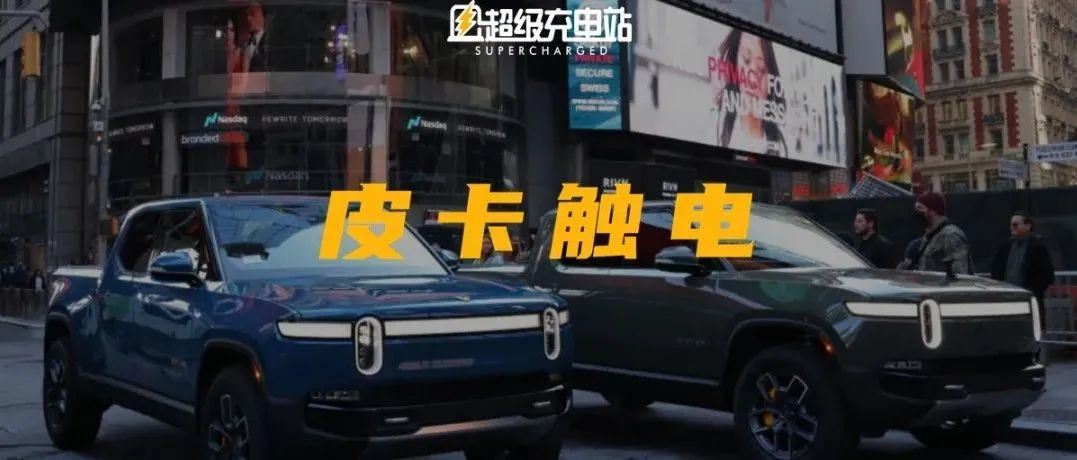
Overnight, Another Electric Vehicle Startup Joins the Ranks of Top Global Auto Companies
On November 10th, local time, American electric pickup and SUV automaker Rivian debuted on the NASDAQ with an IPO issued at $78 per share, offering a total of 135 million shares and raising nearly $12 billion in funding. On a fully diluted basis, the company’s valuation is nearly $77 billion USD (approximately RMB 493.2 billion).

This is the fourth IPO in the US stock market in the past decade to raise over $8 billion USD in funding, with the other three being Alibaba ($25 billion USD), Facebook ($16 billion USD), and Uber ($8.1 billion USD).
Following its listing, Rivian’s stock price rapidly rose. As of the closing of the US stock market on that day, Rivian’s stock price had risen by 29.14%, reaching $100.73 USD per share (approximately RMB 643.7 yuan per share), and its market value had reached $85.9 billion USD (approximately RMB 549 billion yuan).

This means that Rivian has become the third largest auto company in the US, after only Tesla and General Motors, as well as the second largest pure electric vehicle company in the world–and all of this is based on the foundation of Rivian’s mass-produced vehicles, which have only just begun to be delivered in the past few months.
This has led to the media labeling Rivian as “Tesla’s biggest rival,” “Tesla killer,” and “Tesla’s nemesis.”
So why is Rivian so popular among investors? Can its products really compete with Tesla?

Over a Decade of Auto Manufacturing, Over $10 Billion USD in Funding
In recent years, the ups and downs of China’s new car makers have taught us a lesson: auto manufacturing is a money-burning game. Regardless of whether or not cars are actually produced, as long as a business can continuously raise funds, it can survive.
Rivian’s story once again proves this “truth.”
This has even led to Elon Musk, CEO of Tesla, questioning on Twitter whether “being an electric vehicle company means you don’t have to deliver products and can rely solely on funding?”

But as the saying goes, success is not just about personal efforts, but also about various comprehensive factors.
In 2009, Rivian founder Robert J. Scaringe graduated with a PhD in Mechanical Engineering from the Sloan Automotive Lab at the Massachusetts Institute of Technology.
He then founded Mainstream Motors, the predecessor of Rivian, in his hometown of Florida with a dream of building cars.

At first glance, you might think this is another exciting story of high-knowledge entrepreneurship, like the “Silicon Valley Iron Man”. However, compared to Musk’s legendary story of earning his first bucket of gold through Paypal, Scaringe’s story seems more “down-to-earth”.
Scaringe’s father is the founder of a military-related thermal control company. With a strong family background and abundant resources from the government and the military, he can bring many conveniences to Scaringe’s path of making cars.
At the beginning, Mainstream Motors had a team of only about 20 people, and the initial development strategy was similar to Tesla’s, focusing on building a small hybrid sports car with a 2+2 layout.
Their initial funding came from “donations”: the Florida government provided them with $2 million in grants and tax credits.
Well, we can only say that if the second generation of the rich wants to add some challenges to their lives, they can try making cars.
However, two years later, when we come to 2011, Scaringe gave up his dream of building sports cars.
Regarding this change, Scaringe later wrote in a letter to investors, “It is increasingly clear that there are no other achievements to be gained in building new energy sports cars other than what Tesla has already achieved.”
Since the pursuit of speed and passion is not feasible, let’s turn our attention to a broader horizon.
 Rivian decided to follow the lead of GoPro and North Face and create pure electric pickup trucks and SUVs for outdoor off-roading, officially renaming the company Rivian. In 2015, Rivian established research and development centers in Michigan and the San Francisco Bay Area. In the same year, Rivian moved its headquarters from Florida to Livonia, Michigan to be closer to core suppliers. In 2017, Rivian acquired an old factory in Illinois, USA from Mitsubishi, which was known for its expertise in manufacturing hardcore off-road vehicles. This move was often compared to Tesla’s acquisition of an old Toyota factory.
After nearly a decade of research and development, Rivian unveiled two pure electric vehicle models, the R1T pickup truck and R1S SUV, at the 2018 Los Angeles Auto Show. The pickup truck and SUV have clearly captured the hearts of American consumers who love large vehicles, and have also attracted more investors to Rivian’s favor.
Since February 2019, Rivian has completed six rounds of financing, with investors including Amazon, Standard Chartered Bank, Ford, BlackRock, and other enterprises and financial institutions. As of August 2021, Rivian has raised approximately $11 billion (approximately RMB 70.45 billion). This amount would even make many new domestic automakers in China envious.
Among Rivian’s investors, the ones that have attracted the most attention from the outside world are Amazon and Ford Motor Company. Jeff Bezos, the owner of Amazon, and Musk have always had a strained relationship, and the two’s manned aviation companies are also in fierce competition. It’s not difficult to understand why Amazon, who is known to “hate Tesla the most”, invested in Rivian. As early as 2019, Amazon led Rivian’s $700 million Series A financing round. In September of the same year, Rivian signed an agreement with Amazon to provide EDV pure electric logistics vehicles.By 2030, Amazon is expected to purchase 100,000 logistics vehicles that closely resemble “pure electric Iveco” from Rivian.

Amazon’s involvement has injected fashionable “internet genes” into Rivian, which has also attracted the attention of traditional automakers.
Two American auto giants, GM and Ford, have both had contact with Rivian. In the end, Ford won the competition and invested hundreds of millions of dollars in Rivian in multiple rounds.

Interestingly, according to media reports, Ford was in a panic about its own electrification capabilities at the time.
“At that time, all the start-ups were being heavily promoted, and we were panicked and thought we needed to be one of them,” said an internal Ford employee in an interview.
At the same time, it was reported that Ford had considered using Rivian’s pure electric platform to create Lincoln’s electric vehicle model after the investment.
But later, due to changes in senior management and cost control considerations, Ford ultimately gave up this plan and instead launched the F-150 Lightning pure electric pickup truck and the Mustang Mach-E based on its own technology.

So if someone asks you, “Did Ford’s investment in Rivian, which makes pure electric pickups, have anything to do with its own F-150 electric vehicle?” you can confidently tell them, “No.”
According to Rivian’s IPO prospectus, Amazon holds 22.4% of its pre-issuance shares and will hold 17.3% of its post-issuance shares, making it the largest shareholder; Ford holds 14.4% of its pre-issuance shares and will hold 11.1% of its post-issuance shares, making it the fourth largest shareholder.
With investments from two giants, Rivian has been described as “having both internet genes and industrial genes, and perhaps will become Tesla’s strongest opponent” in various reports.

In addition to the support of its backers, another important reason for Rivian’s soaring stock price is that its products have really been mass-produced in the past few months.
With 50,000 orders in hand, production is ahead of CybertruckThere are three models in Rivian’s product lineup, namely R1T electric pickup, R1S electric SUV, and EDV electric delivery van.

Among them, the R1T aimed at consumers has a starting price of $67,500 (about RMB 432,000), with an EPA range of 505 kilometers; the R1S has a starting price of $70,000 (about RMB 448,000), with an EPA range of 508 kilometers.

Rivian models are based on an all-electric platform called “skateboard”. The platform integrates the motor, battery management system, cooling system, suspension system, and hydraulic control system into a complete module, located in the middle of the chassis.

In addition, to deal with the common off-road scenes of pickups and SUVs, Rivian’s two models use a four-motor drive mode, and each wheel is independently driven by a 147kW motor.
With the support of the motors, Rivian models can achieve independent driving of all four wheels, utilizing the differential of the tires on both sides to achieve a 360-degree rotation and turning in place, which is also called “tank turn”.

As for the batteries, Rivian has not disclosed too much information publicly. However, according to previous media reports, thanks to the ample size of the pickup truck model, Rivian models will be equipped with battery packs with a capacity of up to 105/135 kilowatt hours, and a long-range version with a 180 kilowatt-hour battery pack will be released later.
As for the exterior and interior, compared to the futuristic Tesla Cybertruck, Rivian models appear more “traditional” but also more practical.
 Previously, the super-charging station had detailed the “considerate thoughts” for outdoor travel in the R1T interior. Interested friends can click on Rivian R1T just released interior details that make you forget the umbrella pulled out of the Rolls-Royce door for review.
What we want to show you here is still the “mobile kitchen” that can stretch out on the side of the car after the R1T is equipped with outdoor accessories.

According to Rivian’s prospectus, as of the end of September, the company had nearly 50,000 orders for R1T and R1S.
And on September 15th, the founder of Rivian announced on Twitter that the first R1T electric pickup truck has been produced and offline.

In September, Rivian produced 12 R1Ts and delivered 11; in October, the company produced a total of 180 R1Ts and delivered 156.
Although these vehicles are currently delivered to Rivian employees for internal testing and have not been delivered to actual consumers, it does not prevent Rivian from becoming the first automaker to push electric pickup trucks to the market.

This has already surpassed traditional car companies such as GM and Ford. Meanwhile, Tesla’s Cybertruck has currently delayed its delivery plan and is expected to go offline in 2022 and begin mass production and delivery in 2023.
Compared to the one-year delivery time difference of its competitors, undoubtedly gave Rivian a greater valuation imagination.
Rivian’s prospectus shows that it will produce 1,200 R1T models by the end of this year, and 1,000 of them will be delivered to consumers; R1S will produce 25 vehicles in December, and 15 of them will be delivered to customers. As for commercial vehicles, Rivian said it will produce and deliver approximately 10 EDVs this year.

Not necessarily a Tesla killer, but it makes the market more interesting
The pickup truck has always been the most popular model in the American market. In 2020, the top three selling products in the US automotive market were the Ford F-Series, the Chevrolet Silverado, and the Dodge RAM.
In addition, according to incomplete statistics, there are now as many as 8 companies in the US that have released plans for electric pickup trucks.
In this context, it is not difficult to understand why Rivian’s stock price skyrocketed after its listing on the US stock market.
With the US government’s continued promotion of the 2035 zero-emission vehicle policy, electric pickup trucks undoubtedly have huge potential for development in the US in the future.
As for whether Rivian will really become a “Tesla killer” as reported in the media, only time will tell.
But in any case, we can see from Rivian’s products that pickup trucks and SUVs, once seemingly unrelated to outdoor off-roading, can now begin to undergo electrification transformation.
More diverse product forms will undoubtedly make the entire new energy vehicle market more interesting.
It is worth noting that the Chinese market is also within Rivian’s plans. According to the plan, Rivian will launch a compact SUV in China in 2022. The founder has said, “If we don’t consider China and Europe as important long-term markets, we can’t truly create a car company.”
In addition, he has also revealed that Rivian’s products may eventually be manufactured directly in China on a local basis.
This article is a translation by ChatGPT of a Chinese report from 42HOW. If you have any questions about it, please email bd@42how.com.