Introduction:
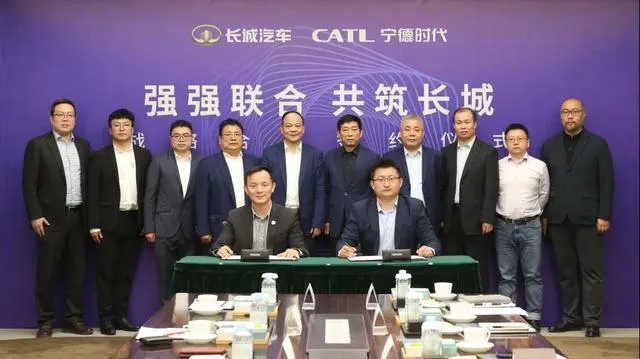
Car manufacturers’ self-developed batteries are facing severe challenges. On June 3, according to Reuters, Tesla is discussing with CATL about building a battery super factory near their Shanghai Gigafactory, with a capacity of up to 80GWh. The day before, Great Wall also announced a ten-year strategic cooperation framework agreement with CATL.
The Route of Car Manufacturers’ Self-Developed Batteries:
Tesla and Great Wall are both firm supporters of the self-developed battery route. For example, the former has developed 4680 batteries and Powerwall energy storage systems, and is expected to become the third global power battery oligarch after CATL and LG New Energy. The latter established the Foton Energy in 2018 to disrupt the power battery market.
Despite both Tesla and Great Wall having their own self-developed battery plans, why did they deepen their cooperation with CATL, the leading battery maker? Is it because their self-developed batteries have encountered a crisis, or some other reason?
Whatever the reason, we can see that CATL has once again become the core of various competitions. Coupled with CATL’s stock price breaking one trillion yuan recently, everything is not coincidental, and the CATL myth is still being written.
The Misery of All Car Manufacturers’ Self-Developed Batteries Reflected by Foton Energy:
In 2012, the global new energy revolution was gradually emerging. For this reason, Great Wall conducted pre-research on the power battery and subsequently established the Power Battery Research Institute.
By 2018, the development of new energy had become an absolute trend. In order to solve the most critical power battery problem of new energy vehicles, Great Wall independently established the Foton Energy based on its Power Battery Research Institute.
Since then, Foton Energy’s development has opened a new chapter.
In terms of customer development, taking lessons from BYD, Foton Energy supplies batteries to Great Wall in-house while competing with other suppliers in the market independently.
Since its establishment more than three years ago, Foton Energy’s development has been visible to the naked eye. Not only has it released cobalt-free and semi-solid state battery technologies, but it has also set up production bases in Changzhou, Huzhou, Suining in Sichuan, even in Europe and other places.
In the market, Foton Energy’s progress has also been rapid. According to data from the China Association of Automobile Manufacturers, the installed capacity of new energy vehicle power batteries in China from January to April was 31.6GWh, and Foton Energy ranked eighth with an installed capacity of 0.57GWh.
Currently, Foton Energy has a capacity of 6GWh, with planned capacity under construction and planning up to 92GWh. It is expected that by 2025, Foton Energy’s global capacity will reach 200GWh.
According to Yang Hongxin, the Chairman and CEO of Honeycomb Energy, the goal for the company is to rank among the top 5 in terms of installed capacity of power batteries in the Chinese market this year.
However, if we calculate the estimated demand for the batteries of one of the core brands of Great Wall Motors – ORA, we will get an opposite conclusion.
According to the “Electric Power” statistics of the new power brands’ real on-off list, in April, ORA ranked first among the new power brands with 12,027 vehicles, exceeding Tesla.
Yes, although Great Wall C30EV, WEY and other plug-in new energy vehicles did not create much impact in the new energy market, the development of the Great Wall ORA is quite rapid, which means that it will require more power batteries.
ORA currently has four pure electric vehicles for sale, including iQ, White Cat, Good Cat and Black Cat, and on average, each car requires 40KWh of electricity. Assuming that ORA’s total monthly sales volume is 10,000, the electricity demand for ORA in the first four months of this year will be 1.6GWh.
Looking at the installed capacity of Honeycomb Energy from January to April, it is only 0.57GWh, which leaves a gap of 1GWh with ORA’s market demand, and there is still supply for other brands. This means that Honeycomb Energy will only provide even less for Great Wall’s self-provided batteries.
Although the above data is estimated, a simple conclusion can be drawn that the “effective battery production capacity” of Honeycomb Energy cannot currently meet Great Wall’s self-provision.
According to Yao Fei, the Market Director of ORA, there is indeed a short supply of power batteries for Good Cat. According to an ORA dealer in Shanghai who revealed to “Electric Power”, due to the shortage of batteries, the delivery period for ORA models has been extended to 2-3 months.
Based on this background and situation, looking at Great Wall’s recent ten-year cooperation agreement signed with CATL, it is not difficult to see Great Wall’s urgent need for power batteries and the helplessness with Honeycomb Energy.
Objectively speaking, the development of Honeycomb Energy over the past three years has been impressive, but compared with ORA’s market demand, Honeycomb still has a long way to go to shoulder the heavy responsibility.
For Great Wall, a strong player in the industry, developing and launching Honeycomb Energy in the long run is not wrong, but it may seem far-fetched to expect it to immediately achieve great results. Signing a deep cooperation agreement with battery giants such as CATL is currently a more practical solution.
As for the future, if Honeycomb Energy can survive and have competitive products in the market, Great Wall will naturally prioritize purchasing Honeycomb Energy batteries, after all, they are their own company.Even in the future, Great Wall Motors will not be able to rely solely on Honeycomb Energy’s batteries. They must continue to rely on third-party battery suppliers such as CATL (Contemporary Amperex Technology Co. Limited) because Honeycomb Energy is expected to go public on the sci-tech innovation board in 2022, and one of the necessary conditions for the IPO is that the proportion of exported products must exceed 50%.
For Great Wall Motors, it is necessary to rely on third-party battery suppliers, whether it is now or in the future. Perhaps it is CATL, or perhaps other battery brands.
Obviously, the case where Great Wall Motors launched Honeycomb and was limited by Honeycomb is not unique. At present, many automakers are still insisting on developing their own batteries in order to gain control of the battery market.
However, the constraints of Honeycomb Energy on the development of Great Wall Motors’ new energy vehicles should also alert other automakers who are still insisting on developing their own batteries. While developing their own batteries can have advantages, they should not sacrifice market share at the expense of their strategy.
Rather than fighting for a share of the mature battery market, it is better to establish an early presence in the chaotic software market.
From insisting on developing their own batteries to choosing to strengthen cooperation with external battery suppliers, Great Wall Motors seems to have stumbled in battery development. In reality, they underestimated the complexity of battery technology and its impact on system development such as cost.
According to a dealer of Euler Motors who spoke to EVnewscn, Honeycomb Energy only supplies the top version of Hao Fei, while the middle version and the most popular model of Black Cat still use CATL batteries.
The above information shows that the amount of batteries supplied by Honeycomb Energy to Euler Motors is even less than expected. From the side, it shows that Honeycomb Energy’s batteries are only a supplement to Great Wall Motors’ new energy vehicles, and the main volume production responsibility is still assigned to CATL.
According to Yang Hongxin, the CEO of Euler Motors, Honeycomb Energy’s battery production capacity and technology are good, but why does Great Wall Motors not dare to “reuse” them? What is the hidden story behind this disparity?
A power battery industry observer told EVnewscn that “Honeycomb Energy’s batteries are not good, and their technology, process, and cost cannot compete with first-tier factories.” We cannot comment on this observer’s statement. Let’s look at the data.
Yang Hongxin said that Honeycomb Energy is currently at full capacity, and the production factory is located in Changzhou with a capacity of 6GWh. Therefore, theoretically, Honeycomb Energy should produce 2GWh of batteries from January to April alone. However, the actual installation volume is only 0.57GWh, leaving a gap of approximately 1.5GWh.
For the above data, outsiders may be confused as to why there is such a large gap. In fact, battery factories generally have a production yield, that is, the ratio of the usable battery production to the total capacity. The higher the ratio, the larger the available capacity and the more mature the battery factory.So, it may be true as Yang Hongxin said that the Honeycomb energy factory is at full production, but it is also an undeniable fact that the yield rate is low.
For a new battery factory, low yield is a common phenomenon. The difference lies in the speed of improvement. International battery giants improve slightly faster due to mature technology and processes, while factories like Honeycomb Energy, with little battery production experience, improve more slowly.
In fact, even veteran battery manufacturers like BYD had serious problems with low yield rates in the early stages due to the complex blade battery process, which indirectly caused various negative effects such as low car supply, dealer price increases, and consumer complaints.
Therefore, batteries are not simple, and producing high-quality batteries is not easy. After several years of rapid development, the power battery market has experienced a Matthew effect, which has led to today’s power battery pattern.
As for the automakers’ self-developed batteries, we can understand their initial intentions. However, the embarrassing situation faced by Honeycomb Energy is enough to make people think deeply. Automotive executives should rethink: should they stick to self-developed batteries? Have they achieved the expected results with self-developed batteries?
In the view of “Electric Force”, binding with battery giants is a better choice than stubbornly self-developing batteries.
First, the inflection point of new energy development has come. The domestic new energy penetration rate has exceeded the critical point of 10%, and Europe has exceeded 15%. The awakened market will not give automakers too much time to self-develop and mass-produce batteries. They must use existing battery products, otherwise they will only be abandoned by the market and the times.
Second, the form of electric vehicle products has changed. It is no longer just a means of transportation, it has the definition of the third space, and coupled with the rise of self-driving, future electric vehicles will become smarter and smarter. The core of smart electric vehicles is not only the three-electric system, but also software. Neither batteries nor software are the strong points of automakers, but compared to the mature battery market, the software market still has opportunities.
Therefore, for automakers, it is better to focus on software development rather than insist on grasping batteries.
The market also deduces this logic. In the past two years, there has been a voice in the industry that automakers are fleeing from Ningde era. However, from the recent three cooperation cases of Tesla, Daimler Trucks, and Great Wall, although they have self-developed batteries, they have not only not escaped from the Ningde era, but have deepened their cooperation with each other.
So, is it still necessary to put in a lot of effort to insist on self-developing batteries? The answer is already very clear.
This article is a translation by ChatGPT of a Chinese report from 42HOW. If you have any questions about it, please email bd@42how.com.