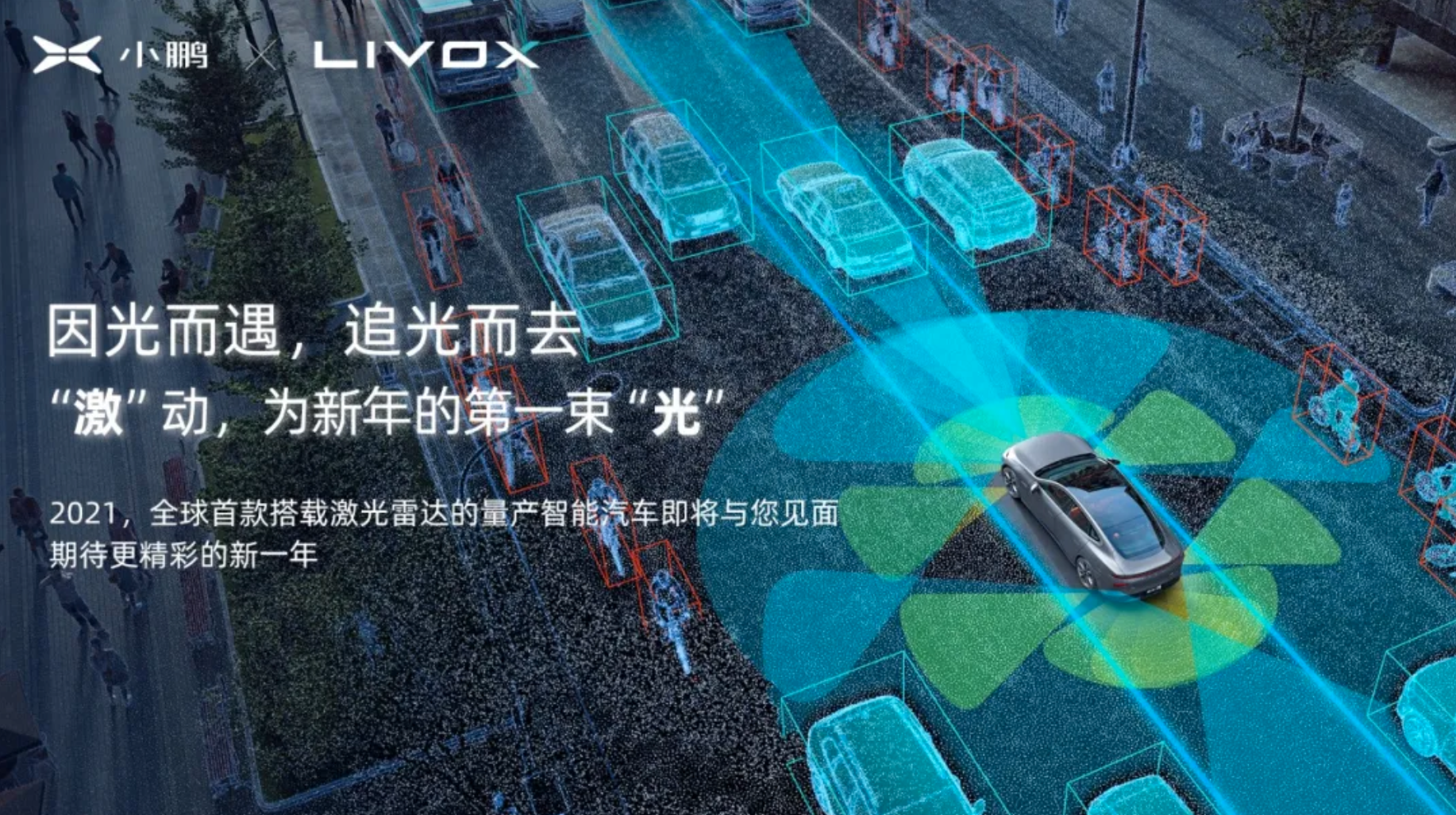
XPeng Motors partners with Livox, a brand under DJI, to launch new models featuring customized automotive-grade LiDAR in 2021
XPeng Motors announced today that it has partnered with Livox, a brand under DJI, to launch new models featuring customized automotive-grade LiDAR provided by Livox in 2021.
According to XPeng Motors’ previous announcement, its new car in 2021 will be a compact car based on its David platform, and this car will also become XPeng’s first product with LiDAR.
Livox, the supplier of LiDAR, was established in 2016 and was incubated by DJI Technology. It focuses on the research and development of scalable and high-performance LiDARs for mass production, currently with an annual production capacity of 100,000 units. The LiDAR adopted by XPeng Motors this time is the customized Horiz LiDAR for automotive-grade use under the Livox brand.
According to information previously released by Livox, the performance data of the public version of the Horiz LiDAR is:
FOV: 120° (horizontal) × 25° (vertical)
Distance accuracy: 2cm
ROI angular resolution: 0.2° × 0.2°
Range: 120m @ 10% reflectivity, 260m @ 80% reflectivity
Lifetime: 120,000 hours
In further data, Livox also stated that after the vehicle is equipped with the Horiz LiDAR, the system can detect white trucks in front of it at least 250m away, and under the speed of 120 km/h, the system can make decisions at 200m, giving the vehicle about 6 seconds of brake response time, and provide more than 20 point cloud data to the system for algorithm detection.
(LiDAR can enhance the comprehensive experience of automatic driving in weak scenarios)
Livox stated that the time required for the OEM project from design confirmation to mass production confirmation to SOP is about 21 months, and the project start time for Horiz LiDAR was Q1 2019. The cost of the public version of Horiz LiDAR is $800 per unit.
He XPeng himself also mentioned in an interview that XPeng Motors’ LiDAR project would require a lot of preparation, and that it was initiated two years ago with the timelines from both sides being basically in agreement.Compared with other ADAS sensors, Lidar has better penetration ability and signal reflection intensity, lower false alarm rate, and can work in environments where visual sensors are limited, such as weak light, darkness, and heavy fog, which has a certain value in improving the safety redundancy of assisted driving.
Although XPeng Motors’ final product has not been unveiled, the XPilot system with Lidar technology is highly likely to have significant improvements. We’ll have to wait until the new car is released.
This article is a translation by ChatGPT of a Chinese report from 42HOW. If you have any questions about it, please email bd@42how.com.