Where is BMW’s next generation of pure electric vehicles in the midst of the Mercedes EQC, the Audi e-tron, the Porsche Taycan, and even the Jaguar I-PACE?
Recently, Stefan Juraschek, Vice President of BMW Electric Powertrain Development, accepted an interview about BMW’s electrification strategy. Based on the interview information, this article discusses BMW’s electrification concept.
Stefan’s comments on BMW’s fifth-generation electric powertrain in the interview were interesting.
“BMW Group’s fifth-generation electric powertrain has been developed. A key advantage of the fifth-generation system is the highly integrated motor, gearbox, and control unit, which are integrated into a single electric drive component. This extremely compact component takes up much less space than the three separate components used in the previous generations.
Its modular architecture also means that it is scalable, allowing its specifications to be adjusted to suit different installation spaces and power requirements of different models. At the same time as launching the new electric powertrain, BMW will also apply the next generation of battery cell in new, scalable, and higher-performing battery packs for next generation vehicles.
The modular “building blocks” concept will allow new batteries to flexibly adapt to various vehicle architectures. Another highly integrated component will be put into operation in the form of a DC/DC charger unit.”
Keywords: highly integrated, downsized, scalable.
In fact, as early as a technology workshop held by BMW in December 2017, BMW established the development direction of the next generation electric powertrain: integrating the motor, gearbox, and control unit into one, which brings five improvements.
- Weight reduction
- Increase in power density
- Cost reduction
- Adaptability to production systems
- Application of new semiconductor technologies (SiC, GaN)
So, when will the fifth-generation electric powertrain be put into production?
The following is BMW’s electrification product roadmap, which reveals a lot of information.Above the timeline is the pure electric product line and below is the hybrid product line. Representing the fifth-generation powertrain is the gray product matrix, with the BMW iX3 as the leftmost model. This is also the first model equipped with BMW’s fifth-generation powertrain and will be launched in 2020.
As the article mentioned at the beginning, BMW launched its first pure electric car in 2013, but it wasn’t until 2020 that it launched the main model, the BMW iX3, to compete head-to-head with fuel-powered cars. From the perspective of product rhythm, BMW’s move is even slower than Mercedes and Audi.
However, from another perspective, launching a year later gives the iX3 the opportunity to be equipped with more integrated and advanced powertrains, as well as the next generation of higher-energy-density batteries, according to Stefan. The more advanced powertrain will be reflected bit by bit in key indicators such as control, energy consumption, and range for pure electric cars.
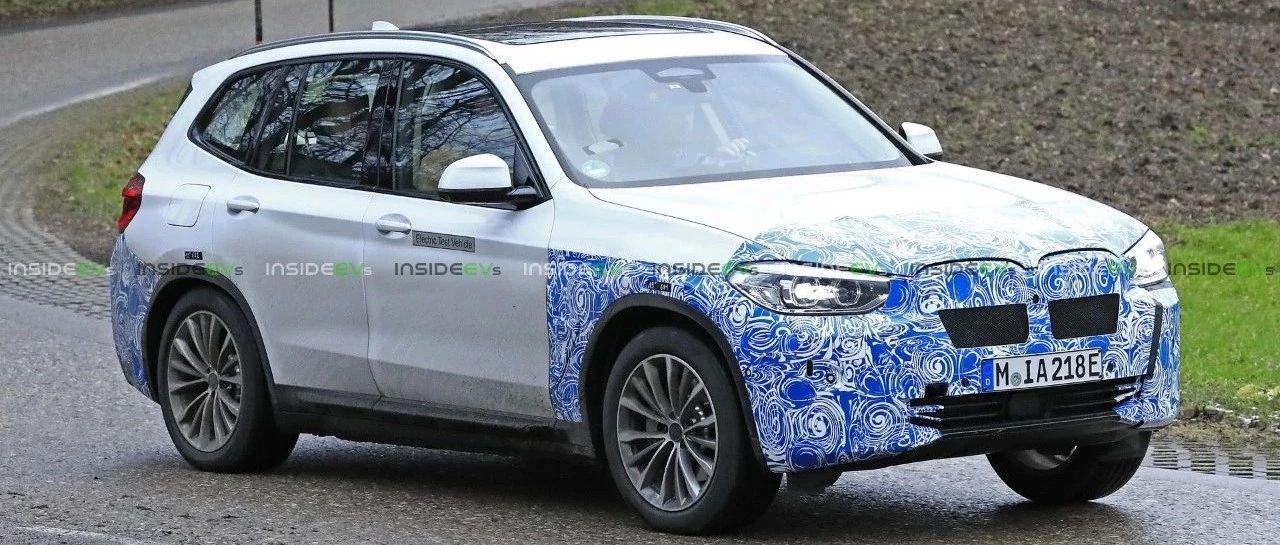
Recently, foreign media took pictures of the iX3 being tested on the road. Compared with the concept car, the charging port seems to have been moved from above the front wheel arch to the rear?


In fact, modularization, integration, and miniaturization should be the trend of the entire electric vehicle industry. In fact, there is a car company that is more extreme than BMW.
UBS mentioned in the Tesla Model 3 teardown report that Tesla has simplified the engineering, removed components, and increased the modularity of the powertrain as much as possible. The motor, gearbox, and inverter of the Model 3 are integrated into one unit, including battery management and charging control, DC/DC charger, onboard charger, and PDU, all of which are integrated into a unified component. (In contrast, 90% of parts for the GM Bolt are purchased from LG.)

UBS engineers describe this highly vertically integrated strategy as “next-generation, military-grade technology that leads peers by many years.”
In fact, this reflects a critical issue: If a car company’s motor, gearbox, electronic control unit, and other components come from different professional suppliers, it is very challenging to achieve high integration.Tesla is committed to vertical integration by replacing supplier solutions with higher levels of independent research and development. For example, starting from the 2170 battery mounted on Model 3, Tesla has grasped the design and R&D of battery monomers, while manufacturing is completed by Tesla’s joint venture, but the design, R&D, and manufacturing of battery modules and Packs are completed independently by Tesla.
Now let’s take a look at BMW’s approach.
According to BMW’s data, BMW has been independently researching and manufacturing battery modules and Packs since 2008. For battery monomers, BMW has “complete specifications and design authority”, but manufacturing is completed by the cooperative partner Samsung SDI.
Stefan elaborated on the meaning of “complete specifications and design authority” in the interview.
BMW has been expanding its expertise in battery technology and promoting its development. BMW will independently research and design prototypes of battery monomers and conduct small-scale trial production to fully understand the challenges of advanced technology in the production process and provide BMW’s exact requirements for suppliers.
Why not build your own battery factory like Tesla? Stefan’s answer is that independent production of batteries will not bring BMW a competitive advantage in the present or future. But this does not mean that BMW has not deployed in the battery field.
In fact, BMW is creating a battery supply alliance similar to the Tesla-Panasonic alliance. BMW has partnered with power battery manufacturer Northvolt.
In the official announcement, BMW stated that the BMW Group has rich experience in battery development, while Northvolt focuses on sustainable battery production. This division of labor is identical to that of the Tesla-Panasonic alliance.
However, the relatively unknown Northvolt is actually a startup established in October 2016. Northvolt’s founder and CEO, Peter Carlsson, was the former Vice President of Global Supply Chain at Tesla, and COO Paolo Cerruti was the former Vice President of Supply Chain & Operations Planning at Tesla.
The Northvolt website openly states that we are committed to building the next-generation lithium battery factory (with a designed capacity of 32GWh/year), with new concepts including economies of scale, vertical integration, and highly controlled manufacturing.
This is a company founded by a Tesla executive who gained experience during the construction of the Tesla Gigafactory and is committed to replicating the Tesla Gigafactory in Europe.
Finally, let’s talk about the impact of electrification on the automotive industry. During the era of combustion engines, top-tier component suppliers such as Bosch, Continental, Denso, and Delphi had a high degree of influence in the entire vehicle production chain. In the era of electric vehicles, the complexity of powertrain and vehicle systems has been greatly reduced.
For automakers, one choice is whether to master the independent research and development and production capacity of the “three electrics” (electric motor, battery, and electronic control). If the integrated supplier solution in the era of combustion engines is adopted, there is a challenge in terms of making differentiation (especially since more and more high-end models will be equipped with all-wheel drive as standard). Vertical integration means that they need to regain many basic technology research and development capabilities from suppliers, but it also poses new challenges for the company’s technological leadership and cost control capabilities.
To vertical integrate or not, that is the question.


This article is a translation by ChatGPT of a Chinese report from 42HOW. If you have any questions about it, please email bd@42how.com.