


NVIDIA Omniverse: The True Infrastructure of the Metaverse
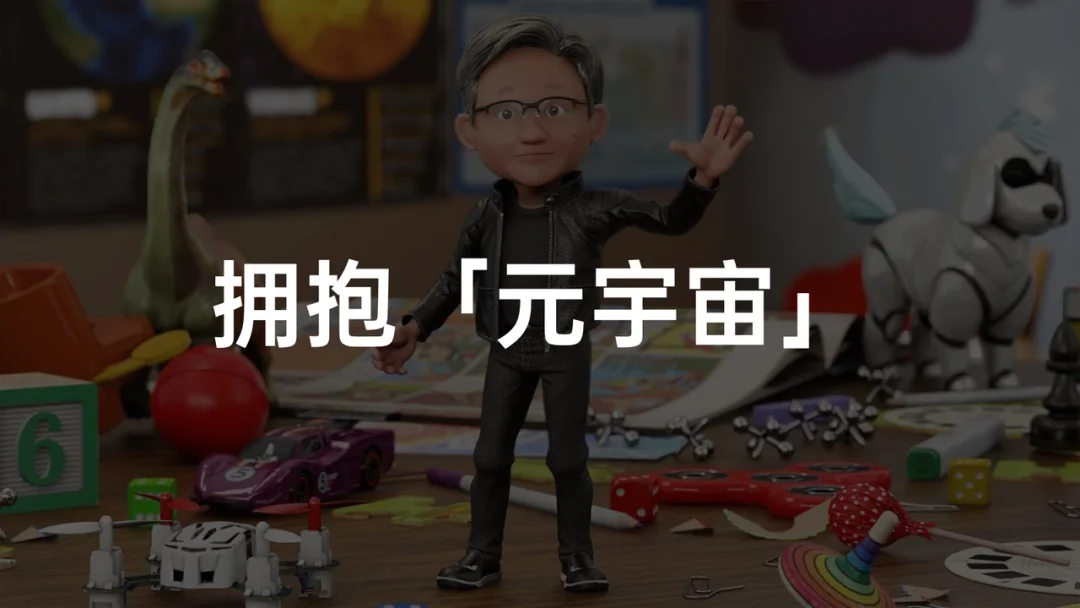
The 2021 GTC arrived as scheduled, and Jensen Huang delivered the keynote address yesterday afternoon. Throughout the one-and-a-half-hour speech, the "leather-jacket guru" maintained high energy throughout, introducing multiple new technologies that have the potential to transform a trillion-dollar industry. The main technical content included AI platforms, conversational AI, digital twins, and autonomous driving, among others. In summary, it was all about fully embracing the metaverse.
01Omniverse Avatar Platform
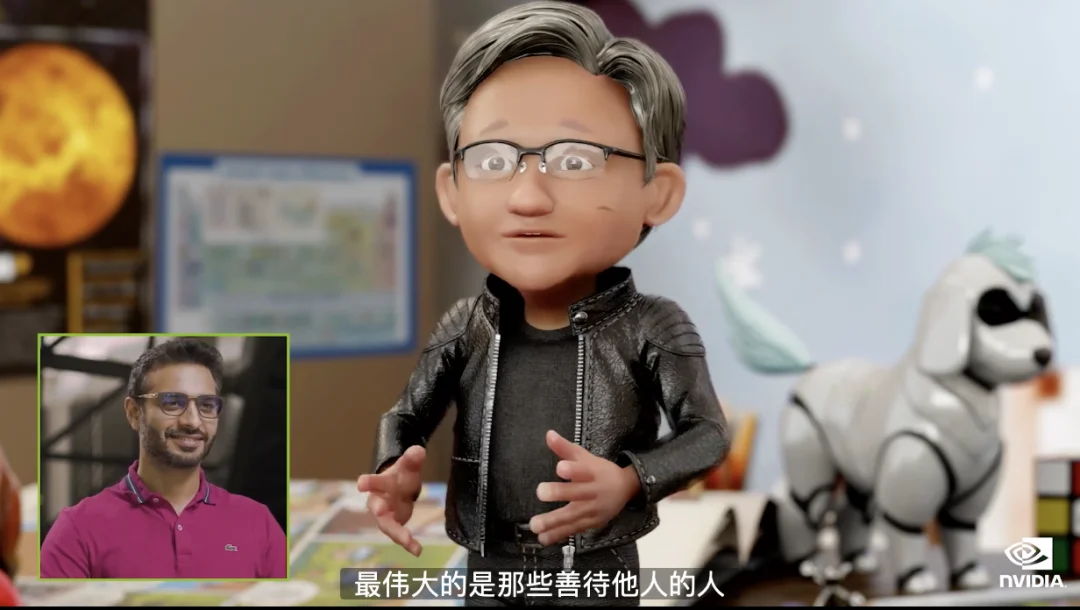
During this session, Huang also introduced a stylized version of himself—Toy-Jensen (referred to by Huang as Toy-Me).
This cute avatar not only mirrors Huang’s physical appearance but also uses voice synthesis based on his own speech patterns. It features real-time ray tracing to ensure high-quality visual fidelity and maintains eye contact with interlocutors during conversations.
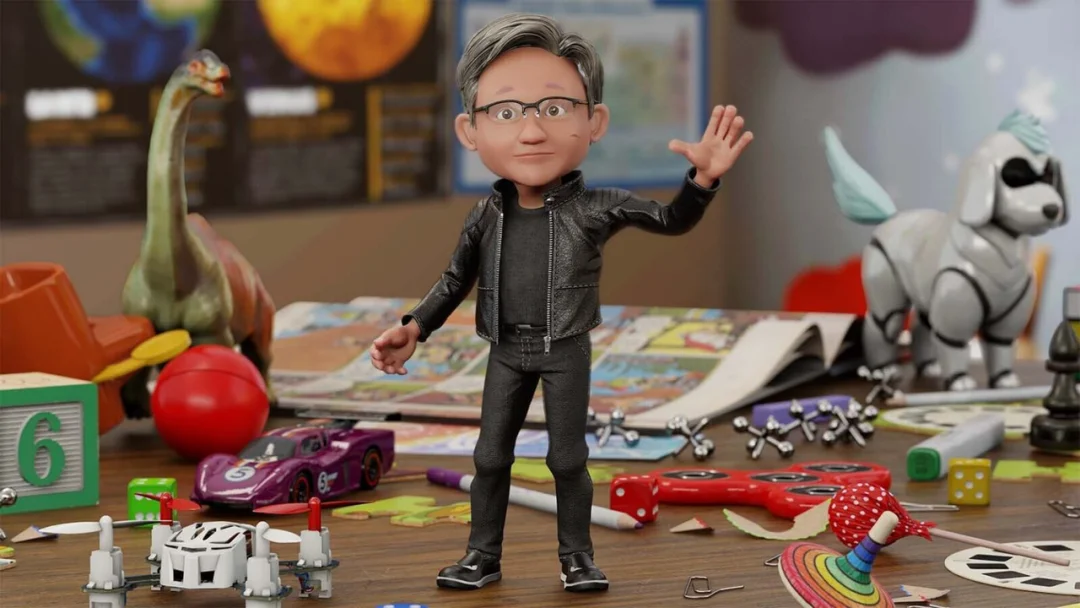
Toy-Jensen is capable of deep interaction with users. During the demonstration, questions from the audience covered climate, astronomy, and biology. Even when faced with complex queries, Toy-Jensen responded fluently. This technology represents the Omniverse Avatar platform, which Huang aims to launch as a comprehensive virtual AI assistant. In the next phase, AI assistants will become more anthropomorphic, warmer, and more lifelike.
Omniverse Avatar enables developers to create and customize AI assistants more rapidly. These AI agents can help users manage billions of customer service interactions, including restaurant ordering, banking transactions, and personal online appointments.
Use cases for Omniverse Avatar also include Project Tokkio, designed for customer support, and Project Maxine, built for video conferencing.
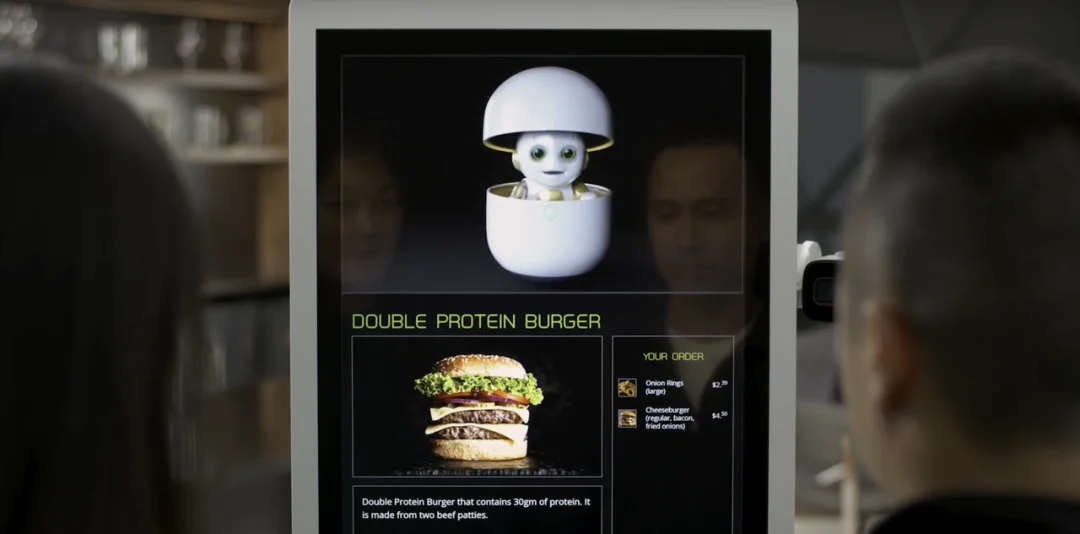
The most common application of Project Tokkio is in restaurant ordering. Virtual avatars can interact with multiple customers simultaneously, understand their intent, and proactively make recommendations.
At last year’s GTC conference, Jensen Huang introduced Maxine. A year later, NVIDIA has enhanced Project Maxine’s capabilities for customer service and video conferencing. Leveraging RIVA (the Speech Software Development Kit), Maxine transcribes and translates human speech in real time while preserving the original tone and timbre.
Omniverse generates 3D facial animations based on voice input, allowing virtual avatars speaking any language to be displayed simultaneously for the recipient to choose from. Even if the speaker on one end looks down at a script or meeting notes, Maxine ensures the user on the other end feels as though the speaker is maintaining eye contact.

In short, the expressions and gestures you see during a video call are not what your eyes actually perceive; everything you see is rendered by Maxine through its voice synthesis technology. The person you are talking to might be sitting in a noisy café.
Omniverse Avatar integrates graphics, computer vision, and speech recognition technologies, all developed in-house. Its natural language understanding is powered by the Megatron 530B large language model, which can recognize, comprehend, and generate human language. The recommendation engine is provided by NVIDIA Merlin, and perceptual capabilities are supplied by NVIDIA Metropolis.
These technologies will also be applied to smart vehicles. With Project Tokkio integrated, cars will feature more natural and user-friendly AI assistants that not only interact with occupants but also proactively recommend optimal driving modes and routes.
02Hyperion 8 Accelerates the Path to Autonomous Driving
Jensen Huang stated that by 2024, the majority of new electric vehicles will possess true autonomous driving capabilities. NVIDIA is currently developing an end-to-end process for building autonomous vehicles, along with a full-stack in-vehicle autonomous driving system and global cloud maps.
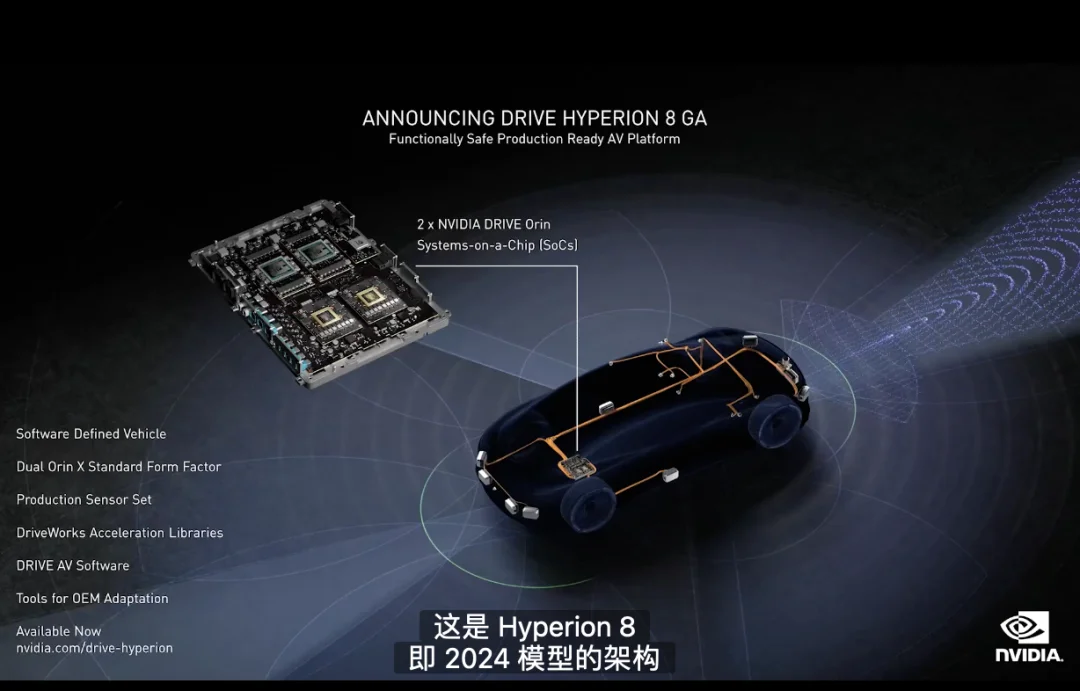
NVIDIA Drive is a fully open, full-stack autonomous driving platform, while Hyperion 8 is NVIDIA’s latest complete hardware and software architecture. Its sensor configuration includes 12 cameras, nine millimeter-wave radars, 12 ultrasonic radars, and one front-facing LiDAR. Additionally, Hyperion 8 is paired with two Orin chips.
Jensen Huang explained that achieving autonomous driving in automobiles is essentially transforming cars into robots. The key pillars of machine learning development involve simulation and synthetic data generation via Drive Sim on the Omniverse platform, as well as constructing real-time robotic workflows using Drive AV on the Orin Robotics chip.
In simpler terms, generated data is critical, followed by verification, and finally outputting as a robotic workflow.
In autonomous driving development, converting sensor data into virtual world information usable by computers is a critical step. This represents the first objective mentioned by Jensen Huang. Leveraging visual imagery and high-definition maps, Hyperion 8 can perform obstacle avoidance, localization, environmental perception, and path planning to reach its destination.
Furthermore, this architecture is designed to provide high-fidelity perception while incorporating redundancy and fault-tolerance mechanisms. The hardware also possesses sufficient computing power and programmability to accommodate software improvements throughout the vehicle's lifecycle.
NVIDIA collects petabytes of road data from around the world and employs approximately 3,000 trained annotators to create and train datasets. Despite this, synthetic data generation remains the cornerstone of NVIDIA’s data strategy. Drive Sim Replicator, a synthetic data generator built on the Omniverse platform, guides AI annotation tools and models before Hyperion 8 is built and real data is collected. Replicator can label ground truth in ways that are impossible for humans.
NVIDIA has also established a LiDAR material library and is currently building a millimeter-wave radar material library. All these efforts aim to enable multi-sensor fusion in autonomous driving.
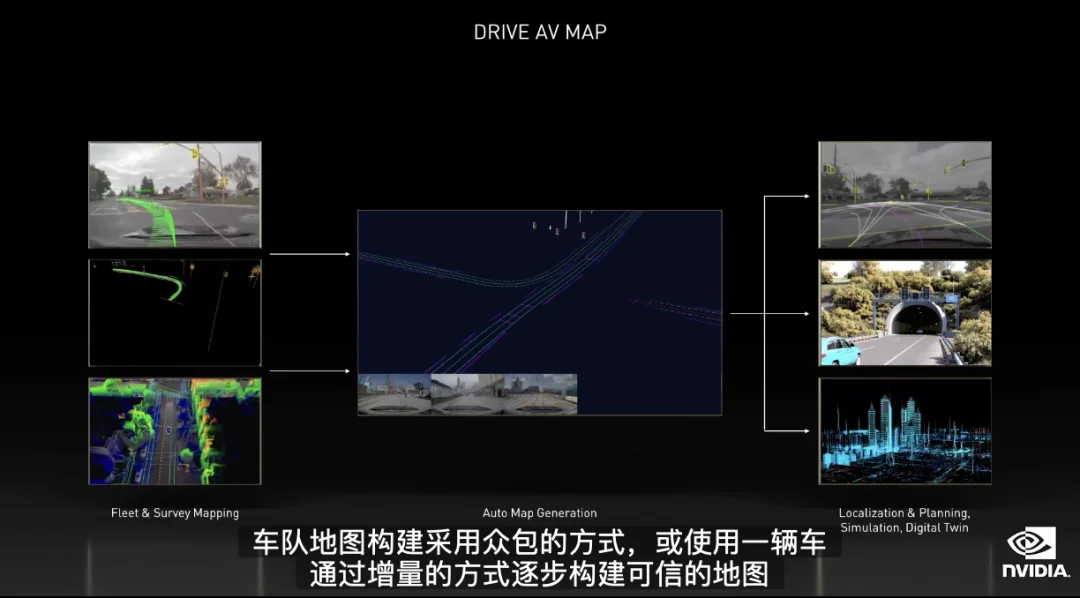
Jensen Huang’s key points emphasized that the important foundations of NVIDIA’s autonomous driving architecture, Hyperion 8, are data and multi-sensor fusion solutions. By using physical simulation, they achieve precise beam reflection. Additionally, the use of high-precision maps provides their autonomous driving solution with an omniscient perspective and adds another layer of redundancy.
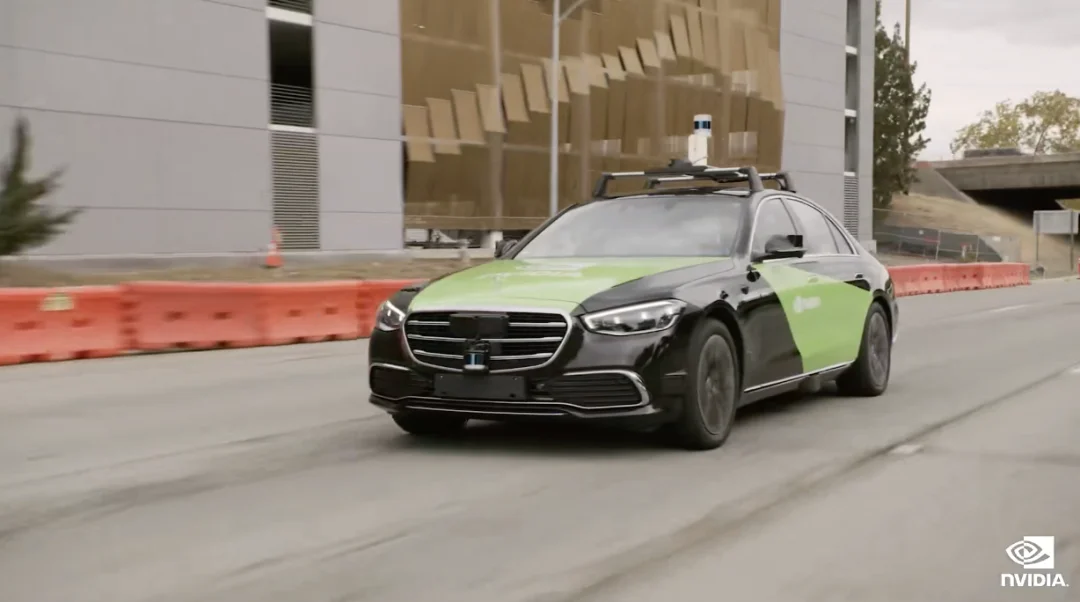
Concepts alone are not enough; during the presentation, Jensen Huang also demonstrated a road test video of a Mercedes-Benz S equipped with the Hyperion 8 architecture. The test route was located around NVIDIA’s headquarters. In this test drive, the Mercedes-Benz S equipped with the Hyperion 8 architecture completed lane changes, crosswalk avoidance, intersection navigation, ring road traversal, and passage through a cloverleaf interchange.
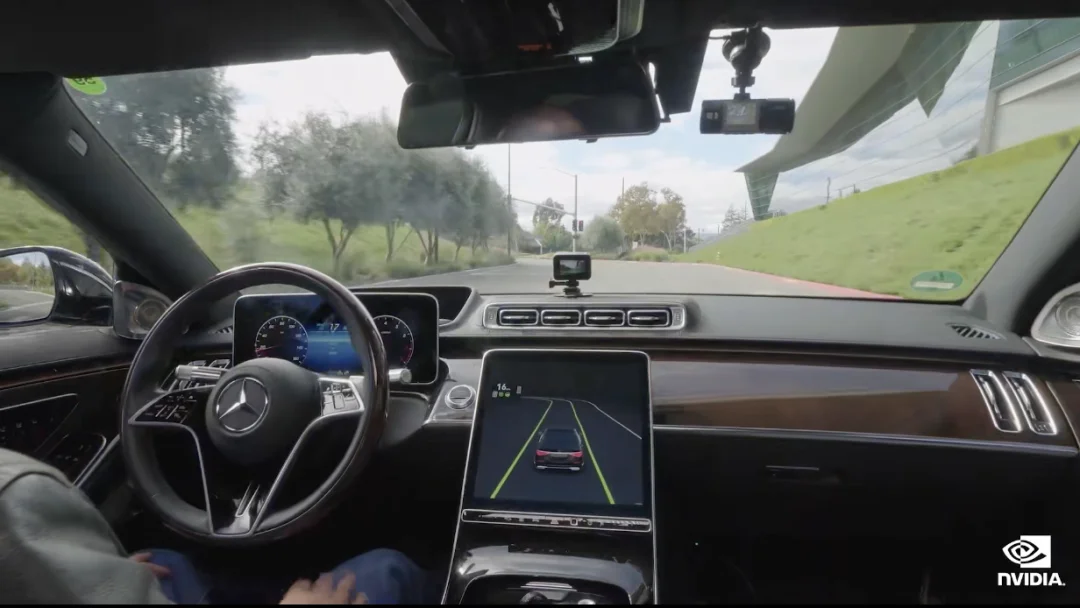
The test scenarios included both closed-course sections and open urban roads. Each case was handled with a high degree of naturalness, closely resembling human driving behavior. Throughout the drive, the driver kept both hands off the wheel, focusing only on the road ahead.
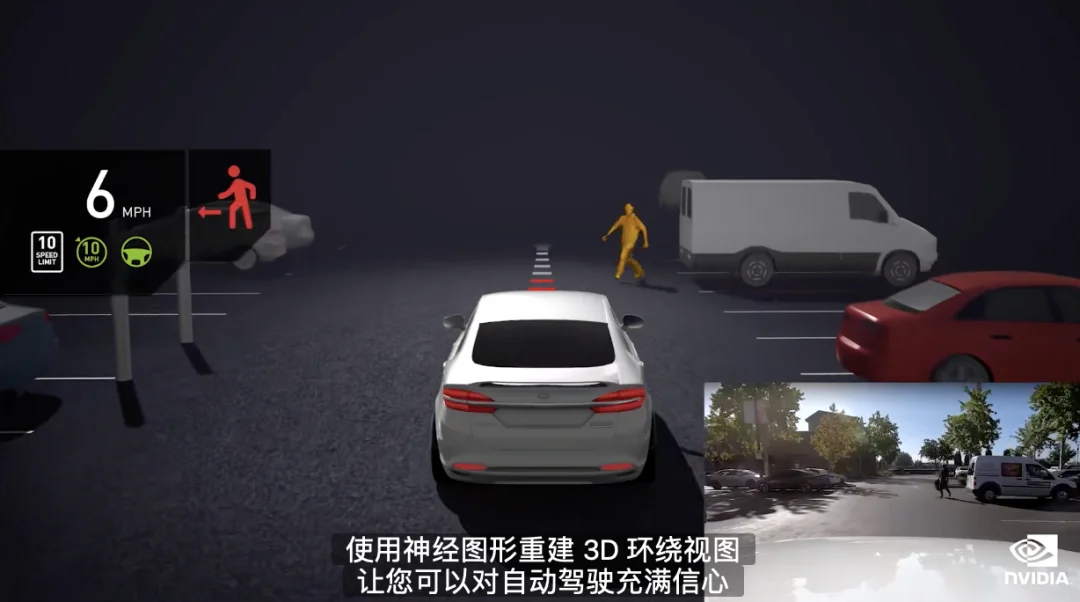
Jensen Huang stated that autonomous driving will not only transform our mobility and improve safety but also fundamentally change how we interact with vehicles once Maxine is integrated into the cabin. With Maxine acting like a personal butler, it can share what the car sees with passengers, helping to build trust between humans and machines.
The focus of driver assistance is currently shifting from closed courses to open urban roads. The uncertainty inherent in open-road environments poses the greatest risk to these systems, while the sheer volume of long-tail scenarios requires continuous data collection and iterative optimization. Technologies such as Huawei ADS and XPENG NGP have sparked imagination about the future of open-road assistance; now, NVIDIA Hyperion 8 offers similar promise.
03Jensen Huang's 'One More Thing'...
NVIDIA’s virtual world simulation engine, Omniverse, ran throughout the keynote presentation. Robots, autonomous fleets, warehouses, factories, and even entire cities are created, trained, and operated within the Omniverse digital twin ecosystem.
Automating warehousing and logistics can save logistics companies billions of dollars annually. For Domino’s Pizza, delivering 14 pizzas involves 87 billion possible route combinations, making a 30-minute delivery window far from trivial. NVIDIA can help logistics firms reduce costs and improve efficiency while providing optimal solutions for complex delivery challenges.
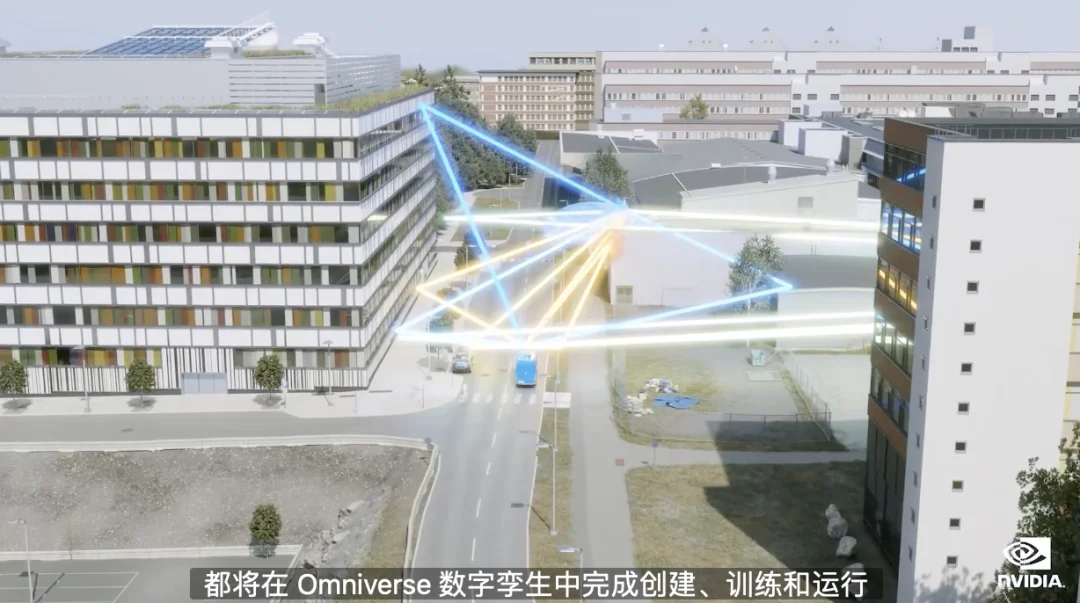
From small beginnings to large-scale impact, Omniverse can simulate warehouses and factories, as well as conduct simulation and verification for autonomous driving. NVIDIA will also create a digital twin model to simulate and predict climate change, naming it E-2, or Earth-2. As the digital twin of Earth, E-2 will run at a million times the speed in Omniverse. Currently, all of NVIDIA's inventions are essential to realizing Earth-2.
Jensen Huang’s speech reached its climax at the final ending, where he stated: 'I cannot think of a grander or more important use.'
To be honest, I did not fully understand this launch event. My only takeaway is the widely circulated saying: technology benefits humanity. This aligns perfectly with the easter egg of this event.
Q: What kind of person is the greatest?
Toy-Jensen: The greatest are those who treat others kindly!
Written by: Bobo Edited by: Reinhardt