


NIO Launches ET5 Sedan; Niuchuang Introduces Ziyoujia Brand; Xiaomi Ecosystem Firm Zhimikeji Enters Carmaking
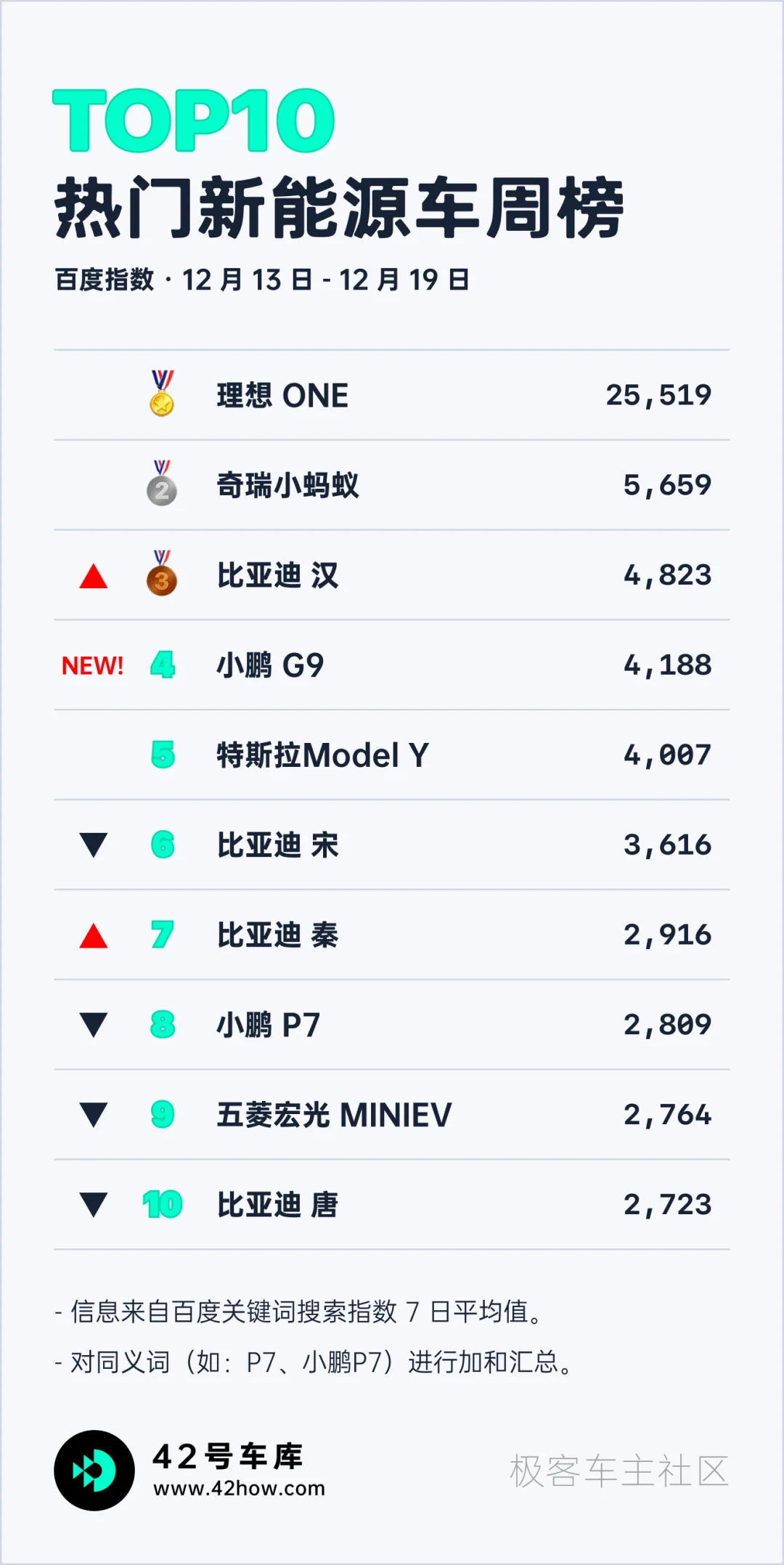
01Weekly Index
02Weekly News
NIO Unveils New Mid-Size ET5 at NIO Day
This Saturday, NIO officially unveiled the ET5. The pricing structure is as follows:
Full Vehicle Purchase
70 kWh version: RMB 328,000
100 kWh version: RMB 386,000
Battery as a Service (BaaS)
70 kWh version: RMB 258,000 (battery monthly fee: RMB 980)
100 kWh version: RMB 258,000 (battery monthly fee: RMB 1,480)
The ET5 comes standard with a dual-motor powertrain featuring a 150 kW asynchronous motor at the front and a 210 kW permanent magnet motor at the rear, delivering a combined maximum output of 360 kW. This setup enables a 0–100 km/h acceleration time of 4.3 seconds. Standard four-piston brake calipers allow the ET5 to stop from 100 km/h in just 33.9 meters.
The audio system, featuring 23 speakers, a 7.1.4 channel layout, Dolby Atmos, and 1,400 W of power, is standard across all trims.
For driver assistance, the vehicle includes one long-range LiDAR, seven 8-megapixel high-definition cameras, four Sony 3-megapixel surround-view cameras, and four Orin X ADAS chips, delivering a total computing power of 1,016 TOPS.
Compared to the ET7, the only reduction is in the surround-view cameras, which drop from 8 megapixels to 3 megapixels. However, the configuration remains highly competitive for its class.
NIO also maintains its First Owner Benefits: a 10-year unlimited-mileage warranty, lifetime free battery swapping (limited to six times per month), lifetime free roadside assistance, lifetime free connected services, and a free home charging pile.
Quick Review:
For NIO today, the ET5 holds significance comparable to that of the Model 3 for Tesla. Recent sales data indicate that the ES8, ES6, and EC6, built on the first-generation platform, struggle to maintain NIO’s position as the top-selling new energy vehicle maker. Meanwhile, the upcoming ET7, with its premium positioning, is unlikely to achieve sales volumes exceeding five digits.
A product capable of truly driving sales must be able to "steal market share" from top-tier competitors. The ET5 appears well-prepared for this challenge through its product design and pricing strategy.
Niuxin New Energy's "Ziyoujia" Enters the EV Manufacturing Arena
Niuchuangxinnengyuankejiyouxiangongsi unveiled its English brand name "NIUTRON" and confirmed the Chinese brand as "Ziyoujia," announcing that its first model, the Ziyoujia NV, will go on sale and accept reservations in the first half of 2022, with deliveries starting in September next year.
The Ziyoujia adopts an Urban Exploring design philosophy, aiming for a "city-off-road fusion" style. It is primarily designed to meet comfortable commuting needs while also being capable of handling light off-road conditions on unpaved surfaces.
Niuchuang did not allow media to photograph the new vehicle. The actual car on site appeared quite rugged, featuring circular headlight designs with dot-matrix light strips spanning the front grille, and similarly styled dot-matrix through-type taillights. A roof rack was visible on the vehicle's top. Inside, the Ziyoujia NV cabin centers around a 12.3-inch instrument cluster and a vertically oriented 15.6-inch central control screen. It lacks a traditional engine start button and uses a column-mounted shifter design.
Regarding driver assistance, Niuchuang adopted a self-defined approach, collaborating with Tier 1 suppliers to implement capabilities at the L2 level.
Quick Review:
When asked about the company's timeline for entering vehicle manufacturing during a group interview, Li Yinan gave an interesting answer. He frankly admitted, "We are definitely late, no need to say it," but added, "Time is the only correct answer to tell everyone."
Although the sales and product lines of the top three new energy vehicle leaders are expanding rapidly, with advantageous resources already concentrated, the vehicles from second-tier automakers like Jidu and Xiaomi, as well as Apple, are far from mass production. The new energy market's product categories are far from fully filled, and the market is still calling for more imaginative players to enter.
Therefore, we really need to let the bullet fly a bit longer regarding how good Li Yinan's car actually is, and then "let time tell everyone the correct answer."
Zhimikeji Reported to Enter Car Manufacturing
This month, Zhimikeji, an ecosystem company controlled by Xiaomi, was reported to have joined the ranks of automakers. Ma Yongdong, former head of electric vehicle projects at GM Asia Technical Center, has joined the team to lead Zhimi's complete vehicle business. Meanwhile, several electronic and electrical architecture engineers from Beiqi have also recently joined Zhimi. An automotive design firm is already in talks with Zhimi to handle complete vehicle design work.
In addition, Zhimikeji's vehicle manufacturing business currently remains independent from Xiaomi Auto, with no visible support from the Xiaomi administrative system for Zhimi. While Zhimi's vehicle manufacturing direction is also focused on passenger cars, unlike Xiaomi's approach, Zhimi's first car will be an SUV.
Quick Review:
The "Xiaomi ecosystem" automotive sector is rising, using a multi-brand strategy to place its "eggs" in different "baskets," initially strengthening internal competition and later refining brand segmentation. The challenge of brand management lies in identifying and reinforcing the differentiation points among brands. In the current smart home appliance product line, Zhimi's positioning is significantly higher than Xiaomi's; perhaps Xiaomi intends to launch it as a mid-to-high-end brand for its automotive ventures.
XPENG Pushes Xmart OS 2.7.0, Adding Features Such as Memory Parking Route Sharing
On December 13, XPENG P7 received a limited OTA public beta. The main content is as follows:
The new version of VPA (automatic parking) has added a route-sharing feature, becoming the first parking assistance function in the industry that allows users to share routes;
The upgraded VPA automatic parking now allows users to select and park in spaces near their destination, accommodating owners without fixed parking spots;
Memory parking recognition elements are more comprehensive, adding static obstacles such as pillars, gates, and bollards;
Xmart OS 2.7.0 optimizes the cone display strategy, ramp-exit experience, and congested traffic following experience under NGP;
Optimizes the cone display strategy, ramp-exit experience, and congested traffic following experience under NGP;
Optimizes XPILOT 2.5’s intelligent parking assist system, intelligent safety system, and the continuous dialogue duration of its full-scenario voice assistant.
Quick Review:
This update targets VPA memory parking in garages and NGP intelligent navigation-assisted driving. The highlight is the new 'Route Sharing' feature, primarily designed for shopping malls and underground parking lot supercharging stations. Users can leverage routes shared by others to quickly and efficiently reach elevator entrances or supercharger spots in these high-frequency scenarios.
Geely Announces Joint Venture with Lifankeji
Recently, Geely Automobile announced it would establish a joint venture with Lifankeji. The company has a registered capital of RMB 600 million, with both parties contributing RMB 300 million in cash and holding 50% stakes each.
The announcement disclosed that the joint venture will primarily engage in:
The design, research and development, and sales of automobiles (including accessories, parts processing equipment, and automotive decoration);
Import and export of goods, agency import and export, and technology import and export;
Software development, technology development, technical services, technical consulting, and technology transfer.
Geely stated that the establishment of the joint venture would leverage complementary advantages to jointly promote the transformation and upgrading of Lifankeji's automotive industry, thereby rapidly increasing its overall market share in the passenger vehicle segment. Additionally, the joint venture would continue to advance the upward development of the Geely brand, forming complete coverage across different tiers of the mainstream market through a portfolio layout of various brands.
On January 26, 2021, Lifankeji (Group) Co., Ltd. was officially unveiled, introducing Geely Technology Group's first battery-swap new energy model.
In May 2021, Lifankeji's first battery-swap model, the Fengye 80V, officially rolled off the production line. The company confirmed purchase intentions for this model with platforms under Geely Automobile, such as CaoCao Mobility.
Quick Review:
After six months of turmoil, Lifankeji finally delivered its first batch of 100 battery-swap taxis on September 22. Riding the coattails of Geely, Lifankeji’s sales rebounded to high growth, with volumes of 200 units in September, 523 in October, and 1,140 in November.
Since Geely entered Lifankeji, the company’s primary business has been producing and selling Geely’s Maple battery-swap models under license. According to plans, Lifankeji will launch two additional battery-swap models, the 60S and 80X, this year. Can Geely’s involvement help Lifankeji regain its former glory? Stay tuned.
Written by: Mingming Edited by: Liu Guangding