I believe many people are curious about the sales of BYD’s new energy vehicles during these past few months.
In the process of analyzing this issue, there may be many different interpretations, such as technology, product, marketing, and end-of-year effects. To keep things simple, I will explore potential factors from the perspective of analyzing data from the past few months.
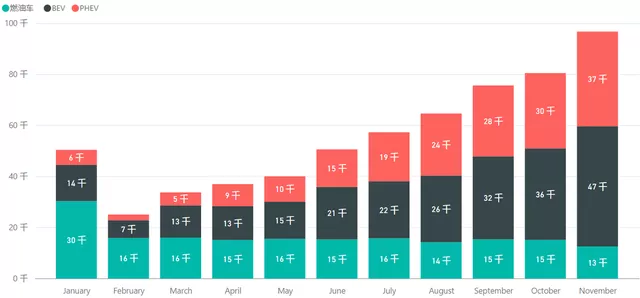
Based on the data, the total number of newly insured vehicles in November was 96,850, including 12,598 gasoline vehicles, 37,124 plug-in hybrid vehicles (an increase of 7,597 compared to the previous month), and 47,128 pure electric vehicles (11,280 more than the previous month). As shown in the following graph, although DM-i vehicles are also selling well, BYD’s pure electric vehicle sales have shown more significant growth, with a doubling compared to the first half of the year.
Analysis of BYD’s Vehicle Sales Data
1) Pure Electric Vehicles
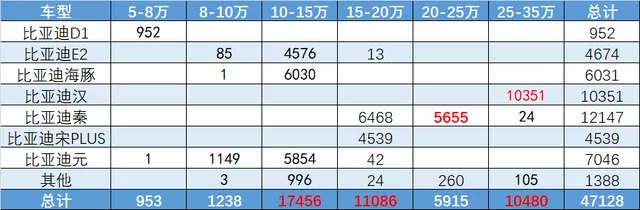
Let’s first take a closer look at the pure electric vehicle models, as shown in the following graph.
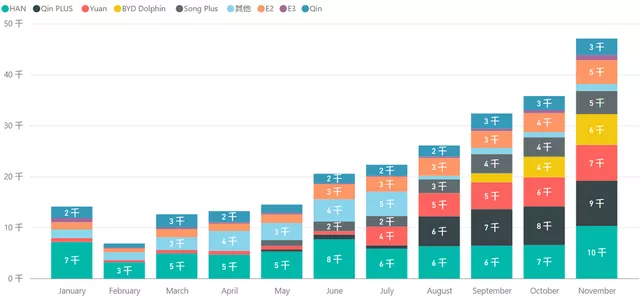
In November, we can see that Han EV sold 10,351 units, Qin Plus sold 8,868 units, Yuan EV sold 7,046 units, and Dolphin sold 6,031 units. Compared to the data from June, it is evident that the sales of Qin Plus have increased significantly, and the cost-effectiveness of Yuan EV has improved rapidly after replacing its blades. Dolphin and Song Plus have also seen significant growth.
We can assume that BYD’s switch from ternary lithium to lithium iron phosphate batteries have improved their products’ safety, and with the benefit of cost reduction, they have pumped up sales.
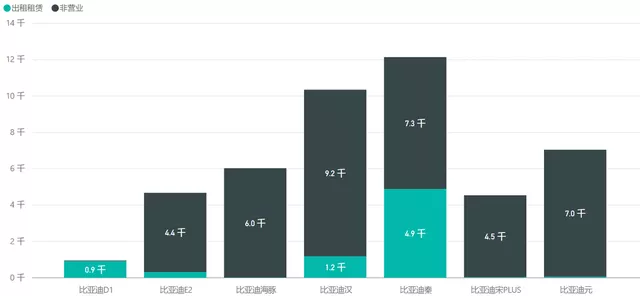
In terms of usage, some D1 (customized cars), Qin family, and Han vehicles are used as operational vehicles.
2) Plug-in Hybrid Electric Vehicles
For plug-in hybrid electric vehicles, it is clear that Han DM hybrid vehicles have remained relatively stable, and the main increase has been in the DM-i series, which empowers Qin, Song, and Tang models that were originally non-hybrid.
In November, the main increase in sales came from the Tang DM-i and Song DM-i models. These cars were mostly used by individual consumers (only 170 PHEVs were used for commercial purposes, and 1220 units were used by companies), which reflects the current level of consumer acceptance of DM-i vehicles.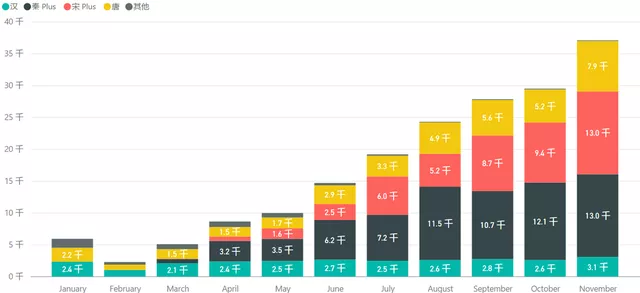
Viewing from Price and Geographic Perspectives
From the perspective of price, BYD’s main price segmentation is currently divided into three categories: Han’s high-price region (after subsidy is over RMB 200,000), Qin+Song’s (after subsidy is over RMB 150,000), and Dolphin+Yuan’s (after subsidy is over RMB 100,000).
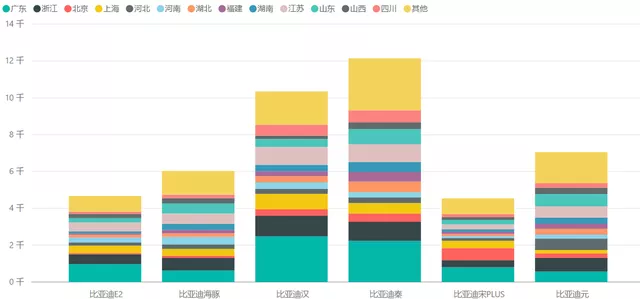
If we split these cars by province, we can see the distribution in Figure 5. Except for Han and Qin, which are concentrated in Guangdong, BYD’s overall sales areas of pure electric vehicles are mostly downward in major regions. This distribution model is still very healthy.
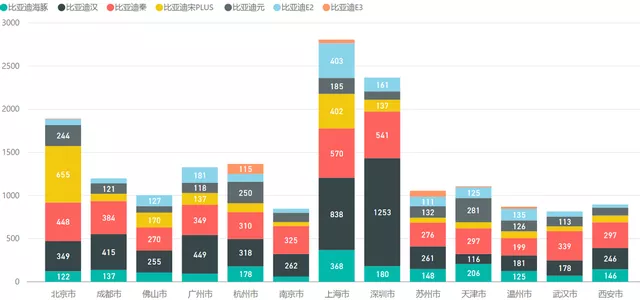
I have organized the distribution of BYD’s pure electric vehicles in different cities here. We can see that Han EV has a large volume in Shenzhen and Shanghai, bringing a very good effect on sales in these major cities.
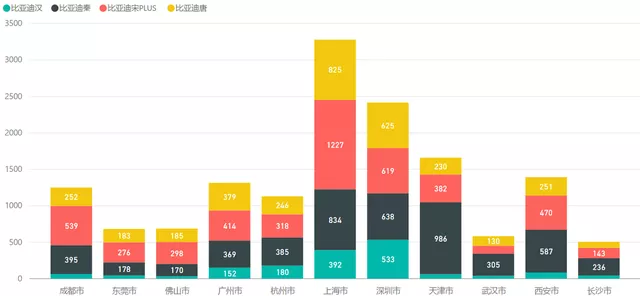
BYD’s most successful move this time is the decentralization of PHEV, which has made a breakthrough in areas without license plates. Currently, the difference between DM-i models in licensed and unlicensed cities such as Shanghai and Shenzhen is not significant. This is a very impressive accomplishment.
In summary, I believe that building on the foundation of high cost-effectiveness products and cooperating with BYD’s wide range of channels is the key area that drove the increases in BYD’s product output. The cost reduction brought by switching to lithium iron phosphate for BEVs has given BYD a greater pricing space, which is still a very essential factor. It’s really cool to use iron lithium instead of ternary in 2021.
This article is a translation by ChatGPT of a Chinese report from 42HOW. If you have any questions about it, please email bd@42how.com.