Today is the last day of the holiday. Good times always pass quickly, and tomorrow we will have to go back to work again. At the end of April, the International Energy Agency (IEA) released a new version of the “Global EV Outlook 2021 Technology Report”. The feature of this report is that it covers a more comprehensive range of topics, including a summary of past history and future prospects according to the IEA. The charts are also beautifully designed, and I would like to make an excerpt and summary.

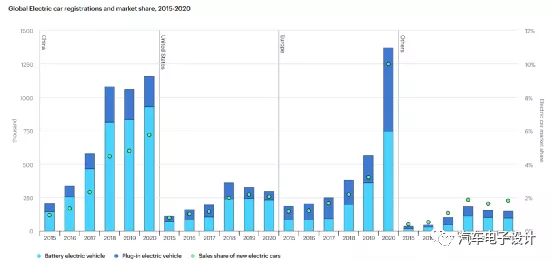
It took 10 years for commercial-scale electric vehicles to be used, and by the end of 2020, there were a total of 10 million electric vehicles in the world (5.4 million in China, 3.3 million in Europe, 1.8 million in the US, and 0.8 million in other regions).
Last year, the global automobile sales fell by 6% due to the pandemic, but the sales of electric vehicles increased by 41%, with approximately three million electric vehicles sold worldwide (with a penetration rate of 4.6%). For the first time, Europe surpassed China and became the largest electric vehicle market in the world.

Here, I have several questions. If China is further divided, there are approximately 3.5 million BEVs and one million PHEVs. Among them, there are approximately 1.4 million PHEVs in Europe, which exceeds China. In principle, considering the past ten years, it may be difficult for China’s PHEVs to continue to surpass Europe in all aspects. We have gained the benefits of having a stock of 3.5 million electric vehicles in the past ten years, one of which is a competitive advantage in the battery industry chain. However, the next step is to compare the popular models, and both sides will begin to directly compare them.

Since 2015, China has been developing the battery industry chain with a demand scale of 50-80 GWh per year. Since 2019, Europe’s demand scale for batteries has been continuously increasing. It can be expected that Europe and the US will pursue the controllability of the battery industry chain in the future, and Europe’s first-mover advantage and low-cost characteristics will continue to consolidate.
 One advantage of the electric vehicle (EV) industry is the charging infrastructure. China has an overwhelming advantage in fast charging stations (although most of them were previously built around 60 kW) and a long-term comparative advantage in the EV charging infrastructure chain.

Amid the pandemic, the EV industry’s growth depends mainly on three pillars:
1) Regulatory frameworks that support EVs globally. By the end of 2020, over 20 countries/regions have announced their future ban on the sale of conventional cars or mandatory sales of zero-emission vehicles.
2) Subsidies amid the pandemic: some European countries have increased subsidies for purchasing EVs, and China postponed its plan to cancel subsidies. In 2020, consumers spent USD 120 billion on EV purchases, and governments worldwide spent USD 14 billion to support EV sales, a 25% increase from 2019. China and Europe lead global development, and all car manufacturers must expand their EV plans around these two regions.
We can understand Toyota, Honda, and Nissan’s helplessness. Under the conditions of no demand in their home country, they have to compete head-on in Europe and China without sufficient preparation. In a sense, without early government funding, there would be no EV market.

In the bus and truck fields, China’s quantity advantage is unsurpassable.

3) As the scale of EVs expands, battery costs continue to decline. Under these factors, almost all automakers have announced increasingly ambitious electrification plans. In 2020, out of the world’s top 20 automakers, 18 have stated their plans to expand EVs.
Note: Honda, with a new CEO, has updated its schedule. The EV promotion plan seems a bit conservative in the current environment. At least car companies will further advance their schedules.
 In this regard, we can see that the supply of European and American car models is insufficient, while the Chinese electric car models have already entered a “red ocean” competition. Personally, I think only car models with a range of over 400 kilometers can let consumers buy them. That is to say, in 2020, when car models with a range of 400 to 600 kilometers are massively launched, they will drive the market demand.

As for fuel cell vehicles, by 2020, the global total number of them is only 34,800, which is still in its infancy compared with electric vehicles.

IEA has made a very surprising prediction. In the scenario of specified policies, the inventory of electric vehicles will reach 145 million units by 2030 (broken down into 80 million BEVs and 44.4 million PHEVs), accounting for 7% of the total number of all cars owned. If the government accelerates efforts to achieve climate targets, the electric vehicle market could be much larger. Global electric vehicle sales will reach 230 million units by 2030, accounting for 12% of all cars owned.

According to IEA’s prediction, China needs to sell 12 million new energy vehicles by 2030, Europe needs to sell 13.3 million, and the United States needs to sell 8.8 million. This follows an accelerating model to continuously increase the share of electric vehicles in traditional vehicles.

Conclusion
From a current perspective, IEA’s ambitious reports tell us that we must survive in the industry. As we accelerate, the Matthew effect will speed up the competition and elimination of companies. Comrades who have been in the industry for more than 10 years must not be thrown out of the entire new energy vehicles industry in the next 10 years.
This article is a translation by ChatGPT of a Chinese report from 42HOW. If you have any questions about it, please email bd@42how.com.