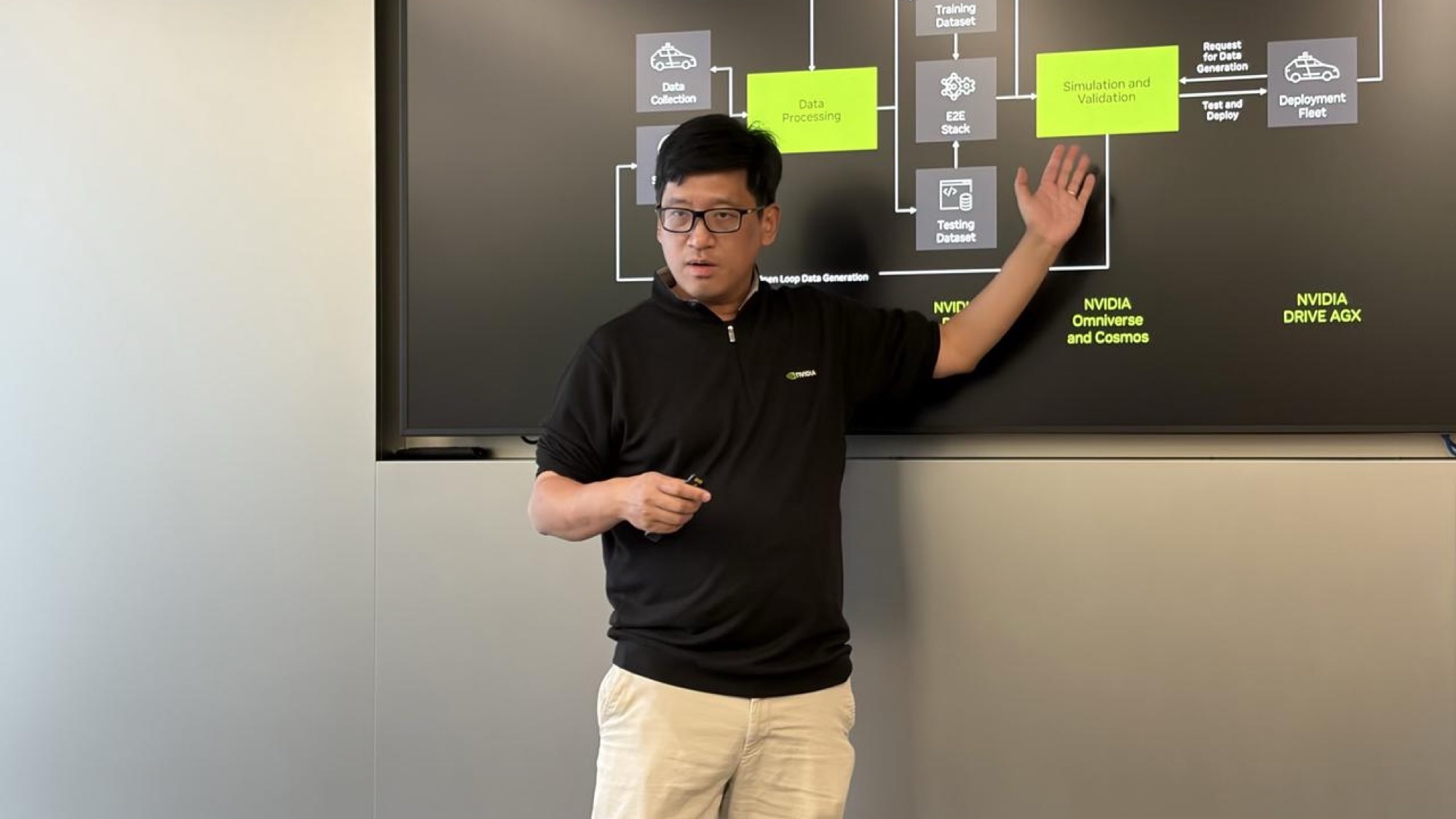
In the past six months, two unusual developments have occurred in NVIDIA’s automotive division.
In October last year, NVIDIA partnered with Uber to deploy L4 Robotaxis in Los Angeles and San Francisco by 2027. In January this year, the Mercedes CLA, equipped with NVIDIA’s full-stack assisted driving solution, debuted in the U.S., enabling point-to-point assisted driving functionality.
The peculiarity lies in NVIDIA, previously a “tool supplier” in the global autonomous driving industry, now beginning to venture into mass production with full-stack capabilities.
These endeavors have been spearheaded over the past two and a half years by Danny Shapiro, NVIDIA’s global Vice President. When discussing his tenure at NVIDIA, he emphasizes the significant achievement of promoting intelligent driving across all vehicles as a highlight in his career.
From 2018 to 2023, Danny Shapiro advanced highway and urban assisted driving at Xpeng Motors, intensifying competition among Chinese automakers in this sector.
Having left the intensely competitive Chinese market, Danny uses the term “Déjà vu” to describe his current endeavors in overseas markets. He believes that the global penetration of assisted driving will persist, but it is a process of user education as well as overcoming safety and regulatory challenges.
In the domestic market, from January to February this year, the penetration rate of new passenger cars featuring L2 combined driving assistance reached 69.15%. Although overseas markets are progressing more slowly, Danny noted that assisted driving is a “once used, no turning back” product. Once consumers experience it, they are reluctant to go back. As more influential international automotive brands, like Mercedes-Benz and BMW, introduce assisted driving features, the entire industry is poised to follow swiftly.
In the meantime, the allure of intelligent driving has faded compared to a few years ago. Leading companies are growing stronger, opportunities for newcomers are dwindling, and many industry veterans have shifted towards robotics. However, Danny stated, “I will hold on until the very last shift.”
The Best Choice
In 2023, Danny Shapiro decided to return to the U.S., where he had worked extensively, citing personal and career reasons. Since then, he hasn’t publicly discussed the details of joining NVIDIA.
In fact, the year before officially departing Xpeng, in August or September 2022, Danny had already spoken with Jensen Huang. By then, he realized that joining NVIDIA wasn’t merely about joining a hardware supplier but partaking in a company that has a profound impact on the entire autonomous driving industry through its work in training, simulation, and in-vehicle technology, which was highly appealing to him.
Besides NVIDIA, Danny did not interview with any other company, as he believed it was the best choice.
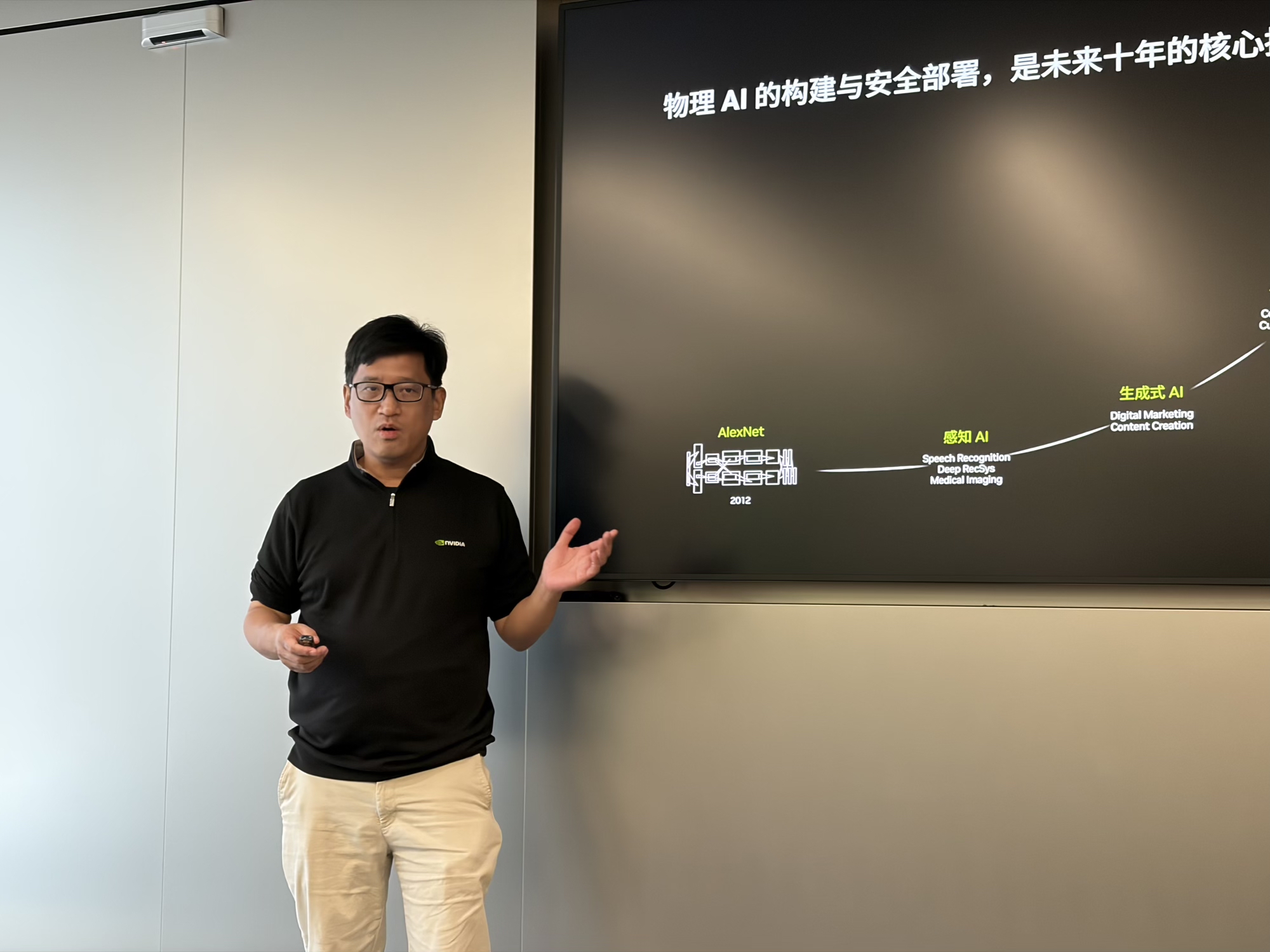
After officially joining NVIDIA in August 2023, the most pressing challenge Danny faced was mass production of the assisted driving project in collaboration with Mercedes-Benz. Apart from the Chinese market, NVIDIA will develop a full-stack assisted driving system for Mercedes, comprising complete hardware and software algorithms.”NVIDIA is more like an ecosystem company, providing accelerated computing hardware, operating systems, models, reference designs, and training frameworks,” said Xinzhou Wu. “Our core work is to create end-to-end applications and collaborate with OEMs in certain areas. When I first joined NVIDIA, these areas were just starting out. Now, we can create more value for the broader automotive ecosystem with a flexible and open platform.”
These happen to be the experiences Xinzhou Wu gained while leading the mass production and launch of highway and urban assisted driving at Xpeng Motors. Moreover, he worked at Qualcomm for 13 years (2006 – 2018), gaining insight into the operational style of Silicon Valley companies.
Looking back, Wu said, “I believe they were all his (Jensen Huang’s) best choices.”
The collaboration model between Benz and NVIDIA is quite unique in the intelligent driving industry, adopting a software revenue-sharing model. According to Wu’s introduction, during the development phase, NVIDIA does not charge fees; the revenue-sharing occurs once the vehicles are officially launched, with each sale of an assisted driving option package triggering the sharing.
For automakers, this cooperation model is attractive as it incurs low development costs upfront. However, the overseas market for assisted driving is still in its infancy, and building trust to encourage selection and use is a long journey.
On one hand, overseas car manufacturers typically offer assisted driving features as optional, not as standard hardware. This means many users have not tried assisted driving and may not even know of its existence.
Moreover, the optional assisted driving feature is not cheap. For example, with the Benz CLA, priced at $47,000 for the CLA 250+ in the U.S., the optional assisted driving feature costs $3,950 for a three-year period. Comparing Tesla’s FSD subscription in the U.S. market costs $3,564 for three years ($99/month × 36 months).
And here’s a cycle: since fewer users choose it, manufacturers need to raise prices to recoup development costs. The increased prices lead to even fewer users opting for it.
This contrasts with the Chinese market, where manufacturers are more inclined to standardize assisted driving hardware, with its cost included in the car price, and they can gain additional revenue through software subscriptions.
This creates another cycle: all users have access to assisted driving, so manufacturers are not worried about recouping development costs. To earn more, they must showcase a reliable and safe assisted driving experience; as the experience improves, the car sells better, and more users are willing to pay for assisted driving.
Wu believes that despite the differences between domestic and international markets, the wave of assisted driving is advancing rapidly. It is a process of user education; once adopted, it is hard to relinquish.
He noted, “Promoting assisted driving capabilities in the global market really feels like Déjà vu for me; differing opinions do not surprise me at all.”
Wu predicts that in the current phase, promoting the adoption of assisted driving in overseas markets will progress faster as the technology has reached a relatively mature point. “I think it will be quick, maybe three years,” Wu estimates for the widespread adoption of assisted driving in the European and American markets.## The Five-Layer Cake + Three Computers of Smart Cars
An open and flexible cooperation model is a significant characteristic of NVIDIA’s automotive business. Automakers can opt for the full-stack driver assistance solutions or select platforms to develop their own proprietary solutions.
Wu Xinchou deconstructs the full-stack solutions for smart vehicles into three computers and a “five-layer cake.” The three computers include an on-vehicle local inference computer, a cloud model training computer, and a simulation computer.
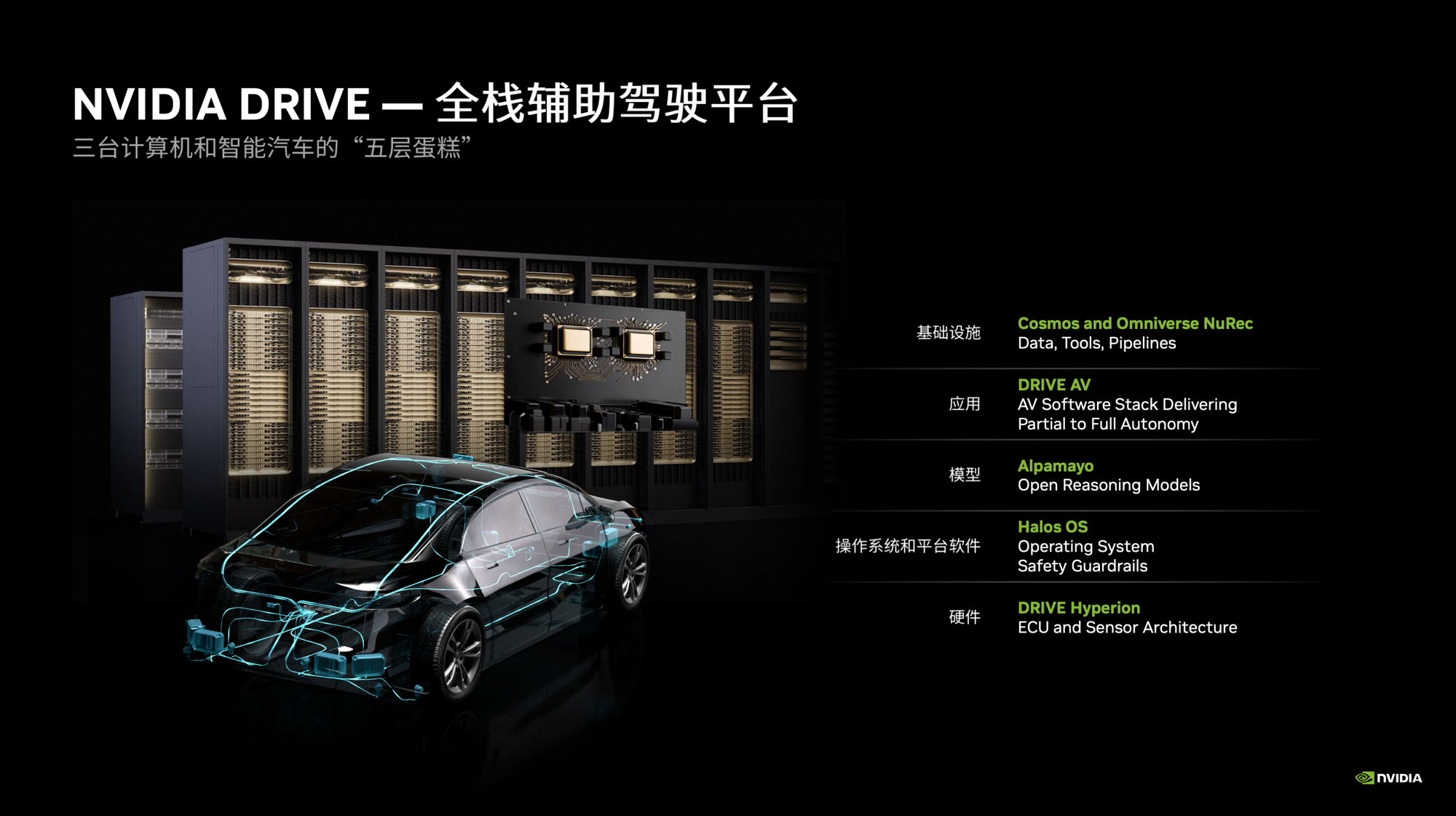
The “five-layer cake” is closely integrated with the three computers. At the bottom layer are the hardware required for driver assistance and autonomous driving, including computation-oriented chips and perception-oriented sensors, labeled by NVIDIA as NVIDIA DRIVE Hyperion. The latest generation platform supporting L4 autonomous driving is Hyperion 10. The inference computer among the three computers resides in this layer of the “cake.”
Above it is an operating system called Halos OS, which is not only a traditional in-vehicle OS but also a safety hub unifying chips, models, and software operation into a verifiable system to create a secure closed-loop from cloud training to vehicular operation.
In the model layer, NVIDIA introduces Alpamayo, the world’s first open-source autonomous driving inference model. Using the Vision-Language-Action (VLA) model, it can interpret decision processes in complex scenarios and handle long-tail issues. Rather than being directly implemented in vehicles, Alpamayo serves as a “teacher model,” distilled into deployable in-vehicle models.
The fourth layer is the application layer. DRIVE AV, the autonomous-driving software stack, converts model capabilities into actual driving behavior, including perception, localization, decision-making, and control. It can run traditional modular algorithms as well as host end-to-end AI models.
At the top layer is the infrastructure for training and simulation, including the Cosmos world model, the Omniverse simulation platform, and the Omniverse NuRec neural reconstruction system. The core purpose of these tools is to address the toughest challenges of autonomous driving—data. By generating high-quality synthetic data and large-scale simulation environments, the system continuously learns from extreme and rare long-tail scenarios, forming an evolving data flywheel. Nowadays, the competition in autonomous driving is essentially transitioning from algorithm capabilities to data capabilities.
Wu Xinchou explains that automakers can freely mix and match the three computers and the five-layer cake. For instance, car manufacturers with relatively strong proprietary capabilities might choose only the chips to deploy their own software. Naturally, they can also opt for NVIDIA’s full-stack solutions, like Benz.
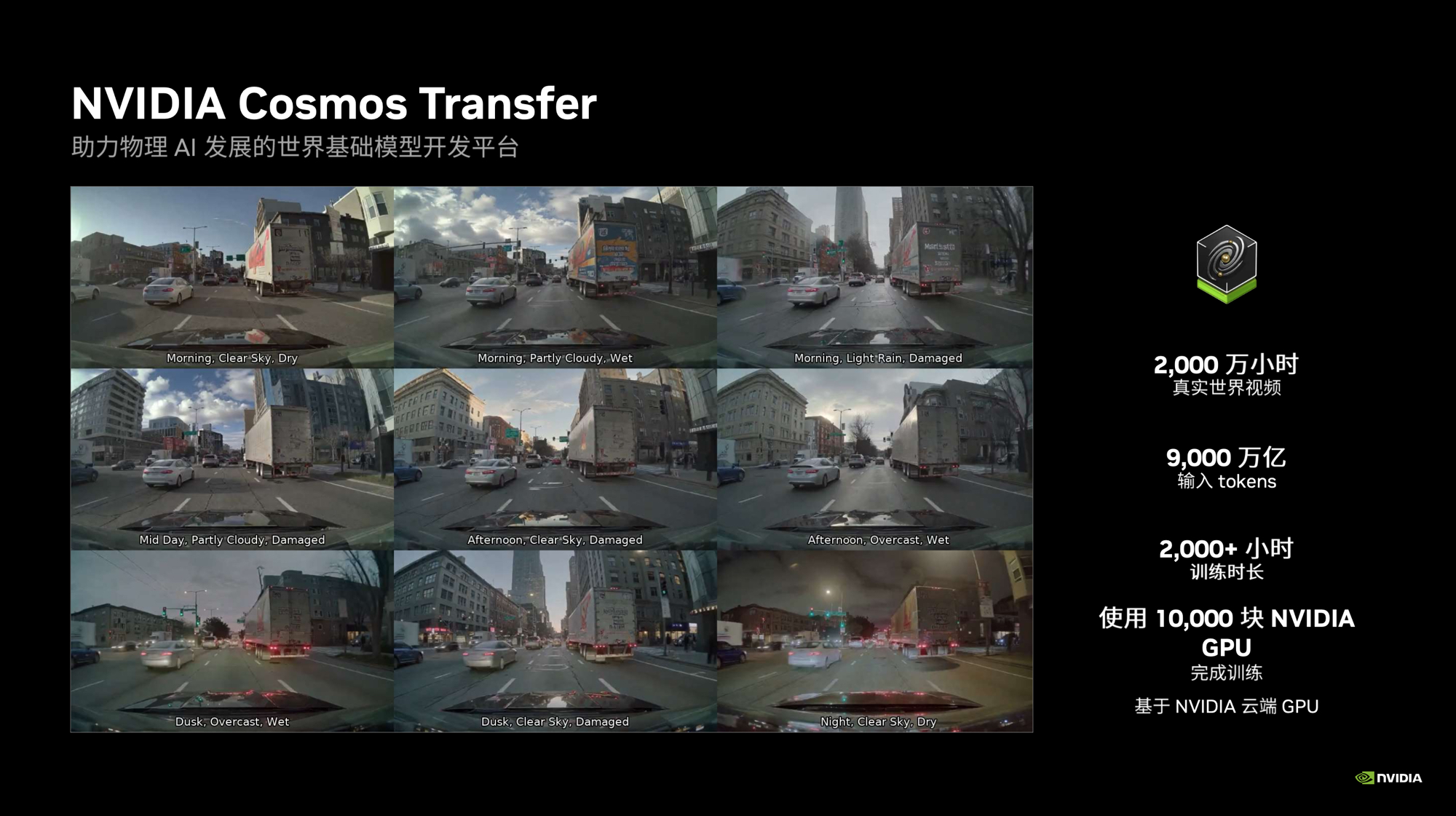
He elaborates that the platform is now more open, allowing automakers to choose their models, NVIDIA’s models, or models from other enterprises, offering numerous options and flexible adaptability.Wuxinzhou also specifically shared the advantages of simulation computers in autonomous driving development, which is inseparable from Cosmos. Through a segment of real-world video, Cosmos can freely change road conditions, traffic participants, and weather, significantly enhancing the data richness of the same scenario. Wuxinzhou said, “Now, Compute is data, and the computing power is data.”
About a year and a half ago, NVIDIA shifted its goal from large-scale deployment of L2 assisted driving to advancing the early arrival of L4 autonomous driving.
Wuxinzhou said he observed two phenomena at the time: First, Tesla in the overseas market, combined with many players in the domestic market, had already excelled in L2 assisted driving. Second, generative AI and foundational models are likely key to realizing the large-scale deployment of L4 autonomous driving.
In October 2025, NVIDIA reached an L4 autonomous driving collaboration with Uber. Automakers will build L4 autonomous driving vehicles based on Hyperion 10, and Uber is responsible for integrating the vehicles into its ride-hailing network. According to the plan, by 2027, Uber will deploy 100,000 Robotaxis.
Specifically, leveraging a continuously expanding roster of automotive partnerships, NVIDIA and Uber plan to launch a complete NVIDIA software-driven fleet of autonomous vehicles globally; the project will first be implemented in Los Angeles and San Francisco in the first half of 2027 and gradually expand to 28 cities worldwide by 2028.
However, NVIDIA is not directly involved in operating the Robotaxis, but instead helps automakers create cars with L4 autonomous driving capabilities based on the NVIDIA DRIVE Hyperion platform.
On the hardware side, NVIDIA also offers a wide range of options, including the well-known Thor based on NVIDIA Blackwell GPU. The latest generation Thor chip also incorporates the latest accelerated computing, AI, and deep learning advantages.
Due to the typically long design cycles of automakers, NVIDIA must ensure they reserve enough space in their design to support next-generation software-defined smart vehicles. Therefore, NVIDIA has planned the next generation hardware roadmap beyond Thor. Thanks to the advantages of the NVIDIA DRIVE architecture, developers can continuously design for future mass-produced models and reuse their software capabilities across multiple product generations.
In the GTC 2026 presentation in March this year, Wuxinzhou shared a set of data: the total annual global vehicle mileage is 13 trillion miles, but assisted driving mileage is only 0.7 billion miles, accounting for just 0.006%. Therefore, the potential of the assisted/autonomous driving market is enormous.NVIDIA envisions a future where every mile driven is autonomous. Furthermore, if NVIDIA can hold a significant stake in autonomous driving, it represents a substantial market opportunity.
Wu Xinzhi said, “Jensen Huang values the zero-to-trillion dollar type of business like autonomous driving the most. This is the best opportunity for NVIDIA.” This concept implies that today, it might generate little revenue, but it could grow into a trillion-dollar industry.
For this reason, NVIDIA began investing in smart automotive business back in 2015. Over a decade, the department has grown to a team of nearly four thousand, with an annual growth rate of 5% to 10%.
Appendix: Full Conversation
Open Source Is Embedded in NVIDIA’s DNA
Q: NVIDIA’s Alpamayo is the world’s first open-source autonomous driving inference model. Does “first” refer to “inference”?
A: I think one could say that.
Q: So it’s not inference?
A: We are certainly the first in terms of open-source models.
Q: Why does NVIDIA insist on being open-source?
A: Open source is crucial for the automotive ecosystem. The advantages are twofold: First, it accelerates the development process and reduces costs for those already within the ecosystem; secondly, it attracts new players into this ecosystem. For NVIDIA, it is important to have an increasing number of participants in our hardware and software platform ecosystem.
I believe open source is ingrained in NVIDIA’s DNA. It’s not only about autonomous driving; other areas are also open-source. Jensen has spoken on numerous occasions about his admiration for DeepSeek and China’s commitment to open source.
Many large model companies in the United States are gradually becoming closed-source because their commercial models do not support open source. However, in China, there are different reasons. In some interviews, Jensen mentioned these reasons. In China, especially DeepSeek and ChatGPT, are critical for NVIDIA because once we have the model, it’s used not just in China but also in the U.S., and even by us. NVIDIA aims to foster deeper AI exploration for all players.
NVIDIA can indeed have a commercial model to support our open-source efforts, with substantial investments in open source. You might have heard of Cosmos, and especially Nemotron, which has received even larger investments with a 128-billion parameter model for enterprise use.
The investment in open-source models is enormous, with training costs accumulating to billions. Why do we do it? Because by providing superior models, others can use them, and in doing so, would purchase GPUs, forming a complete loop that is self-sustaining. Thus, NVIDIA stands as one of the staunchest companies in open-source AI models, and this applies to autonomous driving as well.“`
Q: When NVIDIA open-sourced and attracted users, automotive customers might use cloud computers (business from other departments). Doesn’t this relieve any performance pressure from your department?
A: I think you may have seen elsewhere that NVIDIA operates as a unified company. It is only during each financial report that revenues from automotive and other businesses are discussed separately. For me, there is absolutely no pressure in this regard.
Jensen Huang is someone who plans for the long term. As I mentioned earlier, our business logic is to transform every mile of driving into autonomous driving. Suppose NVIDIA could charge a certain fee for every mile, then this would already be a substantial business. Jensen Huang’s key focus is called a Zero-Trillion Dollar Business—a business that promises to scale into trillions but is currently at zero, representing NVIDIA’s best opportunity.
Currently, autonomous driving is still a Zero-Trillion Dollar Business, so I feel no pressure whatsoever in this area.
Q: You mentioned that intelligent driving currently accounts for a very small portion of the total driving mileage. NVIDIA’s vision is to have every mile driven autonomously or with driver assistance. Are the open-source model and L4 you are working on the only way forward?
A: When I joined, my focus was on implementing L2++. We had a global cooperation agreement with Mercedes-Benz, and our contract was unique in that earnings were shared through software. Our software is co-developed with them, and we do not charge any development fees before it goes live. This approach is attractive to car manufacturers, with lower initial development costs.
After development, if you start selling the software, we cooperate through a revenue-sharing model.
So initially, my major concern was to implement this solution. Although the early stages were not very smooth, after two and a half years of effort, we now have excellent cooperation and mutual trust with Mercedes-Benz.
Moving towards L4 is based on our assessment of technological evolution over the past two years. While Tesla is the only player in North America, several companies in China have already achieved satisfactory progress. So, given this context, and considering the rapid development of L4 technology, which might not yet utilize generative AI and inference models broadly, from our perspective, these elements serve as crucial keys to unlocking L4.
Based on these factors, about a year and a half ago, we shifted our goal to empowering L4 and accelerating its arrival. We will continue to work on L2++; it remains an essential part of L4. However, our overall strategic focus will shift towards L4.
“`Q: Are there too many competitors in L2++ and is the ROI too low?
A: Not really, outside of China there aren’t as many competitors.
The Wave of Assisted Driving is Advancing at Full Speed
Q: Now Nvidia offers flexible collaboration models, allowing the purchase of chips, using cloud training capabilities, and tapping into Nvidia’s full-stack capabilities. How are these different models defined?
A: Currently, many things have been adjusted in the past few months and discussed at CES and GTC. In the past, relatively speaking, it wasn’t that complex. Essentially, you would use NVIDIA’s chips along with the OS, and then develop your own solutions on top. Or you would use our complete solution, which was among just a few companies, essentially only those two options.
After introducing the current end-to-end solution, we also need to provide stronger capabilities, particularly with enhancing the OS. This way, based on the Thor hardware platform, automakers have more options. They can choose to develop their own models, use others’ models, or ours—all are acceptable. We believe this provides more choices for everyone as we move forward technologically.
Q: Will assisted driving be actively promoted in markets outside of China?
A: I think it’s a matter of time because it’s similar in China. Initially, when China began urban assisted driving, many doubted the need, questioning why start with such a hard task when highways aren’t great. I believe it’s part of a natural developmental process. Some markets may be more open, while others may lag, but the overall trend is evident. The U.S. market also requires a period of education and cultivation, but it will inevitably happen.
Q: Is the global rollout of assisted driving not proceeding smoothly?
A: For me, it’s really a Déjà vu feeling—I’ve seen it all in China and now see it once more. Automakers often say things like, “Your solution is useless, consumers don’t need it,” but it’s always a process of educating users. Within Mercedes, you still hear various opinions, but none of it surprises me. Back when I joined Xpeng, when the P7 first came out, only Xpeng’s top executive ordered the high-spec model, while others went for the mid-spec.
I remain calm about it. I believe this wave is irreversible as long as the experience is made good enough. There used to be a saying, “once used, never go back”—once you’ve experienced it, there’s no returning.
Q: How long do you think the global market rollout will take?
A: It’s hard to predict. I think the current intelligent driving penetration rate in China is pretty high—over 50%, I believe. (Note: According to the Ministry of Industry and Information Technology, from January to February this year, the penetration rate for new cars with L2-level combination driving assistance features reached 69.15%.) It was in 2020 that I first talked about urban area assisted driving, at a time when no one believed it. I had to explain why we should do it in cities, and now it’s just been 5 years.Maybe it will be slower in Europe and America, around 7 years? I’m not sure. But I think it should be faster than that because the technology is at a very good point. As long as it’s available in cars, people start using it, and it’s not too expensive, I think it could happen quickly, perhaps in 3 years.
Q: Overseas car companies rely on options to advance assisted driving, but if users don’t choose them much, progress will inevitably be slow.
A: Yes, I think there might be another reason, which is competition. The competition in China is too fierce, and once one company develops it, others will rush to adopt it. In Europe and America, I think if, for example, Benz develops it, BMW will follow, and the entire industry will catch up. With the emergence of more advanced L3 and L4 technologies, the cost of L2++ might decrease.
We are also adapting; our business model will start to change, and L2++ won’t involve profit-sharing. The outcome of this is that it will be cheaper for users.
Q: You’ve launched both software and hardware. Are you concerned about safety risks?
A: There will be Liability (responsibility delineation) negotiations between us and the car manufacturers. The car manufacturers will have some responsibilities, and some aspects might rest with NVIDIA. This is all pre-negotiated.
For L3 and L4, there might also be issues, including future questions about operators like Uber, the car manufacturers, and then the software. How responsibility is defined in this context is something I haven’t delved deeply into. But I know it’s an important topic being discussed by the three parties. It’s more certain that for L3 and L4, the provider will be responsible, not the driver.
Q: With NVIDIA partnering with Uber, will you be involved in operations? Could this concern other autonomous driving companies using NVIDIA solutions?
A: We won’t become an operator. Uber is still the one connecting with the market and users. We won’t carry this out ourselves. We do two things: provide driving software and offer Hyperion along with Halos, a combination of foundational software and hardware, supporting other autonomous driving companies to develop on our platform. Uber or other operators can choose to collaborate with these companies. In fact, Uber is working with nearly everyone now.
Another crucial mission for us is to ensure that all car manufacturers can create L4 Ready vehicles with our Hyperion. This is another vital connection we offer.
Q: Is this generation of Thor sufficient to support L4?
A: Thor has several different configurations to support OEMs from L2++ to L4 levels, which we collectively refer to as Thor.
We consider Thor as a necessary product for L4. It must have a main chip and a “satellite” ECU for redundancy. From our current standpoint, Thor is probably sufficient; however, whether it can achieve 30 frames per second is another matter, as it indeed requires higher computing power.And then, we also provide Hyperion, which allows connecting two Thors through a high-bandwidth connection. You can use two Thors to achieve L4 as well. So, it’s one possibility we’re offering. Companies like WeRide or Pony are in discussions for the Hyperion solution.
Moving forward, we do aim to achieve higher capabilities with our next-generation chips, which will surpass the current ones. While it won’t be this year, it may be next year; SOP still has some time, and I can’t say exactly how long.
Q: How do you ensure software can leapfrog, and what’s the ratio between simulation and real data?
A: I think the highlight moment for autonomous driving is arriving. It’s not just about inference; there are several new components happening simultaneously within the existing architecture.
The first is the foundation model. The foundation model itself can reduce dependence on data. As we discussed with Alpamayo, it arises from internet-scale foundation model training for distillation. In our experience, such a model’s foundation already possesses a deep understanding of the physical world.
On top of that, there’s inference, which can also reduce the data requirement. Inference is language-based. Why is Language so important? Because it is humanity’s most crucial tool for encapsulating the world.
Take a simple example: If I were to teach students (driving), they’d read a manual, take a test to assess what’s allowed and forbidden, and then practice for twenty to thirty hours before getting a license.
In the future, with language skills, we may not need to show a manual. Just 20 hours of video could be enough to teach driving, although it’s still challenging. At the very least, possessing language allows us to, for instance, instruct a model not to hit things on the road, even in scenarios it’s never encountered. This harnesses human abstraction capabilities to vastly improve model generalization.
Thus, whether foundational models or inference abilities, there will be substantial shifts in data demand. It’s no longer the old method; you’ve been presented with an entirely new direction. This is why we believe L4 development will progress rapidly on such a basis.
The third component is simulation, which can significantly enhance road-collected and test data. You can place something on the road and see how the vehicle reacts, all based on real scenes rather than artificial ones. You can modify your real world. No matter how a car drives now, you can recreate the surrounding world pixel by pixel. Moreover, you can build similar constructs or alter environments and weather using Cosmos. This dramatically enriches your data.
There’s a saying we have now: Compute is Data. This is a significant focus for NVIDIA. From a data volume perspective, I think a massive change looms, moving away from the previous brute-force data accumulation strategy.Computation is data. This concept, I believe, is particularly crucial for end-to-end models moving forward. At the same time, model inference can significantly enhance your generalization capability. Originally, it took Waymo perhaps 10 years to carefully handle all Corner Cases. However, for those players currently progressing from L2++ to L4, their timeline could be drastically shortened. We hope to achieve commercial autonomous driving by 2028.
The Influence of Jensen Huang
Q: Why did you choose to join NVIDIA? Do you complement each other with Jensen Huang?
A: I think it’s a bit of both. My first conversation with Jensen was around August or September of 2022, about a year before I officially left my last position. At that time, due to some family reasons, I was considering moving back to the US. Though I always had a great relationship with (He) Xpeng, joining NVIDIA was an excellent opportunity for my career.
Even back in 2022, I saw that joining NVIDIA was truly a chance to influence not just a single automaker but the entire industry, impacting the whole autonomous driving sector, which was very appealing to me. I also knew by then the direction AI was headed. I discussed these topics extensively with both Xpeng and Jensen during that time. Joining NVIDIA was like stepping into the core of driving AI forward, which seemed like the best choice for me.
Of course, since my decision greatly impacted Xpeng, I didn’t attend interviews with any other companies. For me, this was certainly the best choice.
Jensen has always wanted to work on AV (Autonomous Vehicles), but I think NVIDIA is an ecosystem company, with the core being hardware and the supporting software. However, when it comes to end-to-end applications serving automakers, both of those aspects were just getting started when I joined. So whether it’s software or hardware, the entire organization is very flat. Regardless of the vertical, it was primarily focused on selling hardware and then the layer of software on top.
My experience at Qualcomm ensured that I understood NVIDIA’s way of operating, and having worked at Xpeng for a considerable time, I had a solid grasp of the vertical industry and automakers’ needs. Being able to help Jensen accomplish this was, and still is, the best option for him, considering my background.
So, during that conversation in 2022, he didn’t give me an offer immediately, but we both felt that, given my desire to return to the US, it was a pretty good match for both of us.Q: How frequent is your communication with Jensen Huang?
A: He regularly interacts with executives, including myself. His vision is far-reaching, employing a clear and prudent strategy to tackle complex global challenges, while ensuring our vision is tangible and executable through deep technical involvement.
Q: Do you discuss upcoming technological or industry changes?
A: Yes, as our team is large, including the Research team, many people are involved. We have Group Meetings where Jensen reviews everyone’s work and provides feedback.
Q: Are these sessions one to two hours long, or longer?
A: About one to two hours.
Q: Do you think Jensen Huang has a deep understanding of intelligent driving and automobiles?
A: Yes, with the emergence of large models, cross-domain commonalities are increasing. Jensen oversees everything with excellent foresight for technological evolution, providing forward-thinking guidance for each domain’s application. I find Jensen exceptionally brilliant; his feedback is typically precise.
He doesn’t delve into minute details; his strength is strategizing. He filters out specific technical details unless execution issues arise, yet provides direction from a global perspective.
Q: Is there any feedback from him that you find particularly memorable?
A: A significant moment related to inference models left a deep impression. Based on Jensen’s feedback, we made substantial strategic direction adjustments internally.
I mainly focus on execution to ensure the smooth deployment of L2-level assisted driving. Enhancing inference capabilities has been a core direction propelled by Jensen, intensifying our efforts approximately a year ago.
Q: How many people at NVIDIA are working on autonomous driving now?
A: Nearly four thousand people, and there’s about a 5% to 10% annual growth, not much increase. AI tools are becoming increasingly powerful now, so I don’t foresee a need for substantial personnel growth.
Q: NVIDIA is ambitious about autonomous driving, but fields like robotics are even hotter now. Many intelligent driving talents are shifting to robotics.
A: With years of development, the focus of the autonomous driving industry naturally shifts; fatigue among professionals is common. Meanwhile, emerging fields like robotics are rapidly advancing, prompting investors and core engineers in assisted driving to shift seeking new opportunities.
Q: How long do you think you’ll continue in intelligent driving?
A: I think I’ll stay committed until the very end.Because, as I see it, the widespread application of intelligent driving across all vehicles represents a significant achievement for my career. In particular, this technology serves to safeguard lives, granting everyone the right to enjoy the freedom of mobility.
This article is a translation by AI of a Chinese report from 42HOW. If you have any questions about it, please email bd@42how.com.